
Endodontic Insurance Verification and Predetermination Services
Outsourced endodontic IV from Staffingly. An endo-trained specialist who pre-verifies every RCT and crown the day before, flags downgrades and bundle rules, and files predeterminations on every case over $1,200 inside Dentrix, Open Dental, Eaglesoft, Curve, Denticon, EndoVision, or TDO. Live in 1 to 2 weeks.

Trained dental support, inside your software
Healthcare-trained specialists under HIPAA-aware workflows.
A managed dental support team, built around your practice
Endo is high-value (RCT $900 to $1,500, crown $1,000 to $1,800) and high-denial. Plans downgrade molar RCTs. Crown buildup gets bundled. Pulp cap predeterminations sit in the inbox. An endo-trained IV specialist catches these patterns before submission.
Tell us about your practice.
Send us your situation and our team will scope the right setup, usually within one business day. No obligation.
What You Need to Know About Endodontic IV and Predetermination
Pre-verifies every RCT and crown
Day before the visit. Captures downgrade rules, frequency caps, COB hierarchy, and pulpotomy versus pulpectomy distinctions. Prevents day-of surprises.
Predeterminations on every $1,200+ case
Submits on every case over $1,200. Tracks 30-day predetermination response window so the case books while approval is fresh.
Endo-coded compliance posture
HIPAA, SOC 2 Type II, ISO 27001. Signed BAA. Role-based access in endo-specific systems (TDO, EndoVision) plus general PMS systems.
Why Is Endodontic IV So Hard for Most Practices?
Endo cases are high-value and high-denial. Three patterns destroy reimbursement every week.
Molar RCT downgrades
Many plans downgrade molar RCT to LEAT (least expensive alternative treatment) rules. Specialist must check the plan before treatment to catch this and reset patient expectations early.
First-pass denials hit 13 to 15%
First-pass denial rates could reach 13 to 15 percent in 2026 (Practolytics 2026 via Sirius). Eligibility errors cause 25 to 30 percent of all denials. Endo carries higher denial exposure due to claim complexity.
Predeterminations sit in the inbox
Front desk submits predeterminations and forgets to track the response. Cases sit 4 to 6 weeks while the patient cools off and seeks a second opinion. Production walks away.
How Staffingly works, in practice
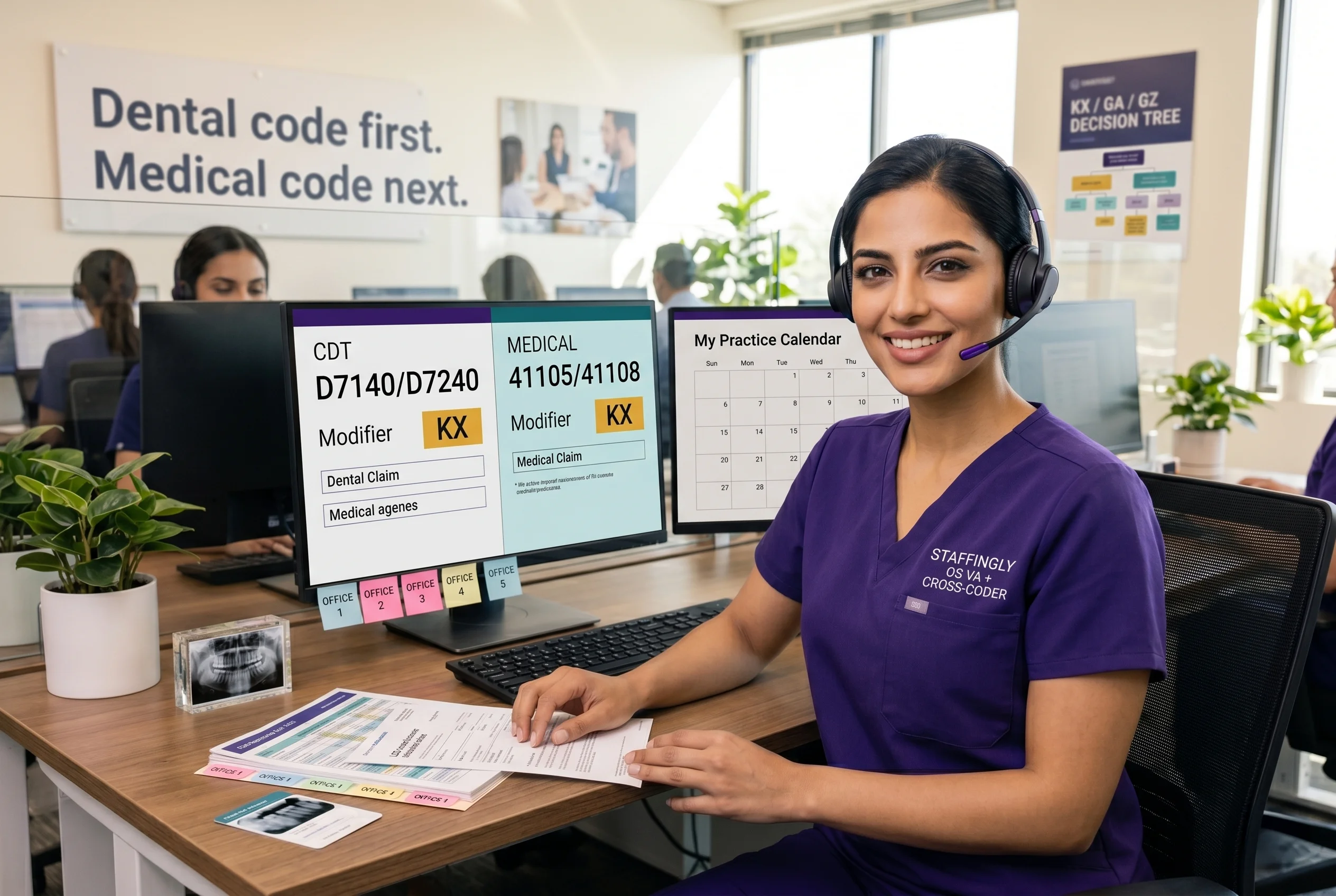
Inside the workA trained Staffingly specialist handles the workflow inside your existing dental software, with clear escalation back to your team.
How Is Staffingly’s Endodontic IV Different?
Four things separate an endo-trained IV specialist from a generic front-desk eligibility check.
Endo CDT code expertise
Specialists pre-tested on D3310, D3320, D3330 (RCT by tooth), D3346, D3347, D3348 (retreatment), D3410, D3421, D3425 (apicoectomy), D3220, D3221 (pulpotomy), and the crown CDT family. Catch downgrades and bundles before submission.
Day-before verification cadence
Every endo case on tomorrow’s schedule pre-verified by 4 PM today. Edge cases routed to the doctor for sign-off before the patient arrives.
Per-payer predetermination tracking
Predetermination response windows tracked per payer. Specialist follows up at day 14, day 21, day 28. Case books while approval is fresh.
2-Week Free Trial
Industry offers no trial. We give you 14 days at the same rate. Cancel before day 14 and owe nothing.
How Does the Endodontic IV Process Work?
Six steps from strategy call to live shift.
Strategy call
Review your top 20 endo CDT codes. Identify highest-denial patterns (molar RCT, crown buildup, retreatment).
BAA + PMS access
Signed BAA. Role-based access to your endo-specific system (TDO, EndoVision) or general PMS (Dentrix, Open Dental, Eaglesoft).
Per-payer playbook build
Per-payer endo coverage rules captured (downgrade triggers, frequency caps, COB). Living document updated quarterly.
Parallel pilot
Week 2. Specialist pre-verifies tomorrow’s schedule alongside your team. Catches downgrades before treatment.
Decision point (day 14)
Pilot results reviewed. Denials caught, predeterminations filed. Go or no-go.
Full handoff
Predetermination tracking workflow live. Monthly denial trending by CDT code and payer.
Where Can You Get Endodontic IV Services?
Our team works remotely inside your endo PMS. Wherever your practice is located, you get the same endo-trained specialist running the same per-payer playbook.
One Flat Weekly Rate. No Surprises.
Dedicated virtual dental assistants at a fixed weekly cost. 45 hours per week, fully managed. No contracts, no minimums, no hidden fees.
Want to compare against an in-house hire? Use the savings calculator.
Frequently asked questions
Are your specialists trained on endo CDT codes?
Yes. Every endo IV specialist passes a pre-placement assessment on D3310, D3320, D3330 (RCT anterior, premolar, molar), D3346, D3347, D3348 (retreatment), D3410, D3421, D3425 (apicoectomy), D3220, D3221 (pulpotomy), and the crown CDT family.
How fast can a Staffingly endo specialist start?
Onboarding for Dentrix, Open Dental, and Eaglesoft typically takes 5 to 7 business days. TDO and EndoVision take 10 to 12 days due to system access setup. Custom systems add 5 to 8 extra days.
Do you catch molar RCT downgrades?
Yes. Pre-verification specifically flags plans that downgrade molar RCT to LEAT rules so your team can reset patient financial expectations before treatment begins.
How do you handle predetermination tracking?
Predetermination response windows tracked per payer. Specialist follows up at day 14, day 21, day 28. Cases book while approval is fresh.
What endo-specific systems do you support?
TDO, EndoVision, Practice Mojo Endo, and major general PMS systems (Dentrix, Open Dental, Eaglesoft, Curve, Denticon, Carestack). Custom systems supported with 5 to 8 extra onboarding days.
Do you handle crown buildup bundle rules?
Yes. Crown buildup (D2950) gets bundled with crown placement on many plans. Specialist checks the plan and flags bundling before submission to prevent denials.
How does pricing work?
Flat per-specialist weekly rate. $399 single, $349 at volume (5 or more), $299 enterprise (10 or more). 2-week free trial at the same rate.
How are your specialists trained, and where do they work from?
Specialists are selected from top-tier healthcare and dental programs, pass rigorous neutral-accent English certifications, and work from biometric-secured HIPAA-aware facilities. Teams are trained specifically for patient-facing dental communication, scheduling workflows, and front-desk etiquette. Support teams operate globally, including secured facilities.

President and CEO, Staffingly, Inc. 25+ years in IT consulting and healthcare BPO operations. One of the earliest US operators to set up an RPO/BPO delivery network in India. Leads AI-driven healthcare workflows that help dental practices and DSOs cut admin costs without compromising care.

Senior Process Associate, Staffingly, Inc. BDS from Sri Sai College of Dental Surgery, Telangana. Hands-on experience in dental front-office operations, medical billing, EHR workflows, and US specialty practice administration. Former Dental Health Facilitator at FMS Dental Hospitals and Senior Medical Billing Specialist supporting US dental practices. Reviews dental content for terminology, workflow accuracy, and compliance fit.
Security Your Compliance Officer Will Sign Off On
Staffingly is audited to SOC 2 Type II with zero exceptions and certified for ISO/IEC 27001:2022, HIPAA, and GDPR. In eight years we have never had a breach. Every workstation runs inside the Venn Blue Border secure enclave on US-based servers, screen captures and downloads are blocked by policy, and every engagement operates under a signed BAA, and Staffingly maintains $5M in professional liability (E&O) and cyber insurance as part of its enterprise risk-management program.