
Radiology Credentialing Services
Outsourced credentialing for radiologists and imaging centers. Medicare PECOS enrollment, commercial CAQH ProView with 120-day re-attestation discipline, NPPES NPI management, IDTF enrollment (CMS-855B + IDTF Performance Standards), and the 3-year commercial re-credentialing cycle. 2026 continuous monitoring built in. 2-Week Free Trial, BAA Signed.
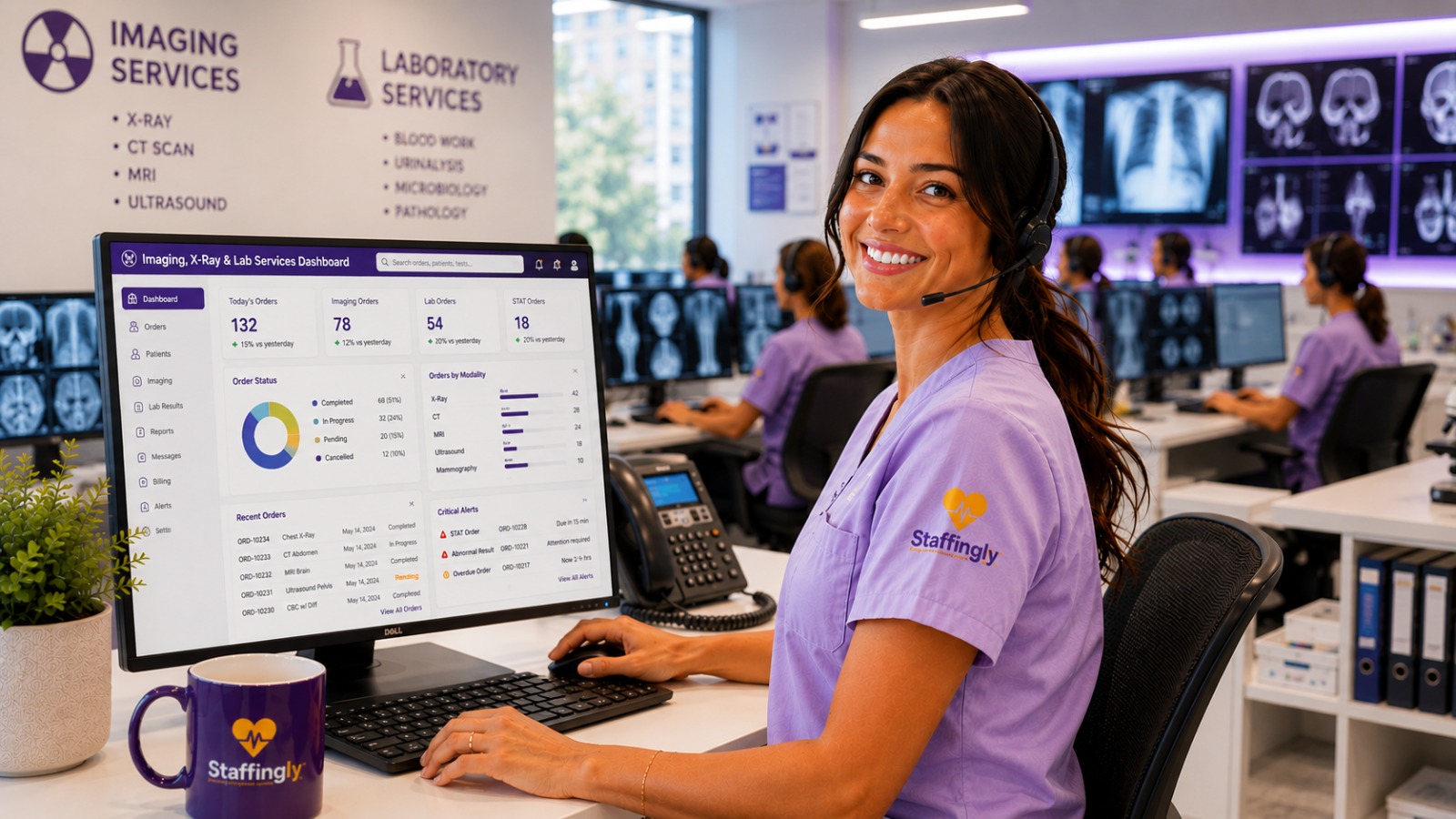
Outsourced credentialing for radiologists and imaging centers.
Medicare PECOS enrollment, commercial CAQH ProView with 120-day re-attestation discipline, NPPES NPI management.
What Is Radiology Credentialing?
What is radiology credentialing? Radiology credentialing is the primary-source verification and payer enrollment workflow that lets a radiologist or imaging center bill payers. Core systems: PECOS (Medicare Provider Enrollment, Chain and Ownership System), NPPES (National Plan and Provider Enumeration System for NPIs), and CAQH ProView (the commercial credentialing database used by Aetna, Cigna, BCBS, Humana, and UHC). Imaging centers also enroll with Medicare via CMS-855B as an IDTF and meet IDTF Performance Standards.
Staffingly's Radiology Credentialing service takes the entire credentialing calendar off your radiology network, imaging center, IDTF, or hospital-based group. The anchor discipline is the 120-day CAQH ProView re-attestation: if a radiologist misses the window, the profile flips inactive and downstream payer credentialing stops moving until it is re-attested. We track every radiologist's attestation date and queue the next attestation 14 days early. Medicare revalidation runs every 5 years for most providers, with DMEPOS suppliers on a 3-year cycle. Standard commercial re-credentialing is every 3 years.
Unlike generic credentialing vendors, Staffingly assigns AAPC-credentialed specialists who become an extension of your team. We file CMS-855B for new IDTFs, manage the IDTF Performance Standards documentation, and handle each location and modality add. Effective January 2026, CMS added enhanced primary-source verification requirements and continuous monitoring (monthly or quarterly automated license and sanctions list checks) on top of the periodic recredentialing cadence. Major commercial radiology payers in our daily queue: Aetna, the BCBS plans, Cigna, Humana, UHC, plus Medicare Advantage and Medicaid MCOs.
This page is part of the main Credentialing & Enrollment page . Most radiology networks pair credentialing with remote radiology coding and radiology prior authorization to close the loop from enrollment to clean claim. See the main Labs & Imaging page at /labs-imaging/services/ for the full vertical.
Tell us about your practice.
Send us your situation and our team will scope the right setup, usually within one business day. No obligation.
What You Need to Know About Radiology Credentialing
CAQH ProView re-attestation is every 120 days. Miss it and the profile flips inactive, freezing downstream commercial credentialing. Standard commercial re-credentialing runs every 3 years; Medicare revalidation runs every 5 years for most providers (3 years for DMEPOS suppliers).
IDTF enrollment uses CMS-855B and requires IDTF Performance Standards (supervision, technician qualifications, equipment, prohibited financial relationships). Each new location and each new modality add can require a separate filing.
Effective January 2026, CMS added enhanced primary-source verification requirements and continuous monitoring (monthly or quarterly automated license and sanctions list checks) on top of periodic recredentialing. Major payers tracked: Aetna, BCBS, Cigna, Humana, UHC, MA, Medicaid MCOs.
Why Is Radiology Credentialing So Hard for Most Imaging Groups?
It is Tuesday morning and three of your radiologists' CAQH profiles flipped inactive over the weekend because the 120-day window quietly closed. Two payers stopped processing claims at the rendering NPI on Monday. A new IDTF location is 11 weeks into a CMS-855B that should have taken 6 because nobody knew the IDTF Performance Standards supervision documentation was missing. Two state license renewals slipped past the 90-day flag because your team only checks CAQH and forgot that the state board uses a separate portal.
The AMA 2024 prior-authorization data confirms administrative burden is rising, not falling, and credentialing sits inside that pressure with the added weight of 2026 CMS continuous monitoring requirements. The point is the same either way: radiology credentialing is a calendar-dense, multi-system workflow, and a generalist BPO firm without a radiology-specific credentialing desk will lose payer participation that takes 90 to 180 days to rebuild.
How Is Staffingly's Radiology Credentialing Different?
Dedicated Credentialing Specialists
Your own team, not shared staff. They learn your radiologist roster, IDTF footprint, payer mix, and state license calendar.
Portal-Specific Desks
PECOS, CAQH, NPPES, plus Aetna, Cigna, BCBS, Humana, UHC desks. Each desk owns its own queue and committee timelines.
HIPAA + SOC 2 Day 1
Encrypted VPN, BAA before kickoff, annual audits. SOC 2 Type II, and ISO 27001 aligned controls.
AI-Augmented Workflow
120-day CAQH alerts, 90-day state license alerts, 5-year PECOS revalidation alerts, and 3-year DMEPOS alerts all on one dashboard.
AAPC-Credentialed Humans
AAPC-credentialed specialists who know CMS-855B IDTF filings, IDTF Performance Standards documentation, and committee timelines per payer.
Weekly KPI Dashboard
Real-time tracking of application age, committee status, CAQH attestation countdowns, 2026 continuous monitoring flags, and revenue at risk per provider.
Month-to-Month
Scale up or down with 30-day notice. Replace any team member in 48 hours. No long-term contract.
One Coordinator
A single point of contact who owns PECOS, CAQH, NPPES, IDTF 855B, state licenses, and continuous monitoring for your radiology network.
AI + Automation in Radiology Credentialing
Credentialing runs on calendar discipline. AI handles the 120-day CAQH alerts, the 90-day state license alerts, the 5-year PECOS revalidation alerts, and the 2026 continuous monitoring (license and sanctions list checks); AAPC-credentialed specialists handle the CMS-855B filings, IDTF Performance Standards documentation, and payer committee follow-up. This is how outsourced radiology credentialing works at scale: intelligent automation plus AAPC-credentialed human review, layered into your existing systems without forcing a platform migration.
120-day CAQH queue
Every radiologist's CAQH attestation date is queued 14 days early. Missed attestation alerts surface the same day the profile flips inactive.
2026 continuous monitoring
Monthly or quarterly automated license and sanctions list checks fire across the full provider roster. Hits route to the human specialist for action.
IDTF 855B builder
New imaging center locations and new modality adds are pre-staged on CMS-855B with the IDTF Performance Standards documentation checklist auto-populated.
How Does the Radiology Credentialing Process Work?
Kickoff call
We map your radiologist roster, IDTF footprint, current payer participation, CAQH attestation calendar, and state license dates.
PECOS + CAQH + NPPES connection
Secure access established within 24 to 48 hours. BAA signed before any access. Existing CAQH profiles audited for completeness.
Staff onboarding
Your dedicated credentialing team completes training on your radiologist roster, IDTF locations, and payer mix.
Go-live
Daily quality reviews and a 2-Week Free Trial scope. 120-day CAQH alerts and continuous monitoring active from day one.
Performance tracking
Weekly reports on application age, committee status, CAQH attestation countdowns, and 2026 monitoring flags.
Continuous refinement
Monthly workflow reviews to tighten committee follow-up cadence and lift first-pass approval rate.
Where Can You Get Radiology Credentialing Services?
Our credentialing team works remotely inside PECOS, CAQH, NPPES, the IDTF CMS-855B portal, and the major commercial payer portals. Wherever your radiology network, imaging center, IDTF, or hospital-based group is located, you get the same trained specialists, same 120-day attestation queue, same 2026 continuous monitoring.
Radiology groups across California, Texas, Florida, New York, Illinois, and every other state rely on Staffingly for credentialing. State medical board renewal calendars, IDTF Performance Standards documentation per location, and Medicaid MCO participation per state are tracked per engagement.
How Staffingly works, in practice
Inside the workA trained Staffingly specialist works inside your existing RIS, LIS, and PACS, with clear escalation back to your team.
One Flat Weekly Rate. No Surprises.
Dedicated radiology, lab, and pathology specialists at a fixed weekly cost. 45 hours per week, fully managed. No contracts, no minimums, no hidden fees.
Want to compare against an in-house hire? Use the savings calculator.
Frequently asked questions
What is radiology credentialing and which systems does it touch?
Radiology credentialing is the verification and enrollment workflow that lets a radiologist or imaging center bill payers. The core systems are PECOS (CMS Medicare Provider Enrollment, Chain and Ownership System), NPPES (National Plan and Provider Enumeration System for NPIs), and CAQH ProView (the commercial insurance credentialing database used by Aetna, Cigna, BCBS, Humana, and UHC). Imaging centers also enroll with Medicare via CMS-855B as an IDTF and meet IDTF Performance Standards.
How often does CAQH need to be attested?
CAQH ProView profiles must be re-attested every 120 days to remain active. If a radiologist misses the 120-day window, the profile flips inactive and downstream payer credentialing stops moving until it is re-attested. We track every radiologist's CAQH attestation date and queue the next attestation 14 days early so the profile never goes dark.
What is the standard re-credentialing cycle?
The standard re-credentialing cycle for most commercial payers and providers is every 3 years. Medicare revalidation runs every 5 years for most providers, with DMEPOS suppliers on a 3-year cycle. Effective January 2026, CMS added enhanced primary-source verification requirements and continuous monitoring (monthly or quarterly automated license and sanctions list checks) on top of the periodic recredentialing cadence.
What is IDTF enrollment and who needs it?
IDTF (Independent Diagnostic Testing Facility) is a Medicare enrollment classification specific to imaging centers that perform diagnostic tests without a treating physician on site. Enrollment uses CMS-855B and requires the IDTF Performance Standards, including supervision, technician qualifications, equipment maintenance, and prohibited financial relationships. We file 855B for new IDTFs, manage the IDTF Performance Standards documentation, and handle each location and modality add.
Which commercial payers matter most for radiology?
The major commercial radiology payers are Aetna, the BCBS plans, Cigna, Humana, and UHC, plus Medicare Advantage and Medicaid managed care organizations (MCOs) in each state. We hold individual desks for each major payer portal, track each plan's credentialing intake window, and follow the application from submission through committee approval. CAQH ProView feeds the application; the payer-specific committee timelines are tracked per file.
Is your radiology credentialing service HIPAA compliant?
Yes. Every team member completes HIPAA training before touching provider or PHI data. We operate under SOC 2 Type II hosting, ISO 27001 aligned information security controls, encrypted VPN, and sign a Business Associate Agreement before day one of the 2-Week Free Trial. Personal phones and personal email accounts are not used during shift.
How long does radiology credentialing take?
Commercial payer enrollment commonly takes 60 to 120 days, and Medicare and Medicaid can take longer. Teleradiology adds a step, because a radiologist cannot bill for a read until they hold a current state license and facility credentials at the reading site. We run CAQH, payer applications, and re-validations in parallel and track every deadline so claims are not held.

President and CEO, Staffingly, Inc. 25+ years in IT consulting and healthcare BPO operations. One of the earliest US operators to set up an RPO/BPO delivery network in India. Leads AI-driven healthcare workflows that help radiology groups, labs, and imaging centers cut admin cost without compromising care.

Bincy Shiiju Kuriakose is a Clinical Content Reviewer at Staffingly and a U.S. Licensed Registered Nurse (MSN, RN). NCLEX-RN certified with expertise in hospital nursing, telehealth, and nursing education. PhD scholar in Nursing at Peoples' College of Nursing, Bhopal. Reviews every service page for medical accuracy, compliance, and evidence-based best practices.
Security Your Compliance Officer Will Sign Off On
Staffingly is audited to SOC 2 Type II with zero exceptions and certified for ISO/IEC 27001:2022, HIPAA, and GDPR. In eight years we have never had a breach. Every workstation runs inside the Venn Blue Border secure enclave on US-based servers, screen captures and downloads are blocked by policy, and every engagement operates under a signed BAA, and Staffingly maintains $5M in professional liability (E&O) and cyber insurance as part of its enterprise risk-management program.