
Oral Surgery Virtual Assistant + Medical Cross-Coding Services
Outsourced oral surgery support from Staffingly. Specialists who live in D-codes AND HCPCS. Files pre-auths with correct modifiers (KX, GA, GZ), runs peer-to-peer review prep, and recovers 40 to 60 percent of the $55K to $190K at-risk per 6-provider group annually. Live in 2 to 3 weeks.
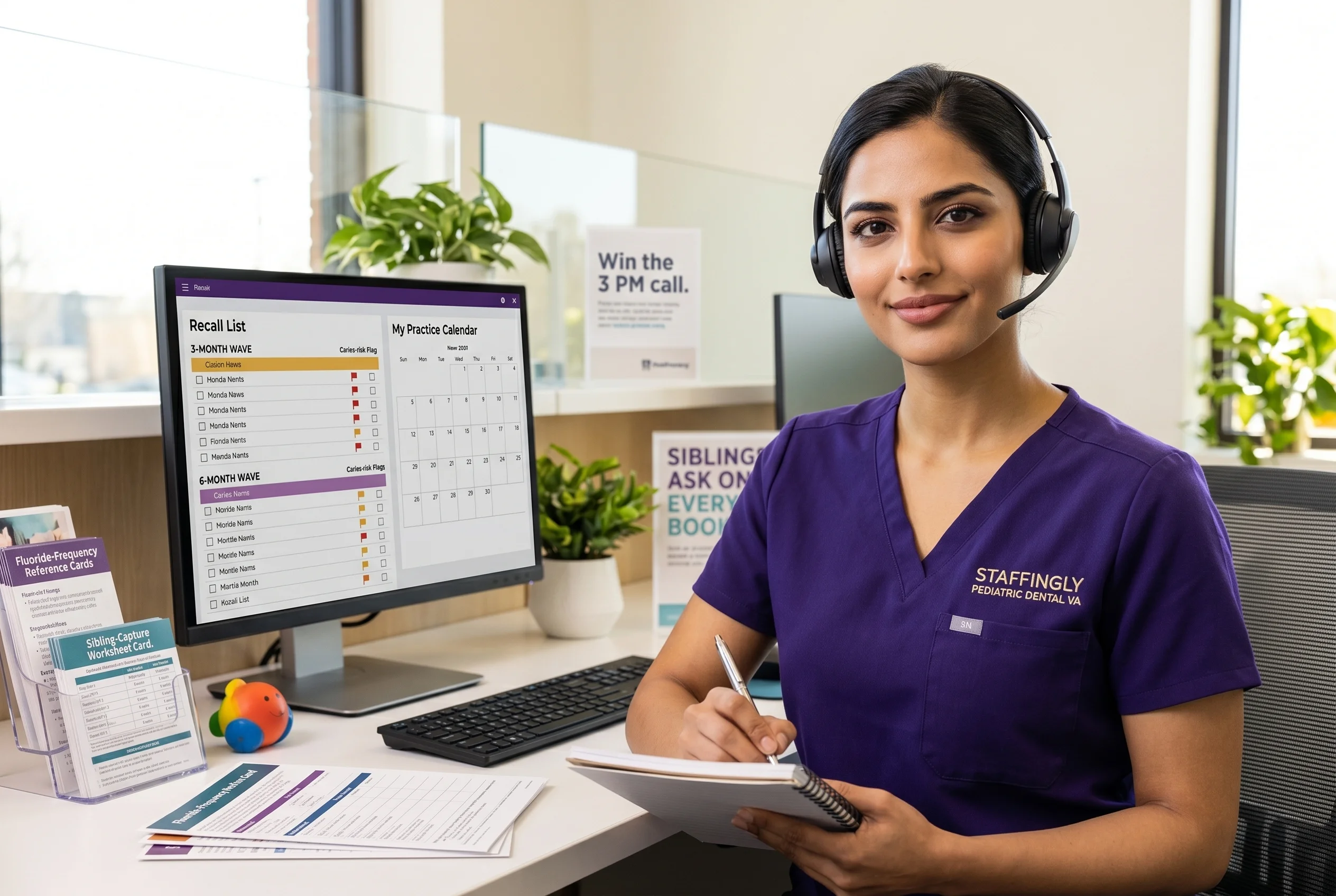
Trained dental support, inside your software
Healthcare-trained specialists under HIPAA-aware workflows.
A managed dental support team, built around your practice
A remote dental support specialist who lives in D-codes AND HCPCS. Trained on dental-to-medical cross-coding maps for OMFS procedures, modifier rules (KX, GA, GZ), peer-to-peer review prep, and the compressed appeal windows at major payers in 2026.
Tell us about your practice.
Send us your situation and our team will scope the right setup, usually within one business day. No obligation.
What You Need to Know About Oral Surgery Cross-Coding Services
D-codes AND HCPCS expertise
Specialists pass pre-placement assessments on CDT, CPT, HCPCS, ICD-10, and modifier application. Critical for complex extractions with IV sedation, TMJ surgery, tumor and cyst removal, and implant cases that cross to medical.
Pre-submission audit
Specialist reviews every pre-auth before submission. Verifies documentation, modifiers, ICD-10 alignment. Catches denial triggers before the payer does.
Peer-to-peer review prep
Prepares the clinical documentation package the surgeon needs for peer-to-peer calls. Often the difference between approval and denial inside compressed 14 to 30 day windows.
Why Is Oral Surgery Cross-Coding So Hard for Most Practices?
PA denial rates are up. Appeal windows are down. Generic dental VAs are not trained for HCPCS modifiers. Three patterns hurt every OMFS office in 2026.
PA denials = 34% of first-pass denials
Up from 22 percent in 2023 (Medical Billers and Coders 2026). For a 6-provider OMFS group, prior auth denials generate $55,000 to $190,000 per year in revenue at risk.
Compressed appeal windows
UnitedHealthcare reduced peer-to-peer review windows from 30 to 14 days. Humana MA expedited appeals from 72 to 48 hours. BCBS state plans from 60 to 30 days. Denied claims that miss the window become permanent write-offs.
Dental-medical billing intersection
Complex extractions with IV sedation, TMJ procedures, tumor and cyst removal, and many implant cases require medical cross-coding. CDT-only billing gets rejected by Medicare DME and commercial medical payers.
How Staffingly works, in practice
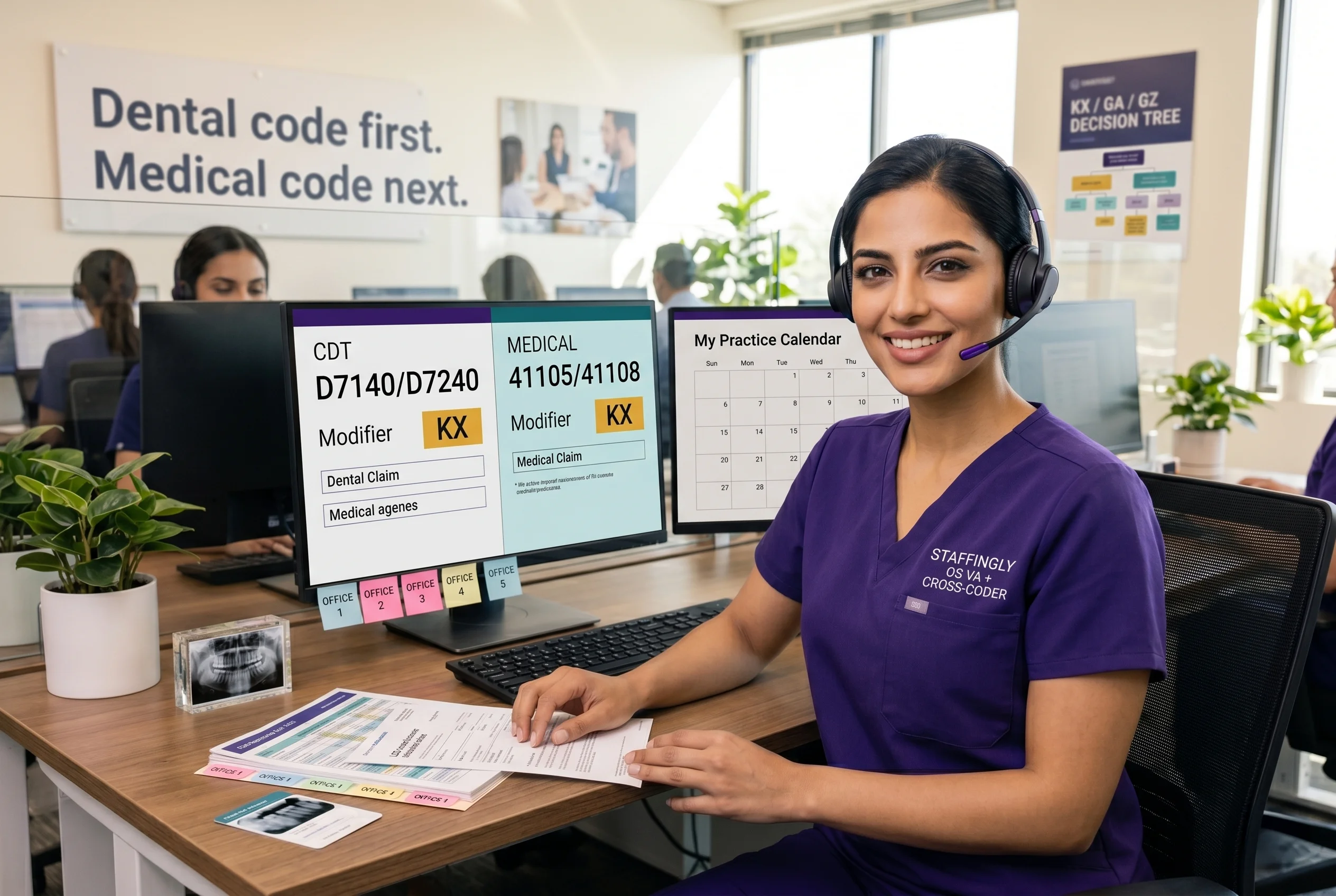
Inside the workA trained Staffingly specialist handles the workflow inside your existing dental software, with clear escalation back to your team.
How Is Staffingly’s OMFS Cross-Coding Different?
Generic dental VAs do not handle HCPCS. We do. Four things that change the outcome.
Cross-coding tested pre-placement
Specialists pass pre-placement assessments on CDT, CPT, HCPCS, ICD-10, and modifier application (KX, GA, GZ) before placement on your account.
Per-payer playbooks
Per-payer cross-coding rules, modifier requirements, and appeal-window tracking maintained as a living document for your practice. Updated quarterly.
Stacked compliance posture
HIPAA, SOC 2 Type II, ISO 27001,. Critical for hospital-affiliated cases and Medicare DME claims.
2-Week Free Trial
Industry offers no trial. We give you 14 days of live work at the same rate. Cancel before day 14 and owe nothing.
How Does the OMFS Cross-Coding Process Work?
Six steps. OMFS onboarding adds 5 to 8 days versus general dentistry because of the medical clearinghouse setup.
Strategy call
Review your denial trends. Identify highest-dollar denial categories (IV sedation, TMJ, surgical extraction).
BAA + dual access
Signed BAA. Role-based access to your OMFS PMS plus the medical clearinghouse you use.
Cross-coding map build
Per-payer cross-coding map built for your top 20 procedures. Living document updated quarterly.
Parallel pilot
Week 2 to 3. Specialist runs pre-submission audits alongside your team. Catches denials before they happen.
Decision point (day 14)
Pilot results reviewed. Denials caught, appeals filed, revenue recovered. Go or no-go.
Full handoff
Compressed-window appeals workflow live. Peer-to-peer prep scheduled per case. Monthly denial trending.
Where Can You Get OMFS Cross-Coding Services?
Our team works remotely inside your OMFS PMS and medical clearinghouse. Wherever your practice is located, you get the same cross-coding specialist running the same per-payer playbook.
One Flat Weekly Rate. No Surprises.
Dedicated virtual dental assistants at a fixed weekly cost. 45 hours per week, fully managed. No contracts, no minimums, no hidden fees.
Want to compare against an in-house hire? Use the savings calculator.
Frequently asked questions
Are your specialists trained on dental-to-medical cross-coding?
Yes. Every OMFS specialist passes a pre-placement assessment on CDT, CPT, HCPCS, ICD-10, and modifier application (KX, GA, GZ). Generic dental VAs are not placed on OMFS accounts.
What’s your appeal success rate?
Industry data shows 75 to 85 percent appeal success when filed within the payer-specific window with proper documentation (Medical Billers and Coders 2026). Our specialists are trained to hit that benchmark.
Can you handle peer-to-peer review prep?
Yes. Specialists assemble the clinical documentation package the surgeon needs for peer-to-peer calls. Specialists do not represent the practice on the peer-to-peer call itself, which requires a US-licensed clinician.
What about Medicare DME for implants and oral appliances?
Medicare DME requires HCPCS coding and specific modifiers. Specialists trained on E0485 versus K1027 for oral appliances and the implant DME rules where applicable.
How fast can a Staffingly OMFS specialist start?
Onboarding for OMFS is 10 to 14 days versus 5 to 7 for general dentistry. The extra time covers medical clearinghouse access setup and per-payer cross-coding map build.
What hospital-affiliated case support do you provide?
Specialists track credentialing alignment with the hospital and OR scheduling. For privileging questions, work routes to the credentialing service line.
How does pricing work?
Flat per-specialist weekly rate. $399 single, $349 at volume (5 or more), $299 enterprise (10 or more). 2-week free trial at the same rate. OMFS specialists are priced at the same rate as general dental specialists.
How are your specialists trained, and where do they work from?
Specialists are selected from top-tier healthcare and dental programs, pass rigorous neutral-accent English certifications, and work from biometric-secured HIPAA-aware facilities. Teams are trained specifically for patient-facing dental communication, scheduling workflows, and front-desk etiquette. Support teams operate globally, including secured facilities.

President and CEO, Staffingly, Inc. 25+ years in IT consulting and healthcare BPO operations. One of the earliest US operators to set up an RPO/BPO delivery network in India. Leads AI-driven healthcare workflows that help dental practices and DSOs cut admin costs without compromising care.
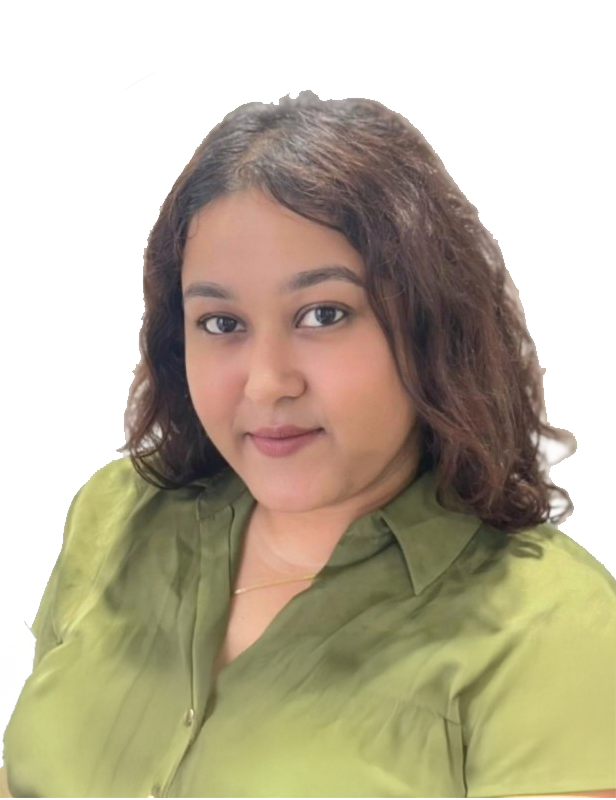
Senior Process Associate, Staffingly, Inc. BDS from Sri Sai College of Dental Surgery, Telangana. Hands-on experience in dental front-office operations, medical billing, EHR workflows, and US specialty practice administration. Former Dental Health Facilitator at FMS Dental Hospitals and Senior Medical Billing Specialist supporting US dental practices. Reviews dental content for terminology, workflow accuracy, and compliance fit.
Security Your Compliance Officer Will Sign Off On
Staffingly is audited to SOC 2 Type II with zero exceptions and certified for ISO/IEC 27001:2022, HIPAA, and GDPR. In eight years we have never had a breach. Every workstation runs inside the Venn Blue Border secure enclave on US-based servers, screen captures and downloads are blocked by policy, and every engagement operates under a signed BAA, and Staffingly maintains $5M in professional liability (E&O) and cyber insurance as part of its enterprise risk-management program.