
Do Outsourced Medical Virtual Assistants and Remote Staff for Scheduling, Billing, Eligibility Verification, and Prior Auth Come Pre-Trained with EMR Expertise?
Yes. Every Staffingly staff member is trained and assessed on your actual workflows before day one: billing, prior authorizations, eligibility, claims follow-up, refills, scheduling, and patient calls. AI patient simulations for anyone who touches your phones, a written scorecard before they start, and once your first team is trained, you never train again: your existing Staffingly team trains every staff member who follows.
Eligibility Verification
Prior Authorizations
Medical Billing & Claims
Denials & AR Follow-Up
Refills & Referrals
Medical Coding Support
Provider Credentialing
One training system for every role you outsource. AI call simulations are the added layer for staff who speak with your patients or your payers.
Why most outsourcing training fails
The failure is rarely the person. It is the system around them, or the absence of one.
Message-takers, not staff
A typical call center takes a message and transfers the call. Your front desk still does the actual work, plus the cleanup. Nothing was offloaded; it was just delayed.
Rotating pools reset to zero
When agents rotate, every shift starts over on your workflows. The training your team invested walks out the door on schedule, every week.
You become the trainer, forever
Most vendors quietly hand the training burden back to the practice. Every new agent, every replacement, every added seat: your staff trains them again.
No proof before day one
You are told the agent is ready. You are not shown anything. The first evidence you get is a live patient on the phone with an untested stranger.
Who we hire before training begins
Training works because of who walks in the door. We do not pull anybody off the streets.
Every staff member arrives with at least two to three years of healthcare experience before Staffingly training even starts.
PharmDs, overseas physicians, and US-licensed RNs and pharmacists working from our offshore facilities. They speak healthcare natively.
General workflow knowledge comes with them: scheduling, eligibility, prior auths, billing basics, refills, referrals, EMR navigation. Our training closes the last mile, which is your practice.
Staff do not answer clinical questions; those transfer to the practice. That line is a trust asset, and it is enforced, not implied.
We collect. You do not fill out forms.
One kickoff meeting after the contract and BAA are signed. No questionnaires sent to your team.
Contract and BAA signed
Nothing touches your data, your systems, or your patients before the Business Associate Agreement is executed.
One kickoff, zero homework
We collect your SOPs, raw documents, and forms in one meeting. If you have no SOPs, we build them from what you tell us and hand them back for your own internal use.
Baseline intelligence build
Before any staff member touches your work, we crawl your website and gather public practice data to build the knowledge baseline they will be tested on.
Two AI assessments. Nobody deploys without passing.
500+ quiz items per client onboarding, scored by an AI coach that never gets tired of repetition.
Assessment #1: before onboarding
Baseline practice knowledge and EMR familiarity, built from your website crawl and public data. This happens before the staff member is ever introduced to you.
- Practice services, locations, providers
- EMR navigation for your specific system
- General workflow readiness
Assessment #2: after kickoff
Loaded with your actual workflows, your SOPs, your rules. The passing bar is 85 percent. Score below it and the staff member goes back and retrains until they clear it.
- Your billing, prior auth, eligibility, and refill workflows
- Your escalation and transfer rules
- Your payer mix, denial reasons, and common call types
The patient simulation engine: trained on your patients before meeting your patients
This is the part nobody else in the category describes, because nobody else in the category does it.
The two assessments above cover every role we train: billers, prior authorization specialists, eligibility teams, coders, and front office. The simulation engine is the additional layer for staff who will speak with your patients or call payers on your behalf.
Before a Staffingly staff member answers a live call, they practice against AI patients built from your practice. We analyze your public Google reviews and your patient population to build patient personas: the demographics, the language patterns, the common complaints, the behavioral tendencies of the people who actually call your office. A practice in Florida gets Florida patients. A pediatric practice gets anxious parents. The personas match the phones you actually answer.
The staff member then runs simulated calls against those personas, over and over, with an AI coach scoring every interaction. The simulations cover patient calls and insurance company calls both. A human trainer cannot sustain that repetition. The AI coach does not get bored, does not skip scenarios, and does not let a weak answer slide.
Three hundred simulated calls is the standard, not a one-time story. Every staff member who will speak with your patients completes 300 AI call simulations before their first live call, then continues with ongoing refresher simulations after deployment, on the same cadence as the annual HIPAA refresher.
“Create 200 situations, and act like each time you act like a new patient.”
What a Staffingly training session looks like
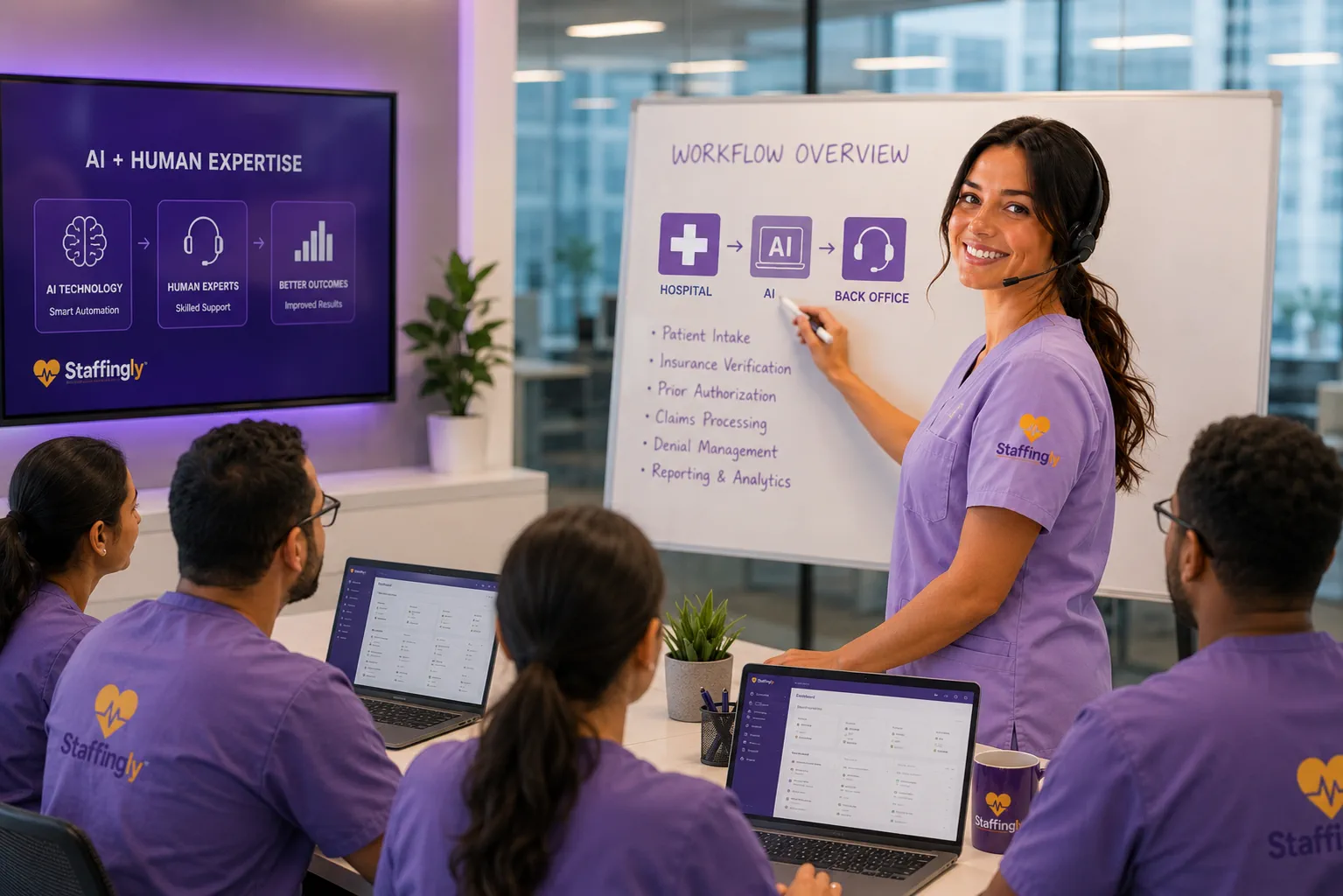
A team lead walks the group through one client’s workflow on the board: patient intake, insurance verification, prior authorization, claims processing, denial management, and reporting, while every trainee follows along on their own screen. This is the room where the pieces described on this page come together: your SOPs, the two AI assessments, and the call simulations, before anybody touches your live system.
300 simulated calls. One patient review.
The engagement that built the system: Dr. Kevin Schrock, orthopedic practice, Florida. Shared with his permission.
Dr. Kevin Schrock’s orthopedic practice in Florida came to us after their front desk person left abruptly. No handover, no notes, phones ringing.
We analyzed the practice’s Google reviews and built patient personas around the actual population: demographics, language, complaints, and the local context of a Florida patient base.
The assigned staff member ran 300 AI patient simulations against those personas before answering a single real patient. That number became the Staffingly standard for every patient-facing staff member since.
The agent handled live calls like someone long familiar with the practice, because in simulation terms, they were.
The proof did not come from us. It came from a patient who took the time to name the person who answered the phone.
The complete engagement is documented as a written success story: the overnight front desk loss, the persona build from real Google reviews, the 300 simulations, and the patient review that named our staff member.
The scorecard you receive before deployment
You do not take our word that the staff member is ready. You get the report.
After deployment: weekly reports with work volumes, calls handled, and outcomes, daily reports on request, and full call auditing on your own phone system. Every new process triggers a fresh assessment, and annual refreshers run on the HIPAA refresher cadence. Documented outcomes from trained teams live in our case studies.
The two-week trial: what it costs us
From day one of your engagement, Staffingly is paying the dedicated staff member, the trained backup floater, the team lead, and the customer success manager. You are not billed for the first two weeks. In Dan’s words on a client call: “we eat the cost.” The staff are learning your practice in those two weeks, and we do not believe you should pay for learning.
That reframes what the trial is. It is not a marketing offer. Run your own numbers in the medical outsourcing savings calculator if you want the math beside it. It is a financial commitment that the training system described on this page actually works, made by the people who have to absorb the loss if it does not.
You train once. Then you never train again.
This is the question practices ask most, in exactly these words: “can you then take over training additional staff, so we do not have to?” Yes. That is the design.
Once your first team is trained, they become the training hub. New staff train off your existing Staffingly team, on your workflows, with your SOPs. One ABA client grew from 2 or 3 people to 25 or 30 on exactly this model.
Every dedicated staff member comes with a backup floater trained on your practice at no cost to you. Vacation, sick day, or resignation: coverage does not gap.
SOPs, checklists, workflows, and assessments stay ready. If a staff member leaves, the floater converts to full time immediately and the next hire tests against the same material. Nothing resets.
You pay for the staff member. You get a team lead with 5+ years of VMA experience and a customer success manager watching quality every week.
Security during training: no PHI in the simulation layer
The simulation personas are built from public data: your website and your public Google reviews. No PHI touches the simulation layer at any point. The simulation bots run on Google Vertex AI, and wherever PHI is involved anywhere else in the stack, it stays inside HIPAA-covered systems under a signed BAA.
Working access is controlled through the Venn secure workspace, which blocks screenshots and copy operations, with Microsoft E5 where applicable and a US-based VPN tunnel for EMR access. Every staff member holds an individual HIPAA training certificate, renewed annually, and a copy ships with the pre-deployment report. Eight years, zero breaches. The full security program, including the SOC 2 Type II report and ISO 27001 certification, is documented on our HIPAA and security page.
Assessed on the EMR you already run
Assessment #2 is built around your system. These are the platforms our teams train and test on most.
Greenway Intergy
eClinicalWorks
Practice Fusion
SimplePractice
WellSky
PCC
Will my patients know they’re speaking with offshore staff?
No. Every Staffingly VMA is an accent-neutral English speaker trained to communicate slowly and clearly. We also use AI-powered voice neutralization tools in real time. Your patients will never feel like they are speaking with an offshore team.
The questions practices actually ask us
Taken from real vetting calls, answered the way we answer them live.
The full library is in the FAQ Knowledge Center.
How long does it take to onboard a staff member?
Once we train the first team, can you take over training additional staff so we do not have to?
Do billing, prior auth, and eligibility staff go through the same training as phone staff?
How do we monitor quality and control?
Can we audit the phone calls?
What happens when a patient asks if the call is outsourced?
Do your staff give clinical advice?
What a trained, assessed, simulated staff member costs
Flat weekly fee per dedicated specialist. Never a percentage of your collections.
1 to 4 dedicated staff members, fully trained and assessed on your practice before day one.
5 to 9 staff members. Your trained team becomes the hub; new hires train off it.
10+ staff members for multi-location groups and enterprise teams.
2-Week Free Trial on every engagement. Need to grow? Expansion staff members go live in about 45 hours, trained by your existing Staffingly team on the same SOPs and assessments, at no training cost to you.
Meet a trained team, not a promise
Book a strategy meeting. We will walk you through the assessments, the simulations, and the scorecard you would receive, using your practice as the example. Dan Nandan, CEO, joins most calls personally.