
Veterinary Medical Scribing & Documentation
Veterinary medical scribing handled by an AI and automation enabled remote scribe team that drafts SOAP notes, discharge instructions, and referral letters directly inside your PIMS. Scribes draft, your veterinarian reviews and signs every note. The chart closes when the appointment ends, not at 9 PM. Live in about a week.
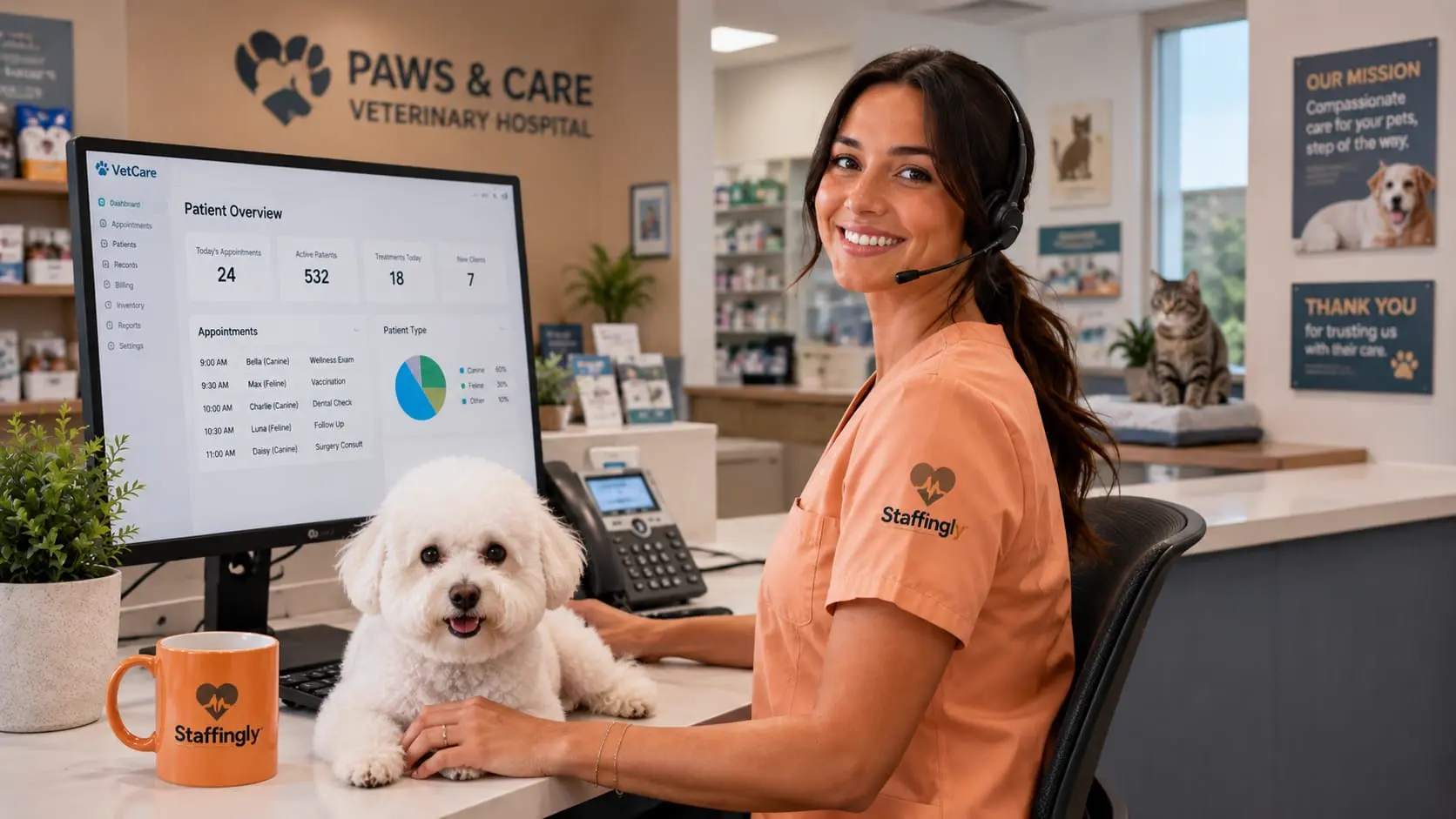
Veterinary medical scribing handled by an AI and automation enabled remote scribe team that drafts SOAP notes.
Scribes draft, your veterinarian reviews and signs every note.
The appointments end at 6. The charting ends at 9.
It's 7:45 PM. The last patient left two hours ago, the techs went home, and your DVM is still at the desk finishing SOAP notes from a 28-appointment day, plus two discharge summaries and a referral letter she promised the cardiologist. Charting after close is the most common unpaid overtime in veterinary medicine, and it's why practices comparing top veterinary outsourcing companies keep landing on documentation first: it's the workload that follows doctors home.
Exhaustion is the burnout driver
The Merck Animal Health Fourth Veterinary Wellbeing Study (2024, conducted with the AVMA) found exhaustion to be the principal burnout dimension across veterinary teams. Notes written at 9 PM after a full clinical day are a direct, fixable contributor, because documentation is the part of the day with no hard stop.
The note-takers keep leaving
Vet tech turnover runs about 22 percent, and practice-wide turnover sits around 21 to 30 percent (AAHA compensation data via JAVMA News). Every departure takes your charting shorthand, your template knowledge, and your record-keeping habits out the door, and the backlog lands back on the doctors.
Support staff carry the heaviest load
The same Merck wellbeing study found serious psychological distress twice as prevalent among non-DVM team members as among veterinarians. When techs and CSRs absorb records requests, lab filing, and callback documentation between rooms, the quiet administrative pile is a big part of why.
Tell us about your practice.
Send us your situation and our team will scope the right setup, usually within one business day. No obligation.
What is a veterinary medical scribing service ?
A veterinary medical scribing service is a remote scribe team that drafts SOAP notes, discharge instructions, and medical records directly inside your PIMS while or after your veterinarian sees the patient, so the chart is done when the appointment is done. Scribes draft; your DVM reviews and signs every note, because the medical record belongs to the veterinarian and the practice. That division of labor is the whole model: a remote veterinary scribe handles the typing, formatting, filing, and follow-through, and your doctor handles the medicine.
What does a remote veterinary scribe actually handle, day to day?
The eight documentation queues that keep doctors charting after close and techs buried between rooms, absorbed by a remote team trained on your PIMS, your templates, and your record-keeping rules. Scribes draft; your DVM reviews and signs every note.
Live or async SOAP note scribing
Drafts the subjective, objective, assessment, and plan in your PIMS, live during the appointment or from your DVM's dictation afterward. The note lands in the doctor's review queue the same day, formatted to your templates.
Discharge instructions drafting
Turns the visit plan into clear owner-facing discharge instructions: medications, doses, recheck timing, activity restrictions, and warning signs. Drafted from your approved language, signed off by your veterinarian before it goes out.
Records requests + transfers
Handles incoming and outgoing record requests between clinics: compiles the chart, vaccine history, labs, and imaging summaries, sends them through your approved channel, and logs the transfer in the PIMS.
Lab + imaging result filing and flagging
Files inbound lab and imaging results to the right patient record, attaches them to the right visit, and flags abnormal values to the doctor's queue so nothing sits unread in a fax folder.
Callback documentation
Documents post-visit and post-surgery callback conversations in the chart: how the patient is doing, what the owner reported, what was advised per the DVM's instructions, and what follow-up was booked.
Referral letters
Drafts referral letters to specialists and response summaries back to referring clinics, pulling history, diagnostics, and the treatment timeline from the PIMS. Your veterinarian edits and signs before anything is sent.
Pet insurance claim documentation
Prepares the medical-record side of pet insurance claims: pulls the relevant notes, itemized history, and diagnostics the insurer asks for, and packages them for your team to submit. Clean records mean fewer back-and-forth requests.
Template and macro cleanup
Audits and rebuilds your PIMS note templates and macros: removes dead fields, standardizes formats across doctors, and keeps the shortcuts current so every note starts faster, for your team and ours.
Trained veterinary scribes, not a transcription mill
Plenty of vendors will type what they hear. Almost none of them can build a clean SOAP note in Cornerstone, spot a transposed drug dose, or know why the assessment line matters in a board complaint. Our overseas-licensed and educated veterinary support professionals pass an assessment on SOAP structure, veterinary terminology, and PIMS charting before they touch a live record.
The DVM owns every record
One rule runs the whole playbook: scribes draft, doctors sign. Every note carries a draft status until your veterinarian reviews and finalizes it. Nothing enters the medical record without your DVM's sign-off, ever.
HIPAA-grade security in a non-HIPAA field
Veterinary medicine isn't covered by HIPAA. We secure your client data like it is anyway: the same SOC 2 Type II, ISO 27001, and HITRUST-audited controls our medical clients run on, plus state confidentiality law and PCI-aware payment handling.
2-Week Free Trial on your live charts
Two weeks of live scribing on your real appointment schedule, at the regular weekly rate. You measure same-day note closure and review time yourself. Cancel before day 14, owe nothing. No setup fees, no annual contracts after.
Staffingly remote scribe vs DVM charting at 9 PM vs a generic AI scribe alone
Three ways practices actually handle veterinary documentation today. Drafting software speeds up a first pass, and we use it for that. But a draft isn't a record until a trained human verifies it in your PIMS and your veterinarian signs it.
From "let's talk" to live in about a week
Six steps. Each one is documented. Nothing is mysterious.
Strategy call (15 min)
Tell us where documentation hurts most. After-hours SOAP notes? The lab filing pile? Records requests? We map your appointment volume and note backlog on one call. No prep needed from you.
NDA + data-security agreement
NDA and data-security agreement signed before day one. We document your note templates, your discharge language, your record retention rules, and exactly who finalizes records (your veterinarians, always).
PIMS access
Role-based access provisioned in your PIMS with draft-level permissions. Your scribe can create and edit drafts and file documents; finalizing and signing stay locked to your DVMs.
Shadow week
Your scribe shadows live appointments and reads finished charts for 2 to 3 days. Each doctor's phrasing, template preferences, and abbreviation habits get captured in a per-DVM style guide.
Live pilot (2 weeks)
The scribe drafts on your real schedule in parallel with your team. Daily 15-minute sync. You see every draft, every correction, every turnaround time. Cancel before day 14, owe nothing.
Full handoff, cadence locked
Same-day note closure rate, draft accuracy, and filing turnaround in your inbox weekly. Monthly QA audit against your style guides. Add a second doctor or a second location whenever you're ready.
The AI layer behind your scribe team, with humans on every decision
AI speeds up first-draft SOAP notes, discharge instructions, and referral letters. Trained veterinary scribes then verify every line against the visit, fix what the model got wrong, and file it correctly in your PIMS. Your DVM reviews and signs every note. AI-assisted drafting plus human verification is faster than either one alone, and safer than AI alone.
What does a day with a remote veterinary scribe look like?
A real shift, hour by hour, in your local time. The charts close on a schedule, not after the doctor's dinner gets cold.
The chart should close when the appointment does.
Documentation is high-volume, structured, and relentlessly repeatable. That's exactly the work a remote veterinary scribe does better than a doctor at 9 PM. 800+ providers run support functions on Staffingly, we hold a 4.9 Google Rating, and practice owners describe the experience in 5-star Trustpilot reviews. The pilot is two weeks on your live appointment schedule, so you don't have to take anyone's word for it.
Trained on your PIMS, charting in your system
Your scribe drafts inside the PIMS you already run, in your templates, under draft-only permissions. No copy-paste from outside apps, no parallel record. Onboarding on a familiar PIMS takes 5 to 7 business days.
How Staffingly works, in practice
Inside the workA trained Staffingly specialist works inside your existing PIMS, with clear escalation back to your team.
One Flat Weekly Rate. No Surprises.
Dedicated virtual veterinary assistants at a fixed weekly cost. 45 hours per week, fully managed. No contracts, no minimums, no hidden fees.
Want to compare against an in-house hire? Use the savings calculator.
Frequently asked questions
What's the difference between live and async scribing, and which should we pick?
Live scribing means the scribe joins the appointment by audio and drafts the SOAP note in your PIMS in real time, so the note is waiting in the review queue before the doctor leaves the room. Async scribing means your DVM dictates between rooms or at day's end, and the scribe turns the recording into a finished note, usually within hours. Busy GP schedules tend to run live; surgery-heavy practices often prefer async, and most practices end up running both.
Who signs the medical record, the scribe or our veterinarian?
Your veterinarian, on every note, with no exceptions. Scribes work under draft-only PIMS permissions: they can create and edit drafts and file documents, but finalizing and signing are locked to your DVMs. The veterinarian reviews each draft, corrects anything that needs it, and signs.
Which PIMS platforms can your scribes chart in?
Cornerstone, ezyVet, AVImark, IDEXX Neo, Impromed, Covetrus Pulse, Provet Cloud, Vetspire, Shepherd, Digitail, and others. Onboarding on a familiar PIMS takes 5 to 7 business days. All drafting happens inside your system under role-based access, so the audit trail and templates stay in your PIMS.
How do you keep notes accurate? What's the QA process?
Three layers. Each scribe builds a per-doctor style guide during shadow week. Every draft is self-checked against the chart in your PIMS before it enters the review queue: patient, drug names, doses, units, laterality. A Staffingly QA lead audits a sample of signed notes monthly. And your veterinarian reviews and signs every note before it becomes the record. Our team works AI-assisted: automation and AI drafting handle the repetitive steps while a trained human verifies every output in your PIMS.
How long do veterinary medical records have to be kept?
It varies by state. California requires records be kept 3 years (16 CCR 2032.3), Florida requires 3 years (Rule 61G18-18.002), and Texas requires 5 years, while the AVMA recommends retaining records for at least 5 years. Your scribe team files every note, lab, and transfer to the right patient record, and we document your state's rule in the playbook during onboarding.
What does it cost, and how does the pilot work?
$399 per week Single, $349 Team (5 or more VAs), $299 Enterprise (10 or more), per VA FTE, billed weekly. No setup fees and no annual contracts. The engagement starts with a 2-week free trial on your live appointment schedule at the same rate: cancel before day 14 and you owe nothing.
Where do your scribes work from?
Our veterinary-trained virtual assistants work from secured facilities, with monitored access and clean-desk policies. They cover your local business hours, including live appointment blocks, and multi-location groups can pool one documentation team across hospitals and time zones.
Is veterinary client data covered by HIPAA, and how do you protect it?
Veterinary medicine isn't covered by HIPAA. We secure your client data like it is anyway: the same SOC 2 Type II, ISO 27001, and HITRUST-audited controls our medical clients run on, plus state confidentiality law and PCI-aware payment handling. An NDA and data-security agreement is signed before day one.
What does a veterinary medical scribe do?
A veterinary scribe turns the exam conversation into a structured SOAP note and discharge summary and files it in your practice software, so the veterinarian closes the record at the end of the visit instead of after hours. Our scribes are human-reviewed for accuracy before anything is uploaded.

President and CEO, Staffingly, Inc. 25+ years in IT consulting and healthcare BPO operations. One of the earliest US operators to set up an RPO/BPO delivery network in India. Leads AI-driven veterinary workflows that help animal hospitals and multi-location veterinary groups cut admin cost without compromising care.
Security Your Compliance Officer Will Sign Off On
Staffingly is audited to SOC 2 Type II with zero exceptions and certified for ISO/IEC 27001:2022, HIPAA, and GDPR. In eight years we have never had a breach. Every workstation runs inside the Venn Blue Border secure enclave on US-based servers, screen captures and downloads are blocked by policy, and every engagement operates under a signed BAA, and Staffingly maintains $5M in professional liability (E&O) and cyber insurance as part of its enterprise risk-management program.