
DSO Centralized Eligibility and Cross-Location Admin Services
Outsourced DSO operations pod from Staffingly. Centralized eligibility, IV, recall, and reporting across 5 to 50 locations from one dashboard. Standardized SLAs, per-location KPI rollup, single point of contact for the DSO ops lead. Up to $890K annual EBITDA lift on $10M of gross production (Planet DDS 2026). Live in 2 to 3 weeks.
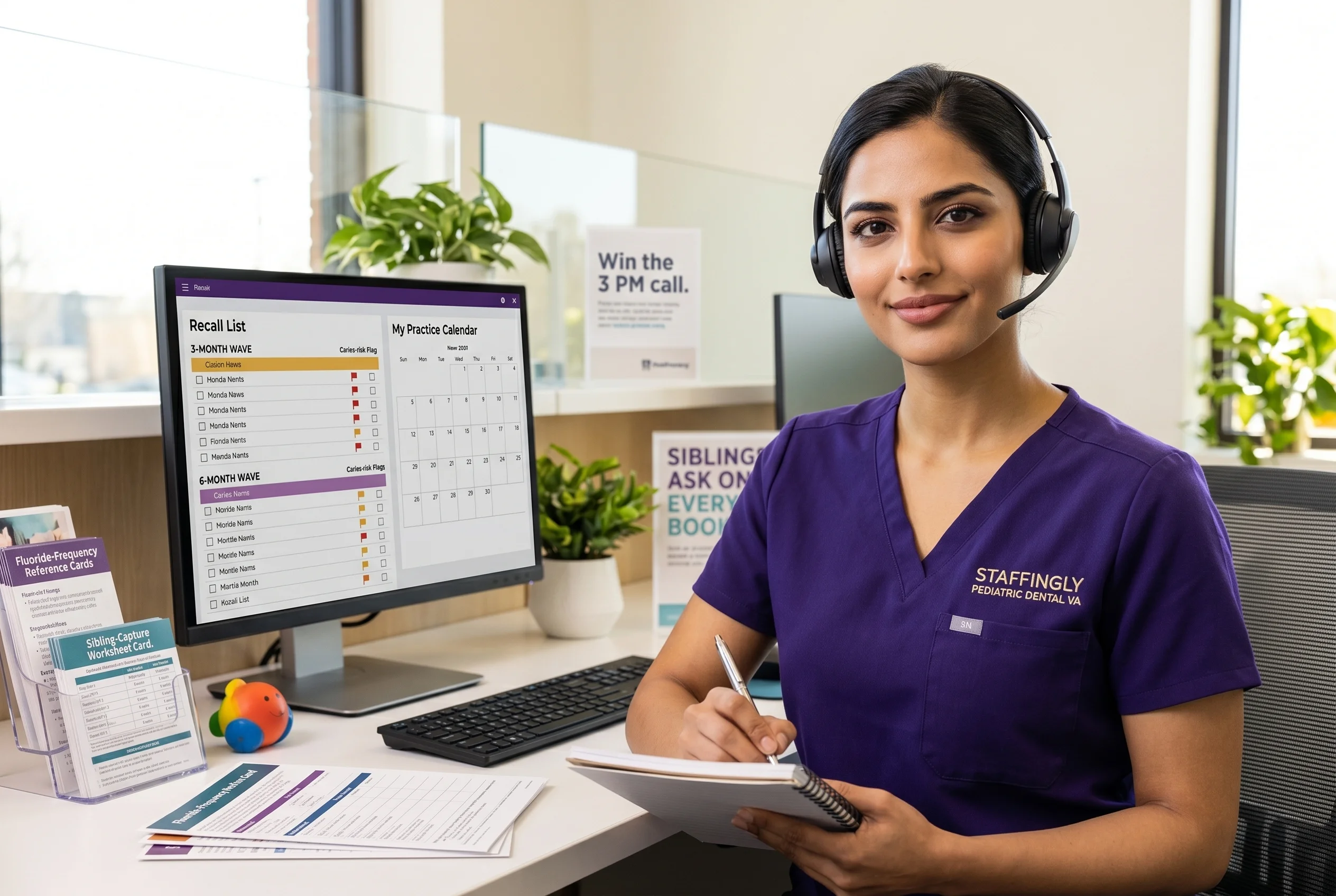
Trained dental support, inside your software
Healthcare-trained specialists under HIPAA-aware workflows.
A managed dental support team, built around your practice
DSO overhead runs 50 to 55 percent of revenue with the biggest savings opportunity in centralized back-office. Most growing DSOs duplicate eligibility, IV, recall, and admin staff across every location. The result: rising labor cost per location even as production grows. Centralized ops pod fixes the pattern.
Tell us about your practice.
Send us your situation and our team will scope the right setup, usually within one business day. No obligation.
What You Need to Know About DSO Centralized Eligibility and Admin
One pod, 5 to 50 locations
Centralized eligibility and IV team running across every location. Standardized SLAs. Per-location KPI rollup. Single point of contact for the DSO ops lead.
60 to 70% labor savings per location
Pooled labor versus hiring per location. For a 15-location DSO, conservative annual savings: $540K to $720K in admin labor alone, before the EBITDA lift from closing the billing gap.
Enterprise compliance posture
HIPAA, SOC 2 Type II, ISO 27001. Required at PE-backed and enterprise DSO scale. Audit logging across every location for governance.
Why Is DSO Centralized Admin So Hard to Build In-House?
Three patterns hurt every DSO scaling past 5 locations.
Duplicated per-location hiring
Every new location adds front desk, eligibility, and recall headcount. Labor cost rises faster than production. 42 percent of dental practices had at least one front desk vacancy in 2025 (ZipRecruiter 2025).
Billing gap is silent EBITDA loss
For a $10M DSO, closing the average operational billing gap adds roughly $890K in annual EBITDA (Planet DDS 2026 Deep Dive Report). Most DSOs don’t measure it well enough to notice.
Inconsistent workflows across locations
Each location runs eligibility, recall, and IV slightly differently. No standardized SLA. No consolidated KPI view. Variance hides under-performing locations from the ops lead.
How Staffingly works, in practice
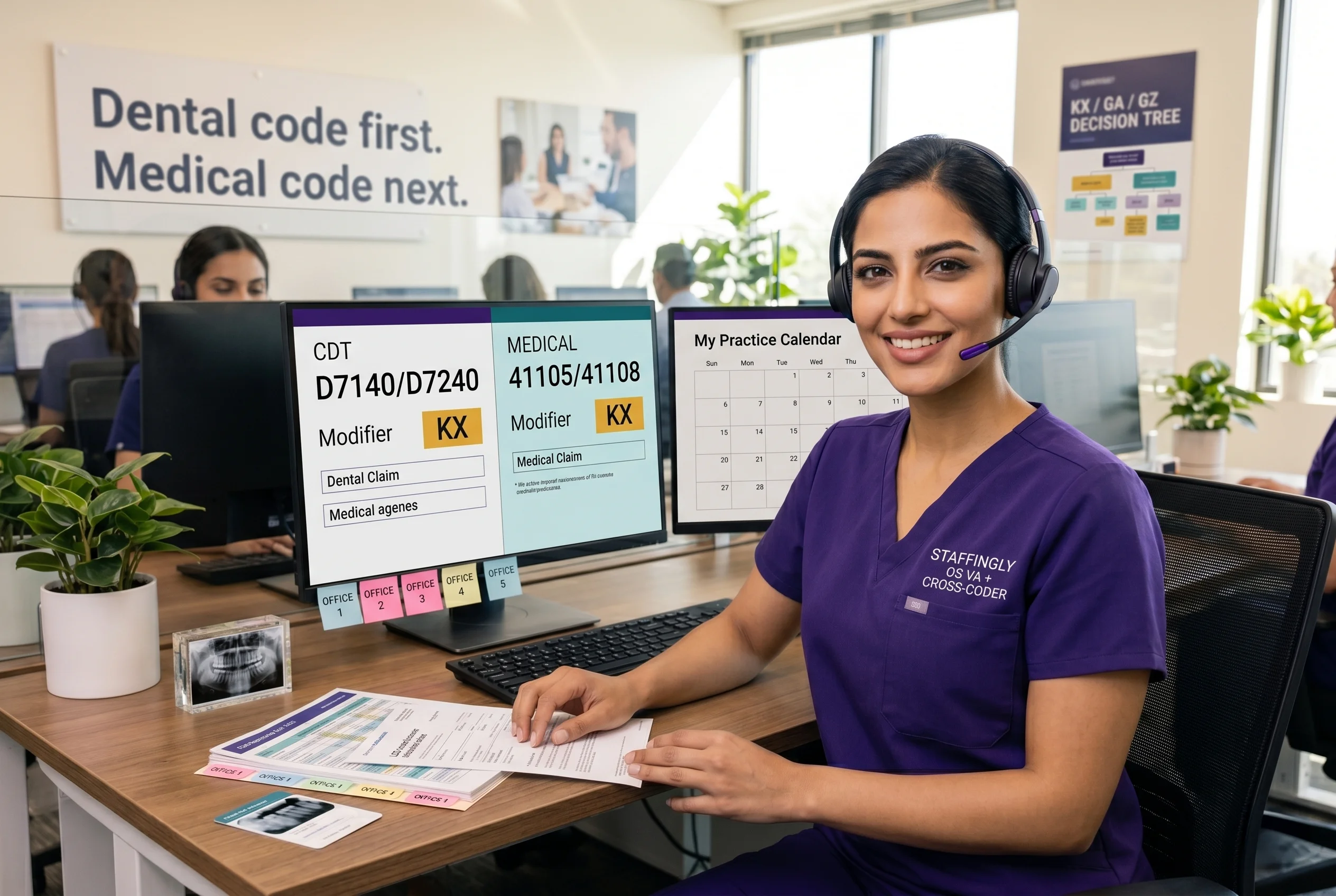
Inside the workA trained Staffingly specialist handles the workflow inside your existing dental software, with clear escalation back to your team.
How Is Staffingly’s DSO Ops Pod Different?
Four things separate a centralized ops pod from hiring per location.
Standardized SLAs per workflow
Eligibility verified day-before-visit at 95 percent SLA. Recall response measured per location per month. SRP frequency caps tracked at the pod level. Every location runs the same playbook.
Per-location KPI rollup dashboard
Daily KPI rollup across every location: clean claim rate, days in AR, recall response, eligibility coverage. DSO ops lead sees variance immediately.
Single point of contact
One account lead for the DSO ops director. No per-location vendor management. No per-location SLA negotiation. One contract, one dashboard, one playbook.
2-Week Free Trial per location group
DSO pilot runs across 3 to 5 representative locations. 14 days at the same rate. Cancel before day 14 and owe nothing. Scale to remaining locations after pilot proves the model.
How Does the DSO Ops Pod Process Work?
Six steps. DSO onboarding adds 5 to 10 days because of the cross-location coordination.
Strategy call
Review your locations, PMS mix, and current admin per-location cost. Identify the pilot location group (3 to 5 representative locations).
BAA + multi-PMS access
Signed BAA. Role-based access provisioned across the pilot locations’ PMS systems.
SLA + playbook build
Standardized SLAs for eligibility, IV, recall, and reporting locked across the pilot group. Per-location escalation rules captured.
Parallel pilot
Week 2 to 3. Pod runs eligibility and IV across pilot locations alongside in-office teams.
Decision point (day 14)
Pilot KPIs reviewed. Eligibility coverage, claim cleanliness, recall response. Go or no-go.
Full handoff + scale
Pod scales to remaining locations on agreed schedule. Monthly QA audit. Quarterly EBITDA-impact reporting to ops lead.
Where Can You Get DSO Centralized Ops?
Our pod works remotely inside every PMS your DSO runs. Wherever your locations are, you get the same standardized SLAs, the same KPI dashboard, the same single point of contact.
One Flat Weekly Rate. No Surprises.
Dedicated virtual dental assistants at a fixed weekly cost. 45 hours per week, fully managed. No contracts, no minimums, no hidden fees.
Want to compare against an in-house hire? Use the savings calculator.
Frequently asked questions
What’s the typical DSO labor savings versus per-location hiring?
60 to 70 percent on pooled eligibility, IV, and recall versus hiring per location. For a 15-location DSO, conservative annual savings is $540K to $720K in admin labor alone, before the EBITDA lift from closing the billing gap.
Can you handle a mix of PMS systems across our locations?
Yes. Most DSOs have a mix (Dentrix, Open Dental, Eaglesoft, Curve, Denticon, Carestack). The pod supports all major PMS systems and is designed for multi-PMS DSO environments.
What KPIs do you report at the location level?
Clean claim rate, days in AR, recall response rate, eligibility coverage rate, SRP frequency-cap denials, predetermination turnaround. Per-location daily plus DSO rollup weekly.
How do you handle state-specific Medicaid rules across locations?
Per-state Medicaid playbooks maintained at the pod level. Locations in different states automatically get the right rule set applied to their workflows.
What’s the EBITDA impact of closing the billing gap?
For a $10M DSO, closing the average operational billing gap adds roughly $890K in annual EBITDA (Planet DDS 2026 Deep Dive Report). Larger DSOs scale linearly.
How do you handle PE-backed reporting and audit requirements?
Quarterly EBITDA-impact reports, monthly KPI dashboards, and audit-trail access available for PE-firm reporting. SOC 2 Type II audit documentation available under NDA.
How does pricing work for DSOs?
Flat per-specialist weekly rate. $349 at volume (5+ seats per DSO), $299 enterprise (10+ seats). 2-week free trial at the same rate. Most DSOs run between 8 and 30 seats across locations.
How are your specialists trained, and where do they work from?
Specialists are selected from top-tier healthcare and dental programs, pass rigorous neutral-accent English certifications, and work from biometric-secured HIPAA-aware facilities. Teams are trained specifically for patient-facing dental communication, scheduling workflows, and front-desk etiquette. Support teams operate globally, including secured facilities.

President and CEO, Staffingly, Inc. 25+ years in IT consulting and healthcare BPO operations. One of the earliest US operators to set up an RPO/BPO delivery network in India. Leads AI-driven healthcare workflows that help dental practices and DSOs cut admin costs without compromising care.

Senior Process Associate, Staffingly, Inc. BDS from Sri Sai College of Dental Surgery, Telangana. Hands-on experience in dental front-office operations, medical billing, EHR workflows, and US specialty practice administration. Former Dental Health Facilitator at FMS Dental Hospitals and Senior Medical Billing Specialist supporting US dental practices. Reviews dental content for terminology, workflow accuracy, and compliance fit.
Security Your Compliance Officer Will Sign Off On
Staffingly is audited to SOC 2 Type II with zero exceptions and certified for ISO/IEC 27001:2022, HIPAA, and GDPR. In eight years we have never had a breach. Every workstation runs inside the Venn Blue Border secure enclave on US-based servers, screen captures and downloads are blocked by policy, and every engagement operates under a signed BAA, and Staffingly maintains $5M in professional liability (E&O) and cyber insurance as part of its enterprise risk-management program.