
FQHC & Community Health Center Back-Office Outsourcing
A flat-fee, HIPAA-trained offshore team running RCM, prior authorization, eligibility, coding, credentialing, and a virtual front-office for FQHCs and community health centers. We are the operator layer that owns the exception work, not just software or seats. Live in 1 to 2 weeks.
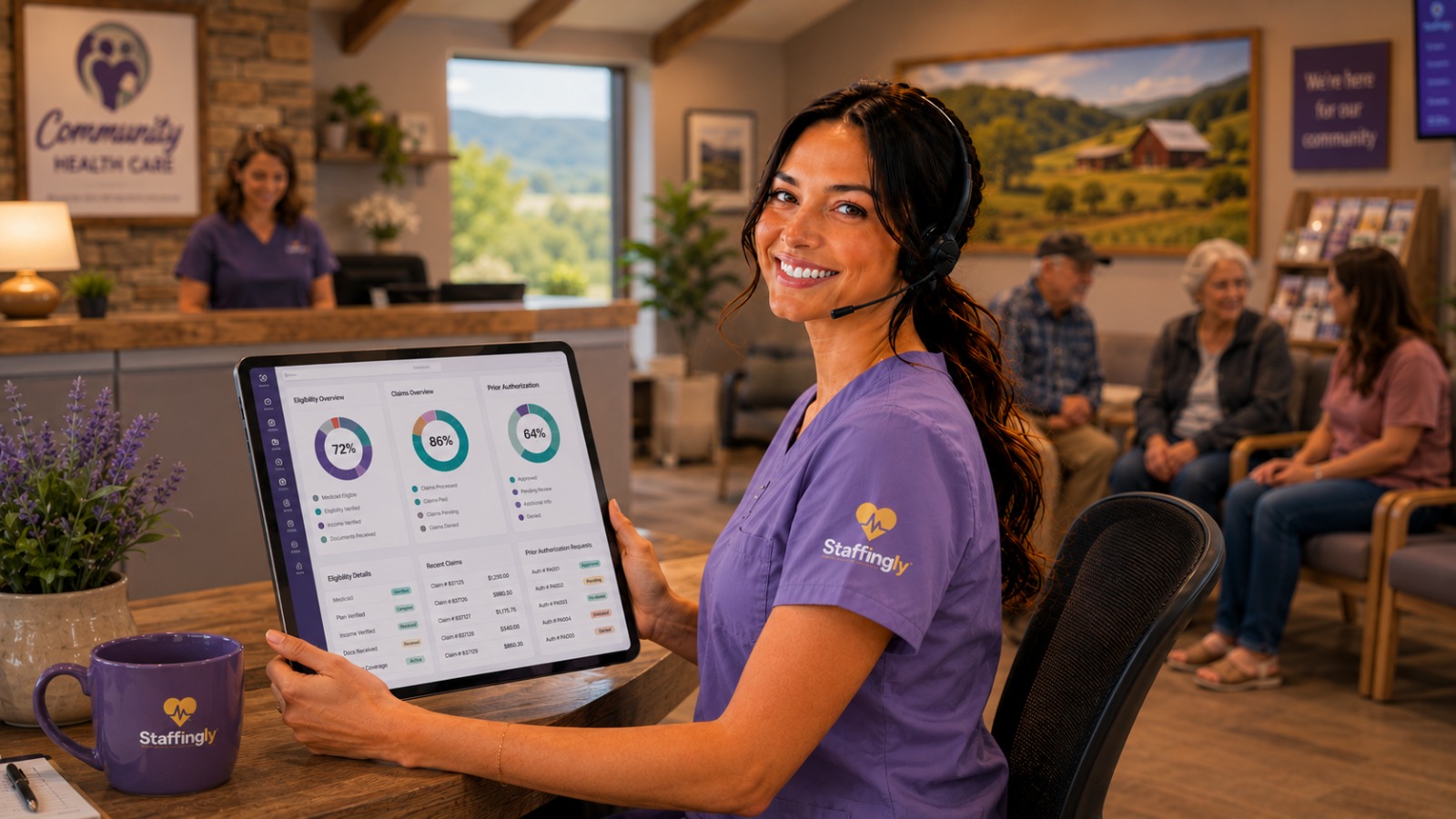
Your safety-net back office, run by a dedicated operator team.
HIPAA-trained, BAA-signed, working inside the system you already use.
Operator-role disclaimer: This page describes administrative and operational staffing services only. Staffingly runs the back office on a flat fee and never takes any share of collections, and we do not provide medical, clinical, diagnostic, legal, or billing advice; your providers and clinic own all clinical and program decisions. Any 340B references describe administrative support around the program only. Billing and compliance points are informational, not legal or billing advice. For your own HIPAA posture, see our HIPAA security overview.
We run the safety-net back office
This is the operator-layer wedge for the safety-net back office. Federally Qualified Health Centers and Community Health Centers run on tight budgets, HRSA and UDS reporting cycles, and staffing that turns over faster than the work can absorb. Most RCM platforms scrub claims and most offshore shops sell a seat, but the exception work, the prior authorizations that stall, the denials that age, the eligibility checks nobody got to, still lands back on your team. Staffingly is the flat-fee outsourced operator team that owns that exception work: prior authorization, insurance verification and eligibility, AR recovery and denial management on wraparound and managed-care claims, encounter coding, credentialing, and a virtual front-office. You keep all clinical and program decisions; we run the operation on a fixed monthly fee, never a percentage of collections.
Tell us about your health center.
Send us your situation and our team will scope the right setup, usually within one business day. No obligation.
What safety-net clinics ask us about
These are anonymized strategy conversations across the safety-net segment, described honestly as conversations rather than delivered results. They show the kinds of problems FQHCs and community health centers bring to us, not outcomes we are claiming.
Minnesota safety-net clinic
New Hampshire nonprofit
Illustrative product views and anonymized, representative strategy conversations. No client is named, no client data is shown, and no outcomes are claimed.
Each of these was a conversation about capability and fit, not a delivered engagement, and we are not attaching any statistics or results to them. We share them because they describe the real shape of the problem in the safety-net segment: a backlog that staffing turnover keeps reopening, volume that outpaces hiring, and a budget that cannot stretch to three more permanent positions. The honest answer in each case was the same operator-layer model described on this page, scoped to the clinic and priced as a flat fee.
Mission-driven budgets, relentless volume
FQHCs and community health centers are paid on an encounter-based prospective payment system, with Medicaid wraparound payments reconciling the PPS rate against managed-care payment. That model rewards clean encounter capture and disciplined follow-up, yet the people who do that work are exactly the roles that turn over and the budget lines that are hardest to fill. When volume grows or UDS reporting season arrives, the load lands on a team that is already short, and the back office becomes the bottleneck that decides whether the funding actually reaches care.
A safety-net clinic cannot solve a volume problem by raising prices; the rate is set and the mission is to see more patients, not fewer. So the only honest levers are clean encounter capture, fewer denials, faster eligibility, and a back office that scales without another hiring cycle. That is the work our team takes off your staff so growth does not turn into an aging AR pile and a UDS scramble. This is general information about how FQHC and RHC funding works, not legal or billing advice; RHC and FQHC are distinct designations and should not be conflated, and any specific rates should be confirmed with your own advisors.
The FQHC back office, run by a HIPAA-trained team
Prior Authorization
We run prior authorization for high-volume specialty referrals, imaging, and high-cost drugs end to end, owning the exception work so referrals do not stall. Fewer stalled approvals means less referral leakage out of your network.
Insurance Verification & Eligibility
We verify Medicaid, Medicaid managed care, and Medicare coverage before the visit and support sliding-fee determination, so the front desk is not chasing coverage after care is already delivered.
Revenue Cycle / AR Recovery
We work denials on wraparound and managed-care claims, run disciplined clean-claim review, and chase aging AR so encounters convert to payment instead of sitting in a queue nobody has time for.
Medical Coding
AAPC-credentialed coders handle encounter coding aligned to the PPS encounter model, so visits are captured accurately and your encounter-based payments reflect the care that was actually delivered.
Credentialing & Enrollment
We manage Medicaid, Medicare, and managed-care plan enrollment and keep the re-credentialing cadence current, so providers stay enrolled and claims do not bounce for a lapsed credential.
Virtual Medical Assistants
Our virtual medical assistants cover front-desk overflow, scheduling, intake, and multilingual patient callbacks, so a growing patient panel is answered without adding permanent front-office headcount.
340B administrative support
We provide administrative support around the 340B program only, the routine operational and back-office tasks, never program-integrity, contract-pharmacy, or compliance advisory, which stay with your own qualified advisors.
Which safety-net operators we run the back office for
We run the back office for safety-net operators across the segment, on top of the system they already use. Whatever the designation, you keep all clinical and program decisions; we run the revenue-cycle and front-office operation on a flat fee, never a share of collections.
Federally Qualified Health Centers (FQHCs)
HRSA-funded centers carrying encounter volume, UDS reporting, and the full PPS revenue cycle.
Community Health Centers (CHCs)
Mission-driven community clinics that need eligibility, coding, and AR run without a hiring cycle.
FQHC Look-Alikes
Centers that meet the program requirements without the federal grant and still carry the same back office.
Rural Health Clinics (RHC)
Rural clinics on the distinct RHC model that need prior authorization, eligibility, and denial follow-up.
Nonprofit safety-net clinics
Budget-constrained nonprofit clinics serving uninsured and underinsured patients on sliding-fee schedules.
Tribal & urban Indian health programs
Tribal and urban Indian health programs that need the same compliant revenue-cycle and front-office support.
The operator layer that owns the exceptions
We own the exception work
We own the PA exceptions and denial follow-up, not just the easy claims. Software that scrubs a claim still leaves the stuck approvals and aged denials to your staff; a shop that sells a seat hands you a person, not an outcome. We own the outcome.
Flat fee, never a percentage of collections
You pay a fixed monthly or per-specialist fee. Staffingly never takes a percentage of collections and never touches the economics of any claim. Budget-constrained safety-net clinics come to us specifically to avoid revenue-share RCM models.
HIPAA-trained and BAA-signed
Our team is trained on PHI handling, works from biometric-secured facilities under SOC 2 Type II, and ISO 27001 aligned controls, signs a Business Associate Agreement from day one, and works inside your own system.
We own the outcome, you own care
We run prior authorization, eligibility, AR, coding, credentialing, and front-office work. Your providers and clinic keep all clinical and program decisions. We are the back office, not the health center.
How Staffingly works, in practice
Inside the workA BAA-signed Staffingly team works inside your existing system, running prior authorization, eligibility, encounter coding, AR recovery, and front-office coverage, with clear escalation back to your clinic.
How does Staffingly use AI in an FQHC workflow?
AI handles the repetitive first pass; a specialist owns every exception, appeal, and judgment call; your providers and clinic own all clinical and program decisions. Everything runs inside your own system, logged under role-based access.
AI pre-checks eligibility and coverage gaps
AI pre-checks eligibility and flags sliding-fee and coverage gaps before the visit, so a coverage problem surfaces early instead of becoming a denial nobody catches until the claim ages.
AI drafts PA packets, surfaces denial reasons
AI drafts prior-authorization packets and surfaces denial reasons from remittances, so the specialist starts from a prepared first pass instead of a blank queue.
A specialist owns every exception
A dedicated specialist owns every exception, appeal, and judgment call. AI prepares and flags; the human files the authorization, works the denial, and makes the decision that needs a person.
Logged under role-based access
Every authorization, claim action, and outreach is logged with an audit trail under role-based access inside your system. Your providers and clinic own all clinical and program decisions; we run the back office.
From first call to live in 1 to 2 weeks
Six steps. Each one is documented. Nothing is mysterious.
Strategy call
We review your back office and pick the queue that hurts most: prior authorization, eligibility, AR and denials, coding, credentialing, or front-office.
BAA + system access
Signed Business Associate Agreement, then role-based access provisioned inside the practice-management and EHR system you already use.
Playbook + setup
We capture your payer mix, PA rules, coding guidance, and reporting cadence, then build the operating playbook before the team goes live.
Parallel pilot
Week 2. Your operator team runs alongside your staff. Daily sync. You see every authorization, claim, and queue.
Decision point (day 14)
Results reviewed against the pilot goals. Go or no-go. No penalty if you cancel.
Full handoff
Reporting and UDS-season coverage layered in. Weekly review with your account lead. Monthly QA audit.
Where Can You Get FQHC & CHC Back-Office Support?
Your patients are US-based and your clinic runs on US time. Your dedicated back-office team works remotely inside your existing system, delivered by accent-neutral, medical-background teams. Community health center density is high in states like California, Texas, New York, and Ohio, and we work with the Medicaid context in each, including Medi-Cal in California, Texas Medicaid through TMHP, eMedNY in New York, and Ohio Medicaid. Wherever your health center is based, you get the same HIPAA-trained, BAA-signed team running the same compliant revenue-cycle and front-office workflows. Searching for FQHC billing or prior authorization support near me returns local vendors; this is the same work, delivered remotely and run as an operator layer.
One Flat Weekly Rate. No Surprises.
Dedicated FQHC and community health center back-office specialists at a fixed weekly cost. Per specialist FTE, per week. No contracts, no minimums, no percentage of your collections, no hidden fees.
Want to compare against an in-house hire? Use the savings calculator.
Frequently asked questions
Who handles billing and prior authorization for FQHCs?
Staffingly handles it as the operator layer for your FQHC. Our HIPAA-trained team runs prior authorization end to end, including high-volume specialty referrals, imaging, and high-cost drugs, and runs the revenue cycle from eligibility through denial follow-up on wraparound and managed-care claims. We work inside the system you already use, on a flat fee, and we own the exception work rather than handing it back to your staff. Your providers keep all clinical decisions; we run the back office.
Can I outsource front-desk and insurance verification for a community health center?
Yes. Our virtual medical assistants cover front-desk overflow, scheduling, intake, and multilingual patient callbacks, and our verification team confirms Medicaid, Medicaid managed care, and Medicare coverage and supports sliding-fee determination before the visit. That lets a community health center absorb rising volume without a hiring cycle. Everything runs remotely inside your existing workflow, logged under role-based access, while your clinic keeps every clinical and program decision.
Is offshore medical billing safe for an FQHC?
Yes, when it is run as a HIPAA-trained, BAA-signed operation. Our staff are trained on PHI handling, work from biometric-secured facilities, and operate under SOC 2 Type II, and ISO 27001 aligned controls with role-based access and full audit trails. We work inside your own system, so PHI stays in your environment. Offshore RCM is safe for an FQHC when the security posture is built in from day one rather than added later.
How do FQHCs staff up for UDS season without hiring?
FQHCs use a dedicated outsourced pod instead of permanent hires. When UDS reporting season adds workload, we scale eligibility, coding, AR, and front-office coverage up for the crunch and back down afterward, so you absorb the load without adding permanent positions or running a hiring cycle. You pay a flat weekly fee per specialist, scale the pod to the season, and your clinic keeps all clinical and reporting decisions.
What does it cost to outsource RCM for a community health center?
Staffingly charges a flat weekly fee per specialist FTE, never a percentage of collections. Pricing starts at a fixed weekly rate per dedicated specialist, with lower per-seat rates as you add volume, and no contracts, minimums, or hidden fees. Because it is a flat fee, your cost does not rise just because collections rise, which is why budget-constrained safety-net clinics come to us instead of revenue-share RCM models.
Where this information comes from
The funding and compliance points on this page trace back to primary U.S. government sources. These are informational, not legal or billing advice; confirm specifics with your own counsel and advisors.
Written + Reviewed By

Dan Nandan is the Founder and CEO of Staffingly, Inc., based in Piscataway, New Jersey. With 25+ years in IT consulting and healthcare BPO operations, he was one of the earliest U.S. operators to set up an RPO/BPO delivery network in India over 20 years ago. Today his work centers on AI-driven healthcare workflows and helping practices across North America cut administrative costs without compromising care.

Bincy Shiiju Kuriakose is a Clinical Content Reviewer at Staffingly and a U.S. Licensed Registered Nurse (MSN, RN). NCLEX-RN certified with expertise in hospital nursing, telehealth, and nursing education. PhD scholar in Nursing at Peoples’ College of Nursing, Bhopal. Reviews every service page for medical accuracy, compliance, and evidence-based best practices.
Connect on LinkedInSecurity Your Compliance Officer Will Sign Off On
Staffingly is audited to SOC 2 Type II with zero exceptions and certified for ISO/IEC 27001:2022, HIPAA, and GDPR. In eight years we have never had a breach. Every workstation runs inside the Venn Blue Border secure enclave on US-based servers, screen captures and downloads are blocked by policy, and every engagement operates under a signed BAA, and Staffingly maintains $5M in professional liability (E&O) and cyber insurance as part of its enterprise risk-management program.