
Dental Implant Center Billing Services
Specialty billing operations for dental implant centers. D6010-D6199 implant family. D7950-D7956 bone graft codes. PA-heavy workflows. LEAT downgrade triggers (porcelain to PFM on abutments). Missing-tooth clause flagging (huge denial driver). Frequency caps (5-year replacement standard). Bundling rules (D2950 buildup with crown). Medical cross-coding for post-traumatic, oncologic resection, and congenital cases. Multi-implant case sequencing billing. Live in 1 to 2 weeks.

Trained dental support, inside your software
Healthcare-trained specialists under HIPAA-aware workflows.
A managed dental support team, built around your practice
Implant cases run $4,000 to $25,000 in patient responsibility once you stack the implant, abutment, crown, bone graft, and any auxiliary procedures. One missing-tooth clause hit destroys the financial conversation. One bundle rule miss destroys the EOB. Implant billing is predetermination-heavy, frequency-cap-heavy, and bundling-heavy from the first case to the last.
Tell us about your practice.
Send us your situation and our team will scope the right setup, usually within one business day. No obligation.
What You Need to Know About Dental Implant Center Billing
D6010-D6199 implant family
D6010 surgical placement of implant body. D6056 prefabricated abutment. D6058-D6065 abutment-supported porcelain or zirconia crowns. D6075-D6094 implant supported retainer. Each step submits separately and predetermines separately.
D7950-D7956 bone graft codes
D7950 osseous, osteoperiosteal, or cartilage graft of the mandible. D7951 sinus augmentation. D7953 bone replacement graft for ridge preservation. D7956 sinus lift via lateral approach. Bundling rules vary widely by payer.
Predetermination-heavy
Most plans require predetermination on implant cases above a threshold (often $1,200 or $1,500). Submitting without predetermination is a coin flip. Patients lose trust when they get a $4,000 bill they were told would be $1,800.
HIPAA + SOC 2
HIPAA, SOC 2 Type II, ISO 27001, alignment. Signed BAA. Role-based PMS access. Audit logging. PHI never leaves the controlled environment.
Why is implant billing so hard to run in-house?
Implant centers carry the largest patient AR balances in dentistry, and the rule sets that govern coverage are dense. Three patterns destroy collections at nearly every implant practice we audit.
Missing-tooth clause not flagged at eligibility
Most dental plans have a missing-tooth clause: if the tooth was missing before the patient enrolled, the policy never covers replacement. The biller does not check the enrollment date against the extraction date. Case gets submitted. Denial three weeks later. Patient owes $4,000 they were told insurance would cover.
LEAT downgrades on abutments and crowns
Porcelain abutment downgrades to PFM on many plans. Zirconia downgrades to PFM on some plans. The patient is paying the difference. When not flagged in predetermination, the patient AR balance balloons after delivery.
D2950 buildup bundles with crown placement
Many plans bundle D2950 buildup with D2740-D2799 crown placement on the same date of service. The biller submits both. One denies. EOB confusion. Patient AR confusion. Time wasted on resubmission.
How Staffingly works, in practice
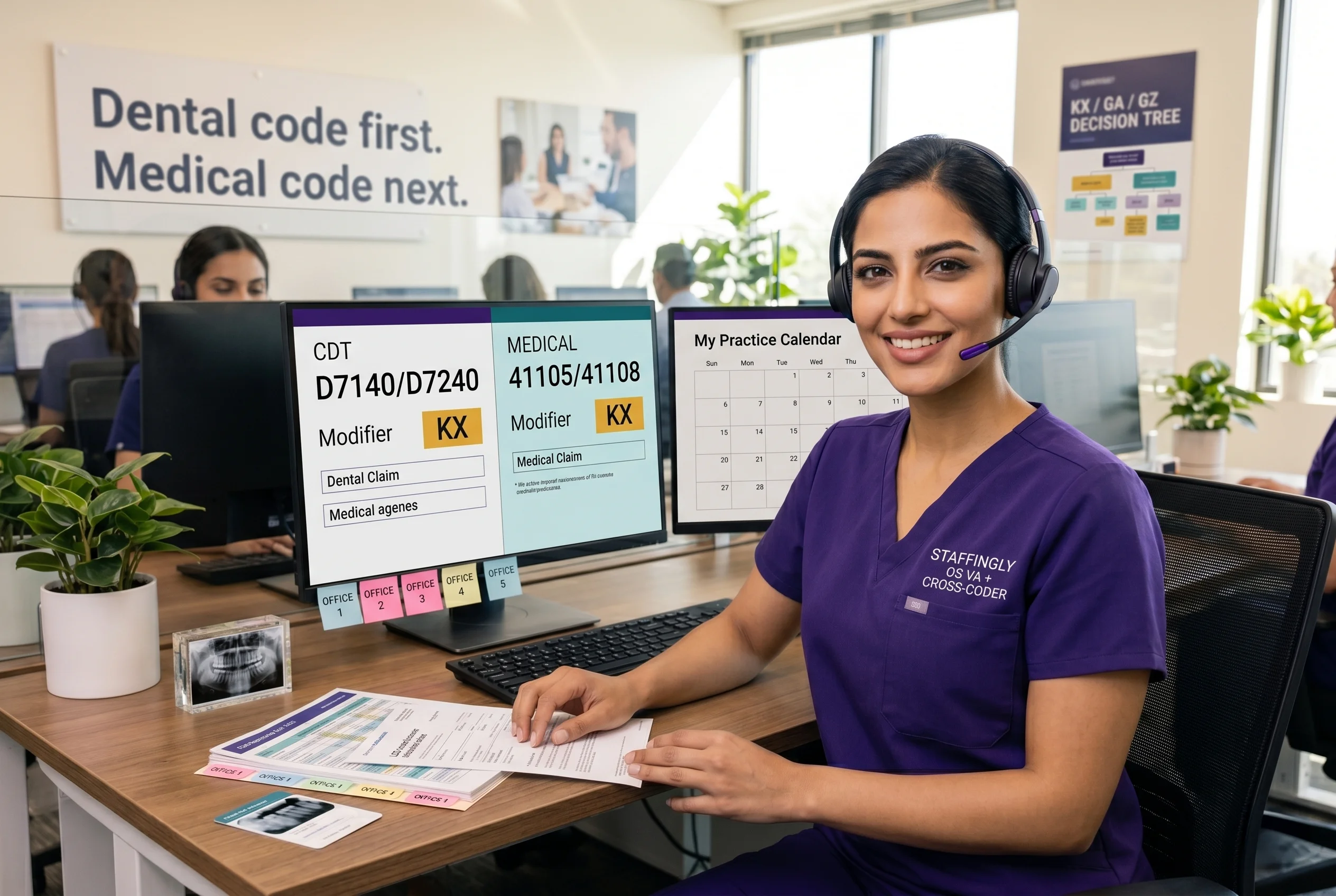
Inside the workA trained Staffingly specialist handles the workflow inside your existing dental software, with clear escalation back to your team.
How Is Staffingly’s Implant Center Billing Different?
Most outsourcers do not flag the missing-tooth clause at eligibility. Ours do, every time.
Implant-specific specialty training
Implant billers pre-trained on D6010-D6199 family, D7950-D7956 bone graft codes, LEAT downgrade triggers, missing-tooth clauses, and multi-implant case sequencing before placement. Not generic dental billers cross-trained on implants.
Dedicated account manager
One named contact for your practice. Weekly review, monthly KPI rollup, quarterly tuning. Not a ticket queue.
Transparent flat pricing
$399 per specialist per week single, $349 at volume, $299 enterprise. No percentage-of-collections games. No surprise fees.
2-Week Free Trial
Live work for 14 days at the same rate. Cancel before day 14, owe nothing. No annual contracts after.
How fast can your implant billing go live? 14 days.
Three steps from first call to first cleared predetermination batch. Decision point at day 14.
Days 1-3: Strategy, BAA, PMS access
15-minute strategy call. We pull your last 30 implant denials and AR aging by case. Signed BAA. Role-based PMS access.
Days 4-10: Payer rule capture + parallel predetermination
Top 10 payers documented. Missing-tooth clause check workflow locked. LEAT downgrade triggers indexed. Bundling rules confirmed in writing. Predetermination submissions start parallel.
Days 11-14: Decision point + handoff
Pilot results reviewed: predetermination approval rate, missing-tooth clause flagging accuracy, patient AR reduction. Go or no-go. No penalty.
Where can you get implant center billing services?
Our implant specialty billing team works remotely inside your dental PMS. Wherever your implant center is located, you get the same implant-trained billers running the same missing-tooth-clause and LEAT downgrade playbook.
One Flat Weekly Rate. No Surprises.
Dedicated virtual dental assistants at a fixed weekly cost. 45 hours per week, fully managed. No contracts, no minimums, no hidden fees.
Want to compare against an in-house hire? Use the savings calculator.
Frequently asked questions
What is the missing-tooth clause and why does it cause so many denials?
Most dental plans have a missing-tooth clause: if the tooth was missing before the patient enrolled in the plan, the policy will not cover replacement (including the implant, the abutment, and the crown). The biller has to check enrollment date against extraction date in eligibility before treatment. When missed, the case denies and the patient owes the full balance.
Which CDT codes apply to implant cases?
D6010 surgical placement of implant body, D6056 prefabricated abutment, D6058-D6065 abutment-supported porcelain or zirconia crowns, D6075-D6094 implant supported retainer, D6080 maintenance and cleaning of implants. Plus D7950-D7956 for bone graft and sinus lift codes that often accompany the case.
How do LEAT downgrades work on implant abutments and crowns?
Least expensive alternative treatment (LEAT) rules downgrade porcelain or zirconia abutments and crowns to PFM (porcelain-fused-to-metal) on many plans. The patient pays the difference. When flagged in predetermination, the financial conversation happens up front. When not flagged, the patient is surprised by a large bill after delivery.
Do implants ever bill to medical insurance?
Yes, in specific cases: post-traumatic reconstruction where the implant replaces a tooth lost in an accident, oncologic resection where the implant is part of mandibular or maxillary reconstruction, and certain congenital cases. Medical PA requires CPT and ICD-10 mapping plus a documentation pack supporting medical necessity.
What is the 5-year replacement frequency cap?
Most plans cap implant crown replacement at 5 years from the original placement. When patients want or need replacement sooner, the case becomes patient-responsibility unless medical necessity supports earlier replacement. Tracking frequency caps per patient cohort prevents denied resubmissions.
How do bone graft and sinus lift codes get bundled?
Bundling rules vary by payer. Some plans bundle D7953 ridge preservation with same-day extraction (D7140 or D7210). Some plans bundle D7951 sinus augmentation with same-day implant placement (D6010). Predetermination clarifies the bundling decision before treatment. Submitting blind invites denials.
How does pricing work?
Flat per-specialist weekly rate. $399 single specialist, $349 at volume (5 or more), $299 enterprise (10 or more). 2-week free trial at the same rate. No percentage-of-collections fees.
How are your implant billers trained, and where do they work from?
Implant billers are selected from top-tier healthcare and dental programs, pass rigorous neutral-accent English certifications, are tested on the implant code set, LEAT downgrade rules, missing-tooth clauses, and bundling rules, and work from biometric-secured HIPAA-aware facilities. Support teams operate globally, including secured facilities.

President and CEO, Staffingly, Inc. 25+ years in IT consulting and healthcare BPO operations. One of the earliest US operators to set up an RPO/BPO delivery network in India. Leads AI-driven healthcare workflows that help dental practices and DSOs cut admin costs without compromising care.

Senior Process Associate, Staffingly, Inc. BDS from Sri Sai College of Dental Surgery, Telangana. Hands-on experience in dental front-office operations, medical billing, EHR workflows, and US specialty practice administration. Former Dental Health Facilitator at FMS Dental Hospitals and Senior Medical Billing Specialist supporting US dental practices. Reviews dental content for terminology, workflow accuracy, and compliance fit.
Security Your Compliance Officer Will Sign Off On
Staffingly is audited to SOC 2 Type II with zero exceptions and certified for ISO/IEC 27001:2022, HIPAA, and GDPR. In eight years we have never had a breach. Every workstation runs inside the Venn Blue Border secure enclave on US-based servers, screen captures and downloads are blocked by policy, and every engagement operates under a signed BAA, and Staffingly maintains $5M in professional liability (E&O) and cyber insurance as part of its enterprise risk-management program.