
AI Dental Prior Authorization Automation
AI-assisted dental prior authorization with human CDT-trained review. Payer rule library auto-checks every submission. Auto-narrative drafts go to a licensed dental biller for review before any submission ships. Day 14/21/28 tracking automated. Private containerized endpoints. PHI never enters public LLMs. HIPAA + SOC 2 + ISO 27001. Live in 1 to 2 weeks.
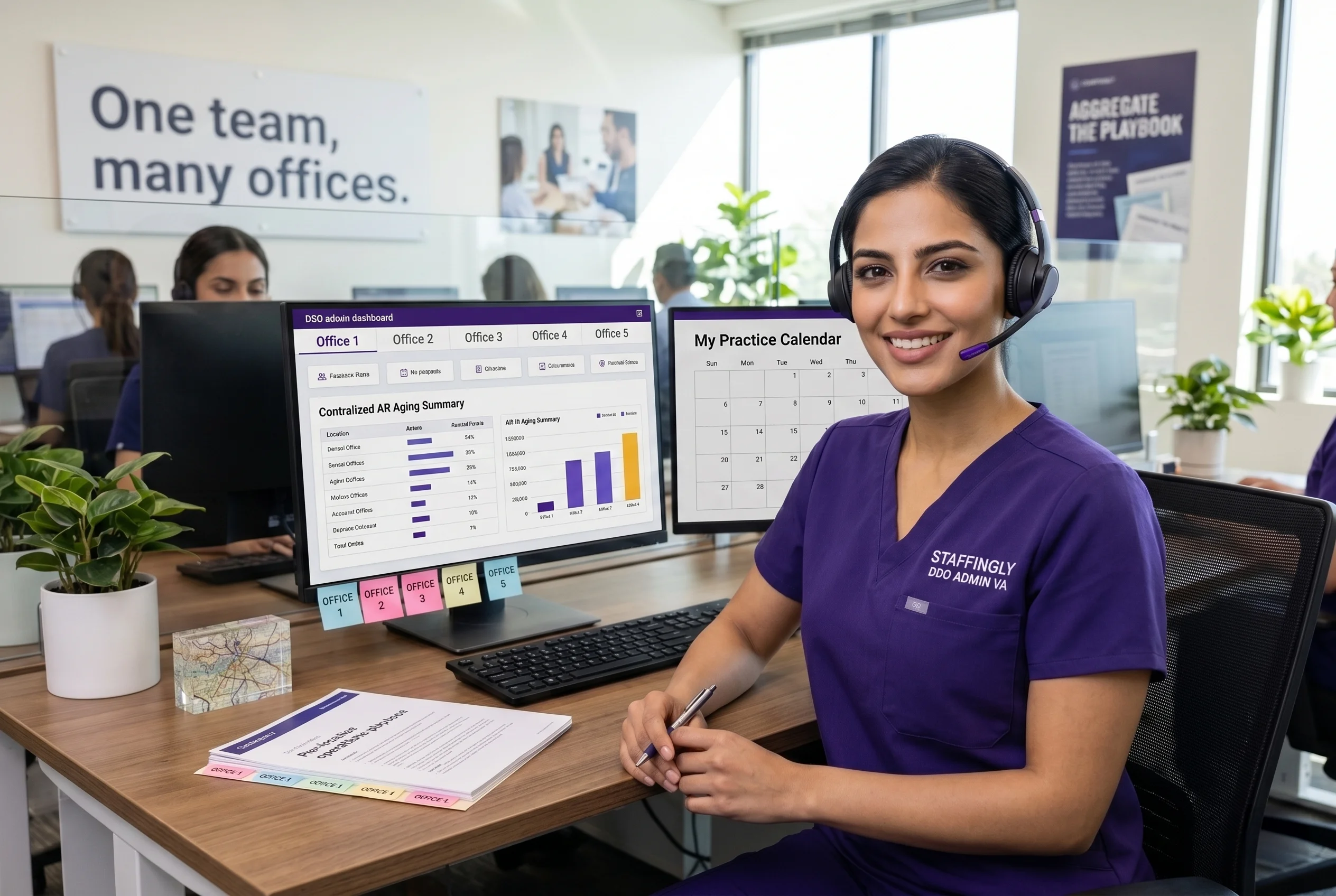
Trained dental support, inside your software
Healthcare-trained specialists under HIPAA-aware workflows.
A managed dental support team, built around your practice
AI dental PA automation is a payer-rule-library plus auto-narrative draft engine with human-in-the-loop review. The AI compares each submission against the payer’s published policy, drafts a narrative when documentation requires it, and routes the entire submission to a CDT-trained dental biller for review. The biller decides what ships. AI never auto-submits. PHI stays in private containerized endpoints.
Tell us about your practice.
Send us your situation and our team will scope the right setup, usually within one business day. No obligation.
What You Need to Know About AI Dental PA Automation
Payer rule library + auto-narrative
AI compares each submission against the payer’s published PA policy. Auto-narrative draft generated when documentation requires a clinical narrative. Human dental biller reviews every output.
Human-in-the-loop on every submission
AI does not auto-submit. A CDT-trained dental biller reviews every output and decides whether to ship, fix, or hold. Final accountability sits with the human.
Compliance preserved
Private containerized endpoints. PHI never enters public LLMs. HIPAA, SOC 2 Type II, ISO 27001. Audit log on every AI output.
Why Does Dental PA Still Eat So Much Front-Desk Time in 2026?
PA submission and narrative authoring is one of the most time-intensive dental admin tasks. Three patterns absorb hours every week.
Narrative authoring eats hours
Hand-authoring clinical narratives for sleep, TMJ, orthognathic, implant, and bone graft PAs takes 15 to 30 minutes per case. Across a busy oral surgery or restorative practice, that is 5 to 10 hours per week of clinician or biller time.
Payer-rule lookup eats hours
Looking up each payer’s PA documentation requirements, frequency caps, and downgrade rules across 10 to 25 payer policies eats hours every week. Most teams memorize the top 3 and miss the rest.
Manual day 14/21/28 tracking gets skipped
Day 14, day 21, and day 28 tracking calls fall off the calendar when the front desk is busy. Without automated tracking, cases drift past response windows and re-submission delays accumulate.
How Staffingly works, in practice

Inside the workA trained Staffingly specialist handles the workflow inside your existing dental software, with clear escalation back to your team.
How Is Staffingly’s AI PA Automation Different?
Most AI PA tools are generic medical engines retrofitted for dental. Ours is dental-only with private containerized endpoints and human review on every output. Four things that change the outcome.
Dental-only rule library
Rules built on CDT D2740 through D9999 PA policies, the top 25 dental payer documentation requirements, AAOMS guidelines, AAOP TMD standards, and CMS LCDs for medical-cross sleep PA. Not a medical scrubber bolted onto dental.
Human biller reviews every AI output
AI does not auto-submit, auto-appeal, or auto-anything. A CDT-trained dental biller reviews every AI output and decides the next action. Final accountability sits with the human.
Private containerized endpoints
Claim data and patient data pass through private endpoints we control. PHI never enters public LLMs. No model training on patient charts. Compliance review on every release.
2-Week Free Trial
Industry standard is multi-month vendor commitments. We give you 14 days at the same rate. Cancel before day 14 and owe nothing. Add or remove scope by the week.
How Does AI Dental PA Automation Work in Practice?
Six steps from strategy call to live AI PA automation. First batch typically auto-drafts in week two.
Strategy call (15 min)
We pull a sample of your last 90 days of PA submissions and identify the top time sinks (narrative authoring, rule lookup, tracking). No prep needed from you.
BAA + PMS access
Signed BAA. Role-based PMS access provisioned. Clearinghouse and payer portal credentials confirmed. Private endpoints configured.
Payer rule library loaded
Your top 10 payers’ PA policies loaded into the rule library. Documentation requirements, frequency caps, downgrade triggers, modifier rules, and predetermination thresholds. Locked in writing.
Parallel automation starts
Week 2. Every outbound PA gets AI auto-narrative draft and rule library check. CDT-trained biller reviews every output. Tracking automation runs day 14/21/28. Daily 15-minute sync.
Decision point (day 14)
Pilot results reviewed: submission turnaround, first-pass approval rate, biller hours saved. Go or no-go. No penalty.
Full handoff
Daily AI PA cadence locked. Weekly approval-rate dashboard. Monthly rule library refresh as payers update policy. Quarterly business review.
Where Can You Get AI Dental PA Automation Services?
Our AI engine and human review team work remotely inside your dental PMS and the payer portals. Wherever your practice is located, you get the same dental-only rule library and the same CDT-trained reviewers.
One Flat Weekly Rate. No Surprises.
Dedicated virtual dental assistants at a fixed weekly cost. 45 hours per week, fully managed. No contracts, no minimums, no hidden fees.
Want to compare against an in-house hire? Use the savings calculator.
Frequently asked questions
Does the AI submit PAs on its own?
No. The AI drafts narratives, checks payer rules, and surfaces flags. A CDT-trained dental biller reviews every AI output and decides whether to ship, fix, or hold. The AI does not auto-submit, auto-appeal, or auto-anything. Final accountability sits with the human.
What does the AI rule library check?
Documentation requirements per payer per code (radiographs, photos, perio chart, AHI, ceph, models). Frequency caps (5-year crown, per-quadrant periodontal). LEAT downgrade triggers. Modifier rules. Predetermination thresholds. Missing-tooth clauses. Sedation credentialing requirements.
Does the AI write the entire clinical narrative?
The AI drafts a clinical narrative based on the chart data and payer-policy language. A CDT-trained dental biller reviews, edits where needed, and approves. The biller is the author of record. The AI is a drafting tool.
Will the AI learn from our patient data?
No. Submission data passes through private containerized endpoints we control. PHI never enters public LLMs. No model training on patient charts. Compliance review on every release.
What are private containerized endpoints?
Compute environments isolated to your data only, deployed inside infrastructure we control. The AI model runs inside the container. Submissions pass in and out without ever touching public LLM endpoints. PHI stays in our HIPAA-aligned environment end to end.
Which dental PMS systems are supported?
Dentrix, Dentrix Ascend, Open Dental, Eaglesoft, Curve Dental, Denticon, Carestack, ClearDent, MacPractice, Practice-Web, and SoftDent. Clearinghouse support includes DentalXChange, ClaimConnect, Change Healthcare, Tesia, and EDI Health Group.
How does pricing work?
Flat per-specialist weekly rate. $399 single specialist, $349 at volume (5 or more), $299 enterprise (10 or more). 2-week free trial at the same rate. No per-submission fees.
How are your reviewers trained, and where do they work from?
Reviewers are selected from top-tier healthcare and dental programs, pass rigorous neutral-accent English certifications, and work from biometric-secured HIPAA-aware facilities. Teams are trained specifically for dental prior authorization workflows. Support teams operate globally, including secured facilities.

President and CEO, Staffingly, Inc. 25+ years in IT consulting and healthcare BPO operations. One of the earliest US operators to set up an RPO/BPO delivery network in India. Leads AI-driven healthcare workflows that help dental practices and DSOs cut admin costs without compromising care.

Senior Process Associate, Staffingly, Inc. BDS from Sri Sai College of Dental Surgery, Telangana. Hands-on experience in dental front-office operations, medical billing, EHR workflows, and US specialty practice administration. Former Dental Health Facilitator at FMS Dental Hospitals and Senior Medical Billing Specialist supporting US dental practices. Reviews dental content for terminology, workflow accuracy, and compliance fit.
Security Your Compliance Officer Will Sign Off On
Staffingly is audited to SOC 2 Type II with zero exceptions and certified for ISO/IEC 27001:2022, HIPAA, and GDPR. In eight years we have never had a breach. Every workstation runs inside the Venn Blue Border secure enclave on US-based servers, screen captures and downloads are blocked by policy, and every engagement operates under a signed BAA, and Staffingly maintains $5M in professional liability (E&O) and cyber insurance as part of its enterprise risk-management program.