
Bone Graft and GBR Prior Authorization
Outsourced bone graft and guided bone regeneration prior authorization from Staffingly. D7950 socket preservation, D7951 sinus augmentation, D7953 ridge preservation, D7955 maxillofacial defect repair, D7956 guided tissue regeneration edentulous, and membrane bundling. Implant-placement bundling rules captured per payer. Frequency caps tracked. CDT-trained specialists. Live in 1 to 2 weeks. No long-term contracts.
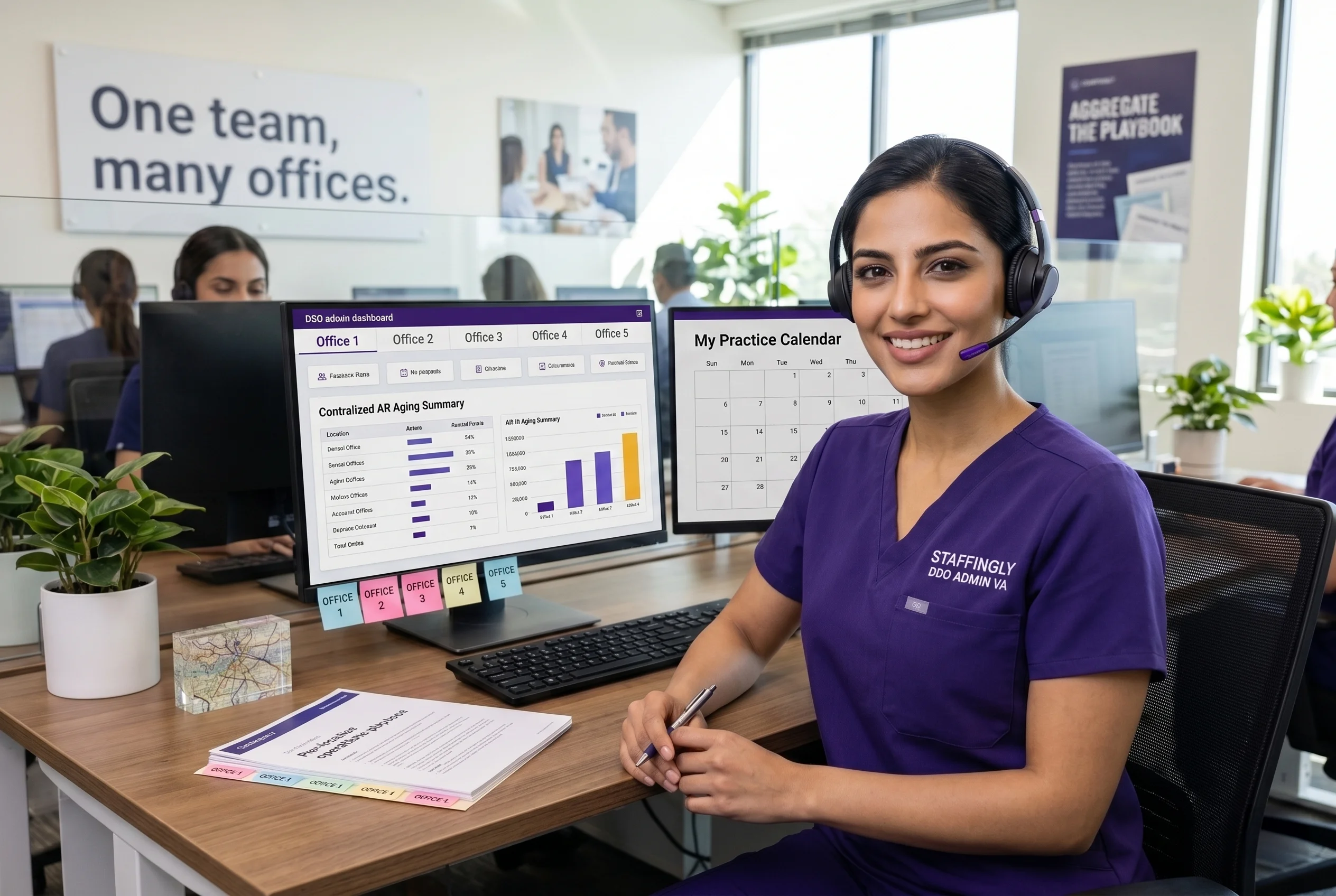
Trained dental support, inside your software
Healthcare-trained specialists under HIPAA-aware workflows.
A managed dental support team, built around your practice
Bone graft and GBR PA is bundling-sensitive and frequency-capped. D7950 socket preservation, D7951 sinus augmentation, D7953 ridge preservation, D7955 maxillofacial defect repair, and D7956 GTR all carry payer-specific bundling rules. Some payers bundle bone graft with implant placement under D6010. Others pay separately. Membrane application (D7956) and biologic adjuncts add another layer. Frequency caps limit how often the same site can be grafted.
Tell us about your practice.
Send us your situation and our team will scope the right setup, usually within one business day. No obligation.
What You Need to Know About Bone Graft and GBR PA
Bundling captured per payer
D7950 through D7956 bundling rules with D6010 implant placement vary by payer. Some bundle, some pay separately. We capture the rules per payer to maximize reimbursement legitimately.
Frequency caps tracked per site
Many plans cap bone graft frequency per tooth or per quadrant. We track frequency caps before submission so re-graft requests align with payer policy.
Stacked compliance posture
HIPAA, SOC 2 Type II, ISO 27001. Signed BAA, role-based access, audit logging. PHI never leaves the controlled environment.
Why Do Bone Graft PAs Get Denied or Downgraded?
Bone graft denials and downgrades cluster around three patterns. Most practices know the codes and still lose revenue because the bundling discipline slips.
Bundling rules not captured pre-submission
Some payers bundle D7950 socket preservation with D6010 implant placement. When submission ships expecting separate payment but the payer bundles, the bone graft fee gets absorbed into the implant payment. Revenue loss compounds across every implant case.
Frequency cap violations cause auto-denial
Many plans cap bone graft frequency per tooth or per quadrant per lifetime or per multi-year window. Re-graft attempts on the same site without checking the cap get auto-denied. Patient AR shifts unexpectedly.
Bone-loss documentation incomplete
Most payers require radiographic documentation showing bone defect or atrophy that justifies grafting. When CBCT or periapical evidence is not attached, the PA gets denied as not medically necessary.
How Staffingly works, in practice

Inside the workA trained Staffingly specialist handles the workflow inside your existing dental software, with clear escalation back to your team.
How Is Staffingly’s Bone Graft and GBR PA Service Different?
Most outsourcers submit bone graft codes and stop. Ours capture bundling rules, frequency caps, and bone-loss documentation per case. Four things that change the outcome.
Bundling rules captured per payer
D7950 through D7956 bundling rules captured per payer. Submission configured to maximize legitimate reimbursement under the payer’s specific bundling policy.
Frequency-cap check pre-submission
Every bone graft PA gets a frequency-cap check before submission. Prior graft history pulled from the chart and compared to payer cap. Re-graft cases that violate the cap flagged for patient AR planning.
Bone-loss documentation pull
CBCT, periapical, or panoramic radiographs with measurable bone defect or atrophy pulled and attached per case. Surgical narrative pulled from the chart and authored per payer language.
2-Week Free Trial
Industry standard is zero risk-free trial. We give you 14 days at the same rate. Cancel before day 14 and owe nothing. No annual contracts after, ever. Scale up or down by the week.
How Does Bone Graft and GBR PA Work in Practice?
Six steps from strategy call to live bone graft PA management. The first bone graft PA batch typically submits within week two.
Strategy call (15 min)
We pull your current bone graft PA backlog and downgrade patterns. Identify bundling gaps. No prep needed from you.
BAA + PMS access
Signed BAA. Role-based PMS access provisioned. Imaging archive credentials confirmed.
Payer bone graft playbook capture
Top dental and medical payers’ bone graft policies documented. Bundling rules with D6010, frequency caps per site, membrane reimbursement, and biologic adjunct policies locked in writing.
Parallel PA submissions start
Week 2. Our team submits new bone graft PAs alongside your in-office staff. Bundling rules applied. Frequency caps checked. Bone-loss documentation pulled. Daily 15-minute sync.
Decision point (day 14)
Pilot results reviewed: submission turnaround, bone graft revenue captured, downgrade prevention. Go or no-go. No penalty.
Full handoff
Weekly bone graft revenue dashboard. Monthly payer-policy refresh. Quarterly business review.
Where Can You Get Bone Graft and GBR PA Services?
Our team works remotely inside your PMS, imaging archive, and the dental and medical payer portals. Wherever your practice is located, you get the same bone graft specialists running the same bundling playbook.
One Flat Weekly Rate. No Surprises.
Dedicated virtual dental assistants at a fixed weekly cost. 45 hours per week, fully managed. No contracts, no minimums, no hidden fees.
Want to compare against an in-house hire? Use the savings calculator.
Frequently asked questions
What CDT codes cover bone grafting?
D7950 osseous, osteoperiosteal, or cartilage graft of the mandible or maxilla (autogenous or non-autogenous). D7951 sinus augmentation via lateral approach. D7952 sinus augmentation via vertical approach. D7953 bone replacement graft for ridge preservation per site. D7955 repair of maxillofacial soft and hard tissue defects. D7956 guided tissue regeneration, edentulous area, per site.
What is the difference between bone graft and GBR?
Bone graft adds bone-volume material to a defect or extraction site. Guided bone regeneration (GBR) uses a membrane (resorbable or non-resorbable) to direct bone growth into a specific area while excluding soft tissue. The codes can be billed together when both are performed.
Does bone graft bundle with implant placement?
On some payers yes, on others no. Some payers bundle D7950 socket preservation with D6010 implant placement (single payment). Others pay separately. We capture the bundling rule per payer per engagement.
What documentation supports a bone graft PA?
CBCT, periapical, or panoramic radiographs showing measurable bone defect or atrophy. Surgical narrative describing the defect and the planned graft material. Where applicable, periodontal chart for defect classification. Photos in some cases.
What are typical bone graft frequency caps?
Many plans cap bone graft per site at one to two lifetime grafts. Re-graft attempts may require failed-graft documentation. Frequency caps vary widely by plan and code.
Can medical insurance pay for bone grafting?
In narrow scenarios: post-traumatic injury, oncologic reconstruction after head and neck cancer treatment, and congenital absence (cleft lip and palate). CPT and ICD-10 cross-coding required. Documentation must support medical necessity.
How does pricing work?
Flat per-specialist weekly rate. $399 single specialist, $349 at volume (5 or more), $299 enterprise (10 or more). 2-week free trial at the same rate. No per-submission fees.
How are your specialists trained, and where do they work from?
Specialists are selected from top-tier healthcare and dental programs, pass rigorous neutral-accent English certifications, and work from biometric-secured HIPAA-aware facilities. Teams are trained specifically for dental prior authorization workflows. Support teams operate globally, including secured facilities.

President and CEO, Staffingly, Inc. 25+ years in IT consulting and healthcare BPO operations. One of the earliest US operators to set up an RPO/BPO delivery network in India. Leads AI-driven healthcare workflows that help dental practices and DSOs cut admin costs without compromising care.

Senior Process Associate, Staffingly, Inc. BDS from Sri Sai College of Dental Surgery, Telangana. Hands-on experience in dental front-office operations, medical billing, EHR workflows, and US specialty practice administration. Former Dental Health Facilitator at FMS Dental Hospitals and Senior Medical Billing Specialist supporting US dental practices. Reviews dental content for terminology, workflow accuracy, and compliance fit.
Security Your Compliance Officer Will Sign Off On
Staffingly is audited to SOC 2 Type II with zero exceptions and certified for ISO/IEC 27001:2022, HIPAA, and GDPR. In eight years we have never had a breach. Every workstation runs inside the Venn Blue Border secure enclave on US-based servers, screen captures and downloads are blocked by policy, and every engagement operates under a signed BAA, and Staffingly maintains $5M in professional liability (E&O) and cyber insurance as part of its enterprise risk-management program.