
Dental Prior Authorization Appeals After Denial
Outsourced dental PA appeal management from Staffingly. CDT-trained specialists pull documentation, author payer-specific narratives, and run appeal-window-disciplined resubmissions targeting a 60 to 75 percent overturn rate. Sleep, TMJ, orthognathic, implant, bone graft, and sedation appeals all covered. Live in 1 to 2 weeks. No long-term contracts.
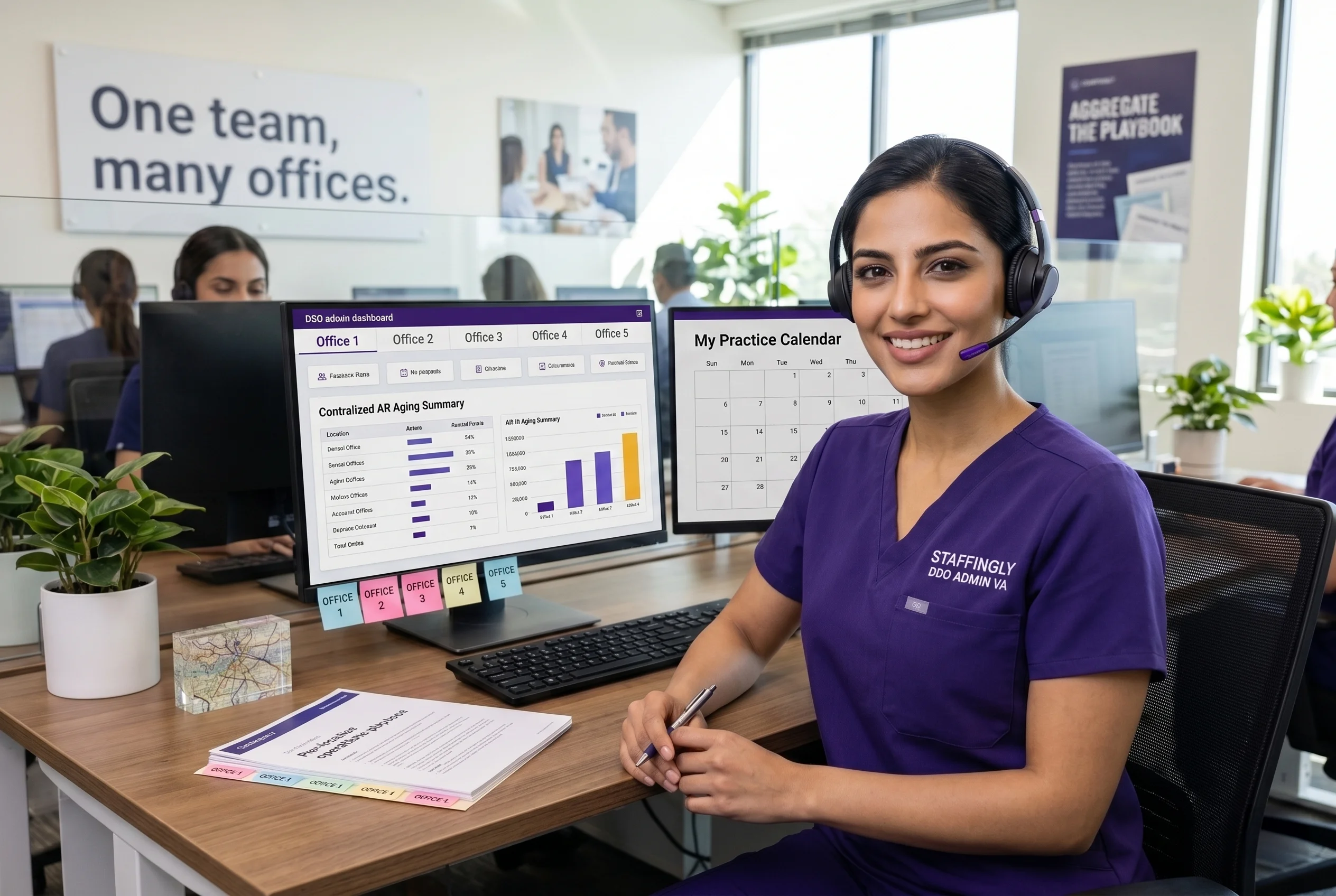
Trained dental support, inside your software
Healthcare-trained specialists under HIPAA-aware workflows.
A managed dental support team, built around your practice
Dental PA appeals are payer-specific exercises. Each major payer publishes its own appeal window, its own required documentation set, and its own internal review tiers. A single generic appeal template fails on most denials. A payer-specific playbook with the right narrative and the right attached documentation overturns 60 to 75 percent of denials in top-quartile practices.
Tell us about your practice.
Send us your situation and our team will scope the right setup, usually within one business day. No obligation.
What You Need to Know About Dental Prior Authorization Appeals
Payer-specific appeal playbooks
We maintain appeal playbooks per major payer. Which review tier to escalate to, what documentation each tier expects, and which narrative phrasing has the best overturn rate. Updated as payers change policy.
60 to 75 percent overturn target
Top-quartile dental practices overturn 60 to 75 percent of appealed PA denials. Most practices sit at 30 to 40 percent. The gap is playbook depth, narrative quality, and appeal-window discipline.
Stacked compliance posture
HIPAA, SOC 2 Type II, ISO 27001. Signed BAA, role-based PMS access, audit logging. PHI never leaves the controlled environment.
Why Do So Many Dental PA Denials Stay Denied?
Most practices appeal once with a generic template and write off the case if the appeal fails. Three patterns leave money on the table every month.
Generic appeals fail on payer-specific denials
A boilerplate appeal letter that does not address the payer’s specific denial reason and does not include the documentation that payer expects gets denied a second time. The case goes to write-off. Patient defers or walks.
Appeal windows expire while documentation gets pulled
Most dental payers cap appeal windows at 60 to 180 days from denial. When documentation pull and narrative authoring eat 45 days of the window, the appeal arrives with no buffer. Late appeals get refused on procedural grounds.
Single attempt strategy ignores second-level review
Most payers offer second-level and third-level internal reviews, plus external IRO review for some plans. Practices that stop at first appeal miss the higher-overturn tiers. The right escalation path adds 15 to 25 percentage points to the overturn rate.
How Staffingly works, in practice
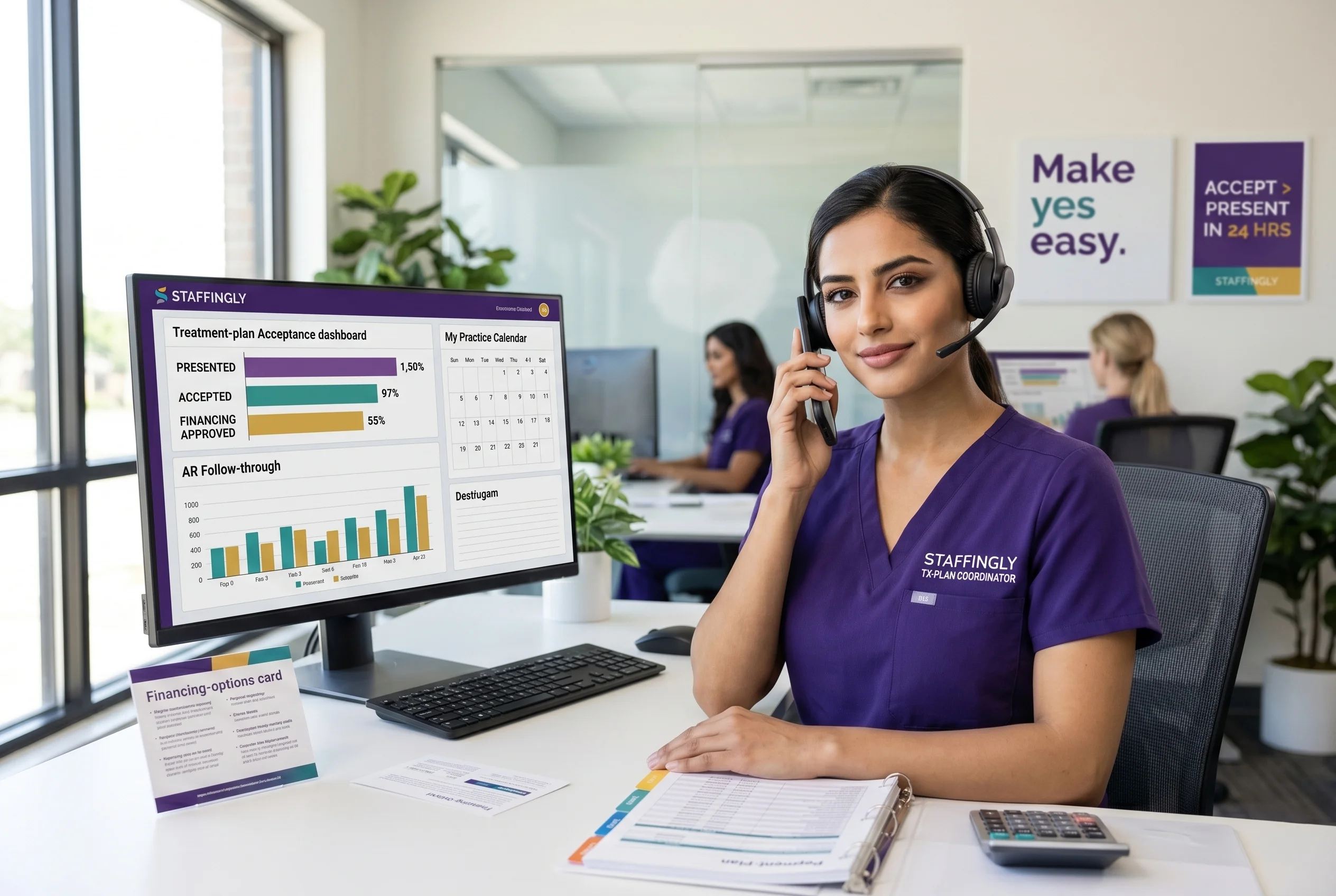
Inside the workA trained Staffingly specialist handles the workflow inside your existing dental software, with clear escalation back to your team.
How Is Staffingly’s Dental PA Appeal Service Different?
Most outsourcers send one template appeal and report the outcome. Ours run a multi-tier playbook per payer with narrative authoring and appeal-window discipline. Four things that change the outcome.
Payer-specific multi-tier playbooks
Each major payer has its own playbook covering first-level, second-level, and external review. We escalate through the tiers in order, with the right documentation set at each tier.
Narrative authoring per denial reason
Every appeal gets a written narrative authored by a CDT-trained specialist. Sleep AHI documentation, TMJ conservative-therapy-first history, orthognathic functional necessity, implant bone-loss measurements. Payer-specific phrasing per case.
Appeal-window discipline
Every denial logged with its appeal window. Documentation pull starts the same week. Appeal ships with buffer remaining. No appeal arrives late on procedural grounds.
2-Week Free Trial
Industry standard is zero risk-free trial. We give you 14 days at the same rate. Cancel before day 14 and owe nothing. No annual contracts after, ever. Scale up or down by the week.
How Does the Dental PA Appeals Process Work?
Six steps from strategy call to live appeal management. The first appeal batch typically ships within week two.
Strategy call (15 min)
We pull your last 90 days of PA denials and identify the top denial reasons by payer. No prep needed from you.
BAA + PMS access
Signed BAA. Role-based PMS access provisioned. Clearinghouse and payer portal credentials confirmed. Denial-tracking log set up.
Payer appeal playbook loaded
Top 10 payers’ appeal procedures documented. Appeal windows, required documentation per tier, escalation paths, and proven narrative templates. Locked in writing.
Parallel appeals start
Week 2. Our team works your denied PA backlog. Daily 15-minute sync. Every denial gets documentation pull, narrative authoring, and appeal submission within the window. Every outcome posted to the PMS.
Decision point (day 14)
Pilot results reviewed: appeals shipped, overturn rate trend, recovered case value. Go or no-go. No penalty.
Full handoff
Weekly overturn-rate dashboard. Monthly QA audit. Quarterly playbook refresh as payers update policy. Add or remove specialists by the week.
Where Can You Get Dental PA Appeals Services?
Our team works remotely inside your dental PMS and the payer portals. Wherever your practice is located, you get the same CDT-trained appeals specialists running the same payer playbook.
One Flat Weekly Rate. No Surprises.
Dedicated virtual dental assistants at a fixed weekly cost. 45 hours per week, fully managed. No contracts, no minimums, no hidden fees.
Want to compare against an in-house hire? Use the savings calculator.
Frequently asked questions
What is a healthy dental PA appeal overturn rate?
Top-quartile dental practices overturn 60 to 75 percent of appealed PA denials. Most practices overturn 30 to 40 percent. The gap is payer-specific playbook depth, narrative quality, documentation completeness, and appeal-window discipline.
What appeal tiers do dental payers offer?
Most commercial dental payers offer first-level internal review, second-level internal review, and external Independent Review Organization (IRO) review for medically-necessary procedures. Medicaid plans add state fair hearing pathways. We escalate through the tiers in order.
What are the typical appeal windows for dental PA?
Commercial dental plans typically allow 60 to 180 days from the denial notice. Medicare DME MAC sleep oral appliance appeals follow CMS timelines. State Medicaid varies. We log every appeal window the day the denial is received.
What documentation does a dental PA appeal require?
Original PA submission, denial notice, full clinical narrative, radiographs (periapical, panoramic, or CBCT), photos where applicable, perio chart for periodontal procedures, AHI report for sleep, cephalometric and model studies for orthognathic, and documentation of conservative therapy where required (TMJ, periodontal). Requirements vary by payer and code.
Do you handle medical-cross PA appeals?
Yes. Sleep apnea oral appliance appeals (HCPCS E0485, E0486, K1027 with ICD-10 G47.33). TMJ appeals (M26.6x with conservative-therapy-first documentation). Orthognathic surgery appeals (CPT 21193 through 21199 with functional necessity documentation). Modifiers KX, GA, GZ applied per LCD.
How fast can your team start working our denial backlog?
Onboarding takes 5 to 7 business days for most PMS systems. First appeal batch typically ships in week two. We work both the new denials coming in and any backlog past appeal window where re-opening is still possible.
How does pricing work?
Flat per-specialist weekly rate. $399 single specialist, $349 at volume (5 or more), $299 enterprise (10 or more). 2-week free trial at the same rate. No per-appeal fees. No percentage-of-overturns fees.
How are your specialists trained, and where do they work from?
Specialists are selected from top-tier healthcare and dental programs, pass rigorous neutral-accent English certifications, and work from biometric-secured HIPAA-aware facilities. Teams are trained specifically for dental prior authorization workflows. Support teams operate globally, including secured facilities.

President and CEO, Staffingly, Inc. 25+ years in IT consulting and healthcare BPO operations. One of the earliest US operators to set up an RPO/BPO delivery network in India. Leads AI-driven healthcare workflows that help dental practices and DSOs cut admin costs without compromising care.

Senior Process Associate, Staffingly, Inc. BDS from Sri Sai College of Dental Surgery, Telangana. Hands-on experience in dental front-office operations, medical billing, EHR workflows, and US specialty practice administration. Former Dental Health Facilitator at FMS Dental Hospitals and Senior Medical Billing Specialist supporting US dental practices. Reviews dental content for terminology, workflow accuracy, and compliance fit.
Security Your Compliance Officer Will Sign Off On
Staffingly is audited to SOC 2 Type II with zero exceptions and certified for ISO/IEC 27001:2022, HIPAA, and GDPR. In eight years we have never had a breach. Every workstation runs inside the Venn Blue Border secure enclave on US-based servers, screen captures and downloads are blocked by policy, and every engagement operates under a signed BAA, and Staffingly maintains $5M in professional liability (E&O) and cyber insurance as part of its enterprise risk-management program.