
Where Do You Find Top-Rated Opus EHR Virtual Support Services?
Dedicated HIPAA-trained teams work inside your own Opus EHR, covering admissions and CRM intake, eligibility and verification of benefits, utilization review administration, claims and billing, outcomes assessment admin, and reporting for SUD and behavioral health organizations. Flat weekly pricing from $299 per FTE (volume based), with a trained backup included at no charge. Live in 14 days.





What Is Opus EHR?
Opus is a cloud EHR built for substance use disorder and behavioral health organizations, from small outpatient teams to agencies with 36 or more clinicians. It folds three systems that usually live apart into one platform: a CRM for admissions and referral management, the clinical EHR with a large library of customizable assessments, and an RCM engine with 837 electronic claim filing, batch claims across locations, and real-time eligibility checks. Around that core sit telehealth, ePrescribing, a lab module, an Outcomes Assessment patient engagement tool, and Copilot AI, Opus’s documentation assistant for clinicians.
The pattern we see in Opus agencies is that the platform consolidates the software but not the staffing. The admissions pipeline, the eligibility queue, the utilization review calendar, the claim follow-up list, and the outcomes assessment chase all still need daily human attention, and in most SUD and behavioral health agencies those hours come out of clinical or leadership time. That is the gap this service closes.
The Work Your Team Does in Opus, We Staff
Who Is This For?
SUD and behavioral health organizations that run on Opus and are losing clinical or leadership hours to administration: addiction treatment centers, outpatient behavioral health agencies, mental health treatment programs, and growing groups moving from a handful of clinicians to multiple locations. It fits a small team that needs one trained Opus specialist as well as an agency that needs an admissions desk plus a dedicated billing pod.
Where Opus Agencies Lose Time and Money
A standard eligibility check says active coverage, then the claim routes to a behavioral health carve-out administrator nobody identified before treatment started.
See the fixSession limits, plan rules, and payer edits produce denials on patients whose eligibility looked clean. Each one takes phone time your team does not have.
See the fixAgencies billing Medicaid face state-specific code sets, modifiers, and documentation rules. What worked in one state’s program produces denials in the next.
See the fixBehavioral health no-show rates run roughly twice those of general medicine, and each empty slot is unrecoverable clinician time. Confirmation and waitlist work is the fix, but someone has to do it daily.
See the fixAdmissions and CRM Intake
Opus’s built-in CRM carries referrals from first contact to admission, and our team keeps that pipeline moving: logging inquiries, following up with referents and families, collecting demographics and insurance ahead of intake, and preparing admission records so clinical staff start with a complete chart. In SUD and behavioral health, the inquiry that waits a day is usually gone; a dedicated owner on the pipeline is how same-day follow-up becomes the norm.
Eligibility and Verification of Benefits
Opus supports real-time eligibility checks, and we run them plus the part software cannot do: calling payers to confirm behavioral health benefits, identifying carve-out administrators before session one, verifying level-of-care coverage and pre-certification requirements for SUD programs, and documenting out-of-network detail. The quiet failure mode in this specialty is the eligibility response that looks clean but hides a session limit; our checklist exists to catch it.
Scheduling and Caseload Admin
We manage appointment scheduling in Opus across clinicians and locations: booking and rescheduling, confirmation calls and reminders, working cancellations against the waitlist, and keeping recurring session series intact. Because behavioral health no-show rates run about double the medical average, daily confirmation work is one of the highest-return admin tasks an agency can staff.
Utilization Review Administration
Opus includes utilization review tooling, and the clinical case for medical necessity belongs to your clinicians. What we staff is the administration around it: maintaining the review calendar by payer, assembling records ahead of each initial and concurrent review, logging authorization numbers, approved units, and expiration dates, and flagging anything close to a deadline. Programs running IOP levels of care know how unforgiving concurrent review clocks are; a named owner on the calendar is the fix.
Claims and Billing
Can you outsource Opus billing? Yes. Dedicated billers work end to end inside your system: charge review, 837 electronic claim filing including batch submission across locations, rejection work, EOB support and reconciliation, denial follow-up and appeals support, AR aging, and patient statements. SUD and behavioral health claims carry their own failure modes, from denials on active coverage to state-by-state Medicaid rules, and our billers work those specifics daily.
Outcomes Assessment Admin
Opus’s Outcomes Assessment tool engages patients between sessions, but assessments only produce data when patients complete them. We run the follow-up side: assigning assessments on your program’s schedule, chasing incomplete ones by phone and portal message, logging completion status, and making sure scores are in the chart before the session that needs them. Interpretation of results stays with your clinicians.
Documentation Status Admin
Opus gives clinicians Copilot AI and a deep assessment library for writing documentation; that tooling, and the writing itself, belongs to your clinical team. We do not write clinical documentation. Our work is the administration around it: tracking unsigned and overdue notes, watching treatment plan review dates, chasing expiring consents, preparing chart audit checklists your supervisors define, and keeping documentation status reports clean. The boundary is written into the SOW.
Reporting and Agency Admin
We run Opus reporting on a fixed calendar: unbilled sessions, claim status and AR aging by payer, authorization utilization, caseload and productivity views, and admissions pipeline summaries. Someone on our team owns that calendar, so a clinician whose sessions quietly stopped generating charges gets caught in week two, not at quarter close.
Put a Dedicated Opus Team on This Work
You have seen what we cover, from the admissions pipeline to the AR report. The next step is simple: meet us, pick the seats you need, and watch a trained team work your own Opus queues before you commit to anything.
Book Your 2-Week Free TrialHow Our Teams Train and Go Live on Opus
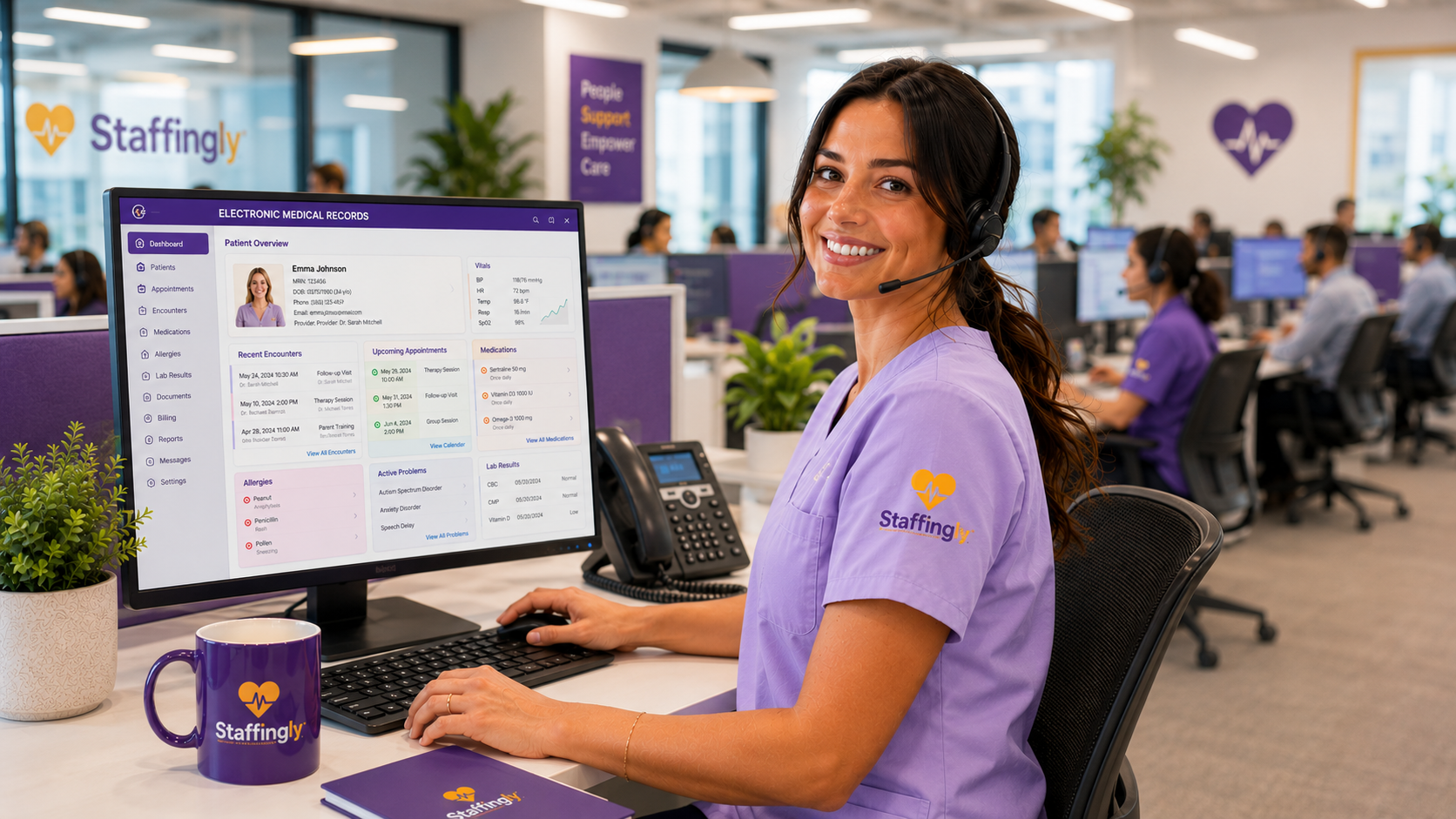
Before anyone touches your production system, your team trains on your own SOPs plus Opus’s published workflows for intake, scheduling, billing, and assessments, then works supervised alongside a senior team lead through go-live. Every account starts with a written runbook for your agency: which queues get worked at what time, what gets escalated, and what gets reported back each evening. A trained backup shadows the account from day one at no charge, so coverage does not hinge on a single person. Every specialist works under an individual HIPAA agreement with named, auditable Opus credentials, never shared logins.
Why Outsource Opus Work, and Why Staffingly
Opus consolidates CRM, EHR, and RCM into one platform; we staff across that same surface, admissions through reporting, so work stops falling between a billing vendor, a front desk, and whoever had a free hour.
Behavioral health billing services usually charge a percentage of collections, so their fee grows with your census. Ours is a flat weekly fee per dedicated specialist, and every efficiency gain accrues to you.
We publish our work in this specialty: a behavioral health eligibility case study, a behavioral health RCM case study, and a library of behavioral health billing answers linked across this page.
Live in 14 days. 2-Week Free Trial. Replace any team member in 48 hours. 800+ providers served, 4.9 Google rating you can verify on our listing.
Organizations We Support on Opus
Addiction treatment centers (VOB speed and level-of-care billing), outpatient behavioral health agencies (scheduling volume and eligibility discipline), mental health treatment programs (assessment follow-up and documentation status admin), Medicaid-heavy agencies (state-specific billing rules worked daily), and growing groups scaling from a few clinicians to multiple locations, where batch claims and consistent admin coverage start to matter.
Process and Onboarding
20 to 30 minutes on Teams. We map your Opus queues, programs, and payer mix before we meet.
Named Opus user accounts per specialist, role-based permissions, your approval on every account.
Your SOPs and consent procedures plus Opus’s published guides; supervised production from day one.
Daily production reports, weekly KPI review, month-to-month after your 2-Week Free Trial.
Security and Compliance
HIPAA-trained staff. Business Associate Agreements executed with every client. Workflows designed to support HIPAA compliance, with SOC 2 Type II attestation, ISO 27001:2022, $5M E&O and cyber liability coverage, and named individual credentials with full audit logs, so you can review our activity in your own system. For SUD records, staff additionally train on the confidentiality discipline that 42 CFR Part 2 requires and follow your program’s consent and disclosure procedures. Read the complete program at HIPAA and Security at Staffingly.
Flat Weekly Pricing Per Dedicated Specialist
1 to 4 dedicated Opus FTEs.
5 to 9 FTEs.
10+ FTEs.
45 hours of coverage for less than others charge for 40.
$399 per week works out to $8.87 per hour across 2,340 hours of coverage a year, flat. Your dedicated specialist covers a 9 hour day, Monday to Friday, a full hour more than a standard shift: the day starts by clearing what arrived after you closed, overnight referrals, eligibility requests, and payer correspondence, and it ends past your close so far less rolls into tomorrow. A trained backup steps in at no charge whenever they are out. Flat weekly fee per dedicated specialist, never a percentage of your collections, no setup fees.
Start with a 2-Week Free Trial. Month-to-month after, with no long-term contract.
- Salary + payroll taxes + benefits
- Recruiting + turnover replacement
- Training on behavioral health billing + your EHR
- EHR seat + equipment + PTO coverage
Calculate Savings
Opus EHR Outsourcing: Frequently Asked Questions
What tasks can a virtual team do in Opus EHR?
Admissions and CRM intake follow-up, eligibility and verification of benefits, scheduling and confirmations, utilization review administration, claim filing and follow-up, EOB reconciliation, outcomes assessment chasing, documentation status tracking, and reporting. Anything administrative that happens inside Opus screens, a trained remote specialist can own.
Can you outsource Opus billing?
Yes. Dedicated billers work inside your Opus: charge review, 837 electronic claims including batch submission across locations, rejections, denial follow-up and appeals support, EOB reconciliation, AR, and statements, with daily production reporting.
Do your staff use Copilot AI or write notes?
No. Copilot AI is a documentation tool for your clinicians, and clinical documentation stays with your clinical team. Our work is the administration around documentation: unsigned note tracking, treatment plan review dates, consent chasing, and audit prep checklists your supervisors define.
How do you handle 42 CFR Part 2 confidentiality?
Our staff work under executed BAAs and train on the heightened confidentiality discipline SUD records require, and they follow your program’s own consent and disclosure procedures. Your policies govern; we work inside them and can review specifics with your compliance officer on the strategy call.
How do your staff access our Opus system?
Through named individual user accounts you approve, with role-based permissions and full audit logging. No shared logins, no offline exports of PHI, and you can review our activity in your own system.
How fast can a dedicated Opus team start?
Most teams go live in about 14 days: access setup, workflow training on your SOPs and consent procedures, then supervised production. The engagement starts with a 2-Week Free Trial.
Which organizations does this fit?
Opus-based settings: addiction treatment centers, outpatient behavioral health agencies, mental health treatment programs, Medicaid-heavy agencies, and growing multi-location groups.
Do we keep control of our Opus?
Yes. It stays your system, your data, your logins to grant or revoke. We work inside it and report daily; you can review our activity in your own system.
Behavioral Health Billing Resources From Our Library
Published work from the teams that do this daily.

Written By
Dan Nandan has spent 25+ years in IT consulting and healthcare BPO, was among the first in the US to build an RPO/BPO delivery network overseas, and has been featured in Computerworld. He runs the operations and the dedicated virtual teams behind the behavioral health workflows described on this page.
Connect on LinkedIn
See what a dedicated Opus team changes in 14 days.
Book a strategy meeting. Dan Nandan, CEO, joins most calls personally. Real conversation, real numbers for your agency.
Claim Your 2-Week Free TrialOpus is a trademark of Opus Behavioral Health, Inc. Staffingly, Inc. is an independent outsourcing company and is not affiliated with or endorsed by Opus Behavioral Health. Staffingly works inside client-owned Opus systems under client-granted access.