





Article author and evidence

Dr. Kainat Amjad, MBBS
Dr. Kainat Amjad is a medical doctor and practice growth strategist who writes about healthcare operations, patient-facing workflows, administrative burden, and practical technology adoption. Her work focuses on helping providers improve the business side of care without weakening accountability, privacy, or the patient experience.
What Should Practices Know Before Patients Ask About WHOOP and Medicare?
Eligibility is narrow
Only Original Medicare Parts A and B beneficiaries with a qualifying cardio-kidney-metabolic condition qualify. Medicare Advantage enrollees do not.
Care continuity stays, with an addition
Patients keep their existing doctor. WHOOP Physician Services adds a separate clinical oversight and coaching relationship alongside it.
Billing guidance is not yet confirmed
CMS has not published program-specific billing guidance. Watch for overlap with any existing remote monitoring or chronic care management billing.
Engagement is not the same as outcomes
Physicians reviewing the launch caution that clinical improvement is more likely driven by medication management than by the wearable alone.
WHOOP Connected Care Launched August 12, 2026
WHOOP announced the launch of Connected Care through its affiliated entity, WHOOP Physician Services, P.C., which was selected into the first cohort of CMS Innovation Center’s ACCESS model in April 2026. The program launched across an initial group of states, with a phased nationwide rollout planned within the month.
A patient on Original Medicare walks into an appointment wearing a WHOOP wristband and mentions she got it free through her Medicare plan. If that sounds unlikely, it is already happening. On August 12, 2026, WHOOP launched WHOOP Connected Care, a program that gives eligible Medicare beneficiaries a wearable device, a blood pressure cuff, and twelve months of platform access at no out-of-pocket cost.
For a consumer, this looks like a straightforward benefit. For a practice, it raises a different set of questions: who actually qualifies, what data is being collected and by whom, and whether this changes anything about how a physician bills, documents, or coordinates care for a patient enrolled in the program. This article walks through what the program actually is, how it fits into the Medicare structure, and what practices should think through before patients start bringing it up at the front desk or in the exam room.
What Is WHOOP Connected Care, in Plain Terms?
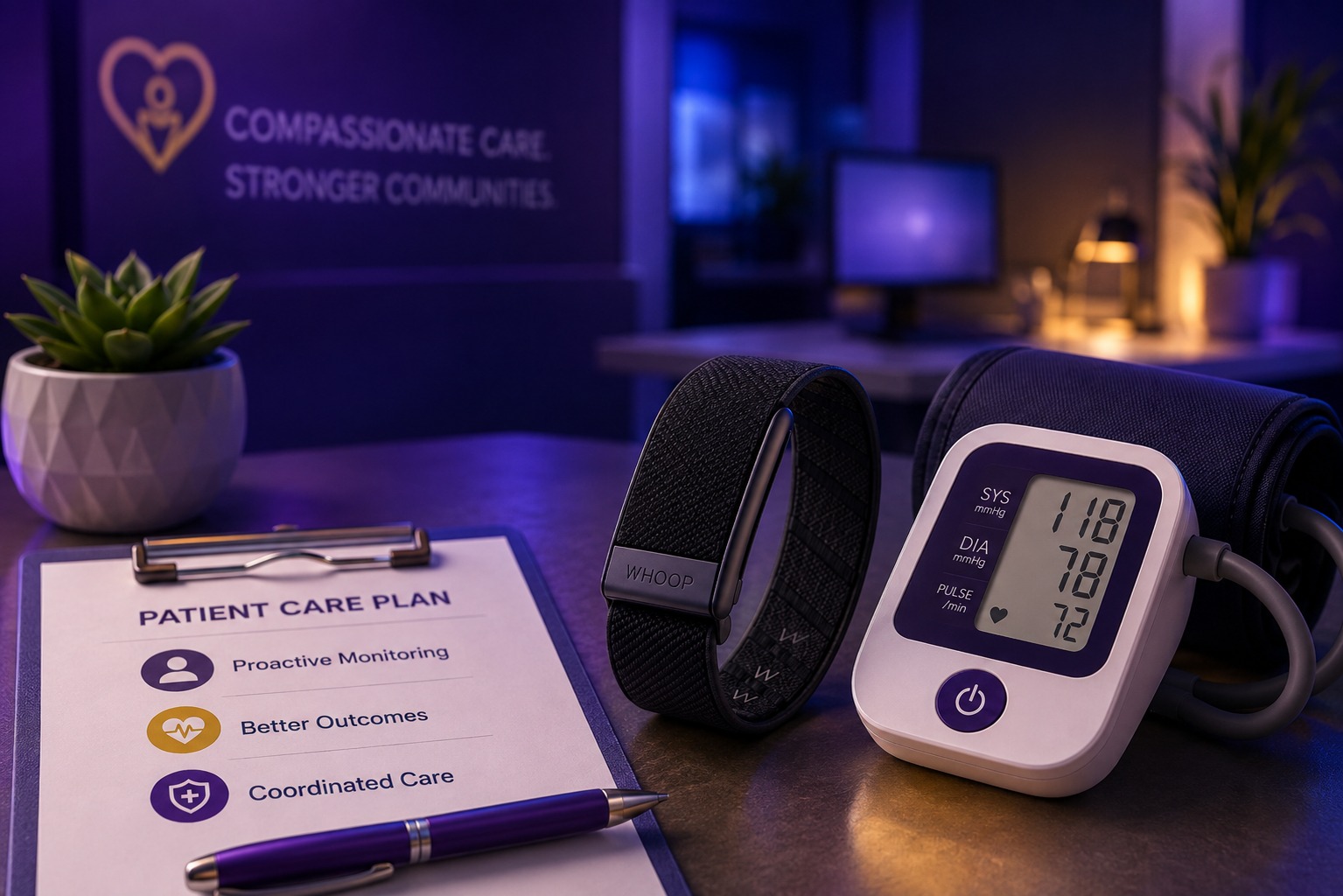
WHOOP makes a wrist-worn device that tracks physiological signals such as heart rate, sleep patterns, and recovery metrics. It does not diagnose conditions and it does not adjust or control blood pressure or any other vital sign. It measures and reports.
Connected Care pairs the wristband with a home blood pressure cuff, which also only measures. Together, the two devices generate a stream of data that is reviewed by a care team affiliated with WHOOP, not by the patient’s existing physician. Patients keep their current primary care doctor. The program is designed to sit alongside standard care, not replace it.
The distinction matters because patients may describe this as “Medicare giving me a device to manage my blood pressure.” It is closer to a monitoring add-on layered onto their existing treatment plan, with a separate clinical team watching for trends between visits.
How Did a Consumer Wearable Company Become a Medicare Provider?
WHOOP itself is not a Medicare-enrolled entity. Medicare requires that clinical services be delivered through a licensed, physician-led organization, so WHOOP created an affiliated entity, WHOOP Physician Services, P.C., to participate. A Professional Corporation structure like this is common when a non-clinical company wants to offer a service that involves clinical oversight. The corporation is controlled by licensed physicians, with Dr. Dan Henderson listed as Medical Director, and it is that entity, not WHOOP the consumer brand, that is enrolled with Medicare.
This entity was selected in April 2026 for the Centers for Medicare & Medicaid Services Innovation Center’s ACCESS model, under a track focused on early cardiometabolic risk. ACCESS stands for Advancing Chronic Care with Effective, Scalable Solutions, and it is a pilot program designed to test whether continuous, technology-driven monitoring can improve outcomes and lower costs for patients managing chronic conditions.
What changes for the patient
- A second clinical entity now monitors data related to a chronic condition.
- The patient receives coaching and outreach from WHOOP Physician Services’ care team.
- Device and platform access are free for twelve months.
What stays the same
- The patient keeps their existing primary care physician.
- Original Medicare coverage and benefits are unaffected.
- No change to the patient’s other treatments or medications is required to enroll.
For practices, the structural detail worth noting is not really about WHOOP specifically. It is a preview of a pattern. As CMS continues to test value-based, technology-enabled care models, more consumer health tech companies are likely to form physician-led entities to gain a reimbursed pathway into Medicare. Practices that understand how this works now will have an easier time evaluating the next version of it.
Who Actually Qualifies for the Program?
Eligibility is narrower than headlines suggest.
| Requirement | Qualifies | Does Not Qualify |
|---|---|---|
| Medicare enrollment type | Original Medicare, Parts A and B | Medicare Advantage plans |
| Clinical risk factor | At least one cardio-kidney-metabolic condition, such as hypertension, pre-diabetes, or high cholesterol | No documented cardiometabolic risk factor |
| Cost to patient | Zero cost-sharing for a 12-month membership and blood pressure cuff | N/A, no premium, copay, or deductible applies to eligible enrollees |
The program is limited to beneficiaries with Original Medicare, Parts A and B. Patients enrolled in Medicare Advantage plans do not qualify. This is a distinction that will trip people up, since many Medicare beneficiaries do not know or remember which type of Medicare they have. Beyond enrollment type, a patient needs at least one qualifying cardio-kidney-metabolic risk factor or condition. The program is not open to any Medicare beneficiary who wants a free wearable.
Patients who meet both criteria and enroll receive a twelve-month WHOOP membership and the blood pressure cuff with zero cost-sharing. WHOOP Physician Services covers that cost directly, which is part of what is generating attention.
Why Will This Show Up in Your Waiting Room Before It Shows Up in Guidance?
Medicare program rollouts are usually slow and quiet. This one is not, because WHOOP has an established consumer brand and marketing muscle that most CMS pilot participants do not. Coverage has already appeared on national business television, health and lifestyle outlets, and social platforms including LinkedIn, where physicians are already discussing it publicly.
That combination, a consumer-facing brand plus a genuinely reimbursed Medicare offering, means practices should expect patient questions well before there is detailed clinical or billing guidance available. Front desk staff, schedulers, and physicians are likely to hear some version of “can I get this” long before there is a standardized answer from CMS about how these programs interact with a beneficiary’s existing chronic care management.
What Does This Mean for Primary Care and Specialty Practices?
Care continuity, plus a new relationship
Patients are not required to switch primary care physicians, but a second clinical entity is now monitoring data related to the same condition. Have a clear stance on how to respond when WHOOP’s guidance overlaps or conflicts with the practice’s own recommendations.
Continuous data in short visits
A fifteen-minute appointment was never designed to accommodate a full year of nightly sleep data and daily strain scores. Decide in advance how staff will handle these conversations, including what gets documented.
Someone needs to own the workflow
Without a clear internal answer, this becomes an inconsistent, ad hoc decision made differently by every clinician on staff. A short, shared protocol prevents that.
What Should Practices Watch on Documentation and Billing?
This is a newly launched pilot program, and CMS has not published detailed billing guidance specific to WHOOP Connected Care as of this writing. Practices should treat anything beyond the confirmed program structure as unverified until CMS or WHOOP Physician Services issues formal documentation.
Check for billing overlap
A practice’s own remote patient monitoring or chronic care management billing is unrelated to WHOOP Physician Services’ relationship with the patient. Confirm there is no overlap or duplication, since duplicate billing for the same monitoring activity by two separate entities draws payer scrutiny.
Verify eligibility accurately
Because the program only applies to Original Medicare, not Medicare Advantage, confirm a patient’s coverage type before a scheduling or clinical conversation goes further.
Document what actually happened
If a physician reviews WHOOP-generated data as part of clinical decision-making, document it the same way any other patient-reported or external data would be documented. If the physician does not review it, that should be clear too.
What Does This Signal About Where Medicare Reimbursement Is Headed?
WHOOP is the most visible participant in the ACCESS model, but it will not be the last consumer health technology company to pursue this path. CMS wants evidence that continuous monitoring, paired with coaching and clinical oversight, can reduce downstream costs for chronic cardiometabolic conditions. If the pilot produces favorable results, more companies will likely attempt the same structure: a physician-led entity, a defined chronic-risk population, and a device-plus-coaching model funded through a value-based pathway rather than a traditional fee-for-service code.
For practices, that trend matters more than the specifics of any single company’s program. Patients will increasingly arrive with monitoring relationships that exist entirely outside the practice’s own systems, generated by vendors the practice did not select and cannot directly verify. Practices that build a consistent internal answer for how external monitoring data is handled will adapt to this shift more easily than those who leave it to be decided differently in every exam room.
Is the Clinical Skepticism Around This Launch Worth Taking Seriously?
Not every physician reaction to this launch has been celebratory, and the more cautious responses are worth paying attention to, because they raise exactly the kind of questions a practice should be asking before treating this program as a settled clinical benefit.
The most substantive pushback centers on a distinction between engagement and outcomes. Early adoption numbers for WHOOP among older users have been strong, but several physicians reviewing the announcement pointed out that people who already choose to buy and wear a WHOOP device are not representative of the broader Medicare population enrolling in ACCESS. A chronically ill beneficiary managing multiple medications, lower digital familiarity, and real daily friction is a different patient than a self-selected wearable enthusiast.
There is also a simpler operational question that has not been publicly answered: what happens after the twelve months of free coverage end. Nothing published so far addresses whether patients pay to continue afterward, what retention looks like, or whether a discontinued device changes the monitoring relationship a patient has come to expect. Practices should treat this as open rather than assume the free period is permanent.
What Should a Practice Ask Before a Patient Enrolls?
Is the patient actually eligible?
Confirm Original Medicare Parts A and B enrollment and the presence of a qualifying cardio-kidney-metabolic condition before assuming participation is possible.
What data comes back to the practice?
Clarify whether WHOOP Physician Services shares any information with the patient’s existing primary care team, and under what terms.
Who is responsible if the data flags a problem?
Establish in advance whether the practice has any expectation to act on WHOOP-flagged concerns or whether that sits entirely with WHOOP Physician Services.
How will staff document related conversations?
Decide whether and how references to the program get noted in the chart, consistent with how the practice handles other external monitoring tools patients bring up.
Does this affect existing billing?
Review current remote monitoring or chronic care management billing for overlap before assuming the two programs operate independently.
What happens when the twelve free months end?
No public guidance addresses retention, cost responsibility, or continuity after the free period, so treat continued participation as an open question.
What Mistakes Should Practices Avoid With This Program?
Assuming the device treats anything
It does not. It measures. Staff communication describing this program should reflect that.
Assuming Medicare Advantage patients qualify
They do not. This distinction is likely to generate the most confusion at the point of first contact.
Treating this as full clinical integration
WHOOP Physician Services operates its own care team. It is not an extension of the practice’s own infrastructure unless a formal arrangement says otherwise.
Ignoring it entirely
Even practices with no direct involvement will have patients enrolled in it. A basic internal answer is worth having regardless of active role.
What Are Healthcare Providers Saying About WHOOP Connected Care?
Physician reaction to the launch has not been uniformly positive. The more substantive discussion, visible in public commentary from physicians reviewing the announcement, raises exactly the kind of operational and clinical questions a practice should weigh before treating this as a settled benefit.
Does strong WHOOP engagement among older adults mean the program will improve clinical outcomes for Medicare patients?
Physicians reviewing the launch have cautioned against assuming so. In a Medicare population managing hypertension or metabolic risk, meaningful movement in blood pressure or A1c is far more likely to come from medication management, dose adjustments, and coordinated care than from a wearable device alone. A device can reflect behavior; it does not prescribe, titrate, or manage a condition. The more defensible position is to wait for evidence that the data changes what a care team actually does, not simply that patients are looking at it.
Should reported daily engagement rates among existing WHOOP users be treated as representative of the broader ACCESS population?
Several physicians pointed out a selection-bias concern: people who already choose to buy and wear a WHOOP device are not the same as a chronically ill Medicare beneficiary managing multiple medications and lower digital familiarity. High engagement among self-selected wearable enthusiasts does not automatically predict the same engagement once the device reaches a broader, involuntary population enrolling through a CMS pilot.
Is this primarily a clinical breakthrough or a reimbursement and access development?
Providers with reimbursement and prior-authorization backgrounds framed the announcement mainly as an access and payment-model milestone, expanding a technology-enabled care pathway to a Medicare population, rather than as clinical validation of the device itself. That framing matters for practices deciding how much weight to give the launch when patients ask about it.
What happens once a patient’s twelve months of free WHOOP access end?
This was raised directly in provider discussion of the launch and has not been publicly answered. Nothing published so far addresses whether patients pay to continue afterward, what retention looks like, or whether a discontinued device changes the monitoring relationship a patient has come to expect. Practices should treat this as an open question rather than assume the free period is permanent.
What Are Practices Asking About WHOOP and Medicare?
Does WHOOP Connected Care control or treat blood pressure?
No. The wristband and the accompanying blood pressure cuff only measure and report data. Neither device adjusts or treats any condition.
Do all Medicare beneficiaries qualify for the free WHOOP device?
No. Only beneficiaries with Original Medicare Parts A and B who have at least one qualifying cardio-kidney-metabolic risk factor or condition, such as hypertension, pre-diabetes, or high cholesterol, are eligible. Medicare Advantage enrollees do not qualify.
Does a patient need to switch doctors to participate?
No. WHOOP Physician Services provides its own clinical oversight and coaching alongside the patient’s existing primary care relationship. Patients keep their current doctor.
Does this program change how a practice bills for a patient’s care?
Not automatically. WHOOP Physician Services’ billing relationship with CMS is separate from a practice’s own billing. Practices should confirm there is no overlap if they already bill for remote monitoring or chronic care management on the same patient.
Is there official CMS billing guidance specific to this program yet?
Not as of this writing. Practices should rely on confirmed CMS Innovation Center guidance rather than early third-party claims about specific codes or reimbursement mechanics.
Should a practice actively encourage eligible patients to enroll?
That is a clinical and practice-level decision. At minimum, practices should be prepared to accurately answer patient questions about eligibility and to clarify what the program does and does not involve.
Does wearing a WHOOP device actually improve a patient’s blood pressure or blood sugar?
There is no published evidence yet that the device itself drives clinical improvement in a Medicare population. Meaningful change in blood pressure or A1c is more likely to come from medication management and coordinated care. The device reflects behavior; it does not treat a condition.
What happens after the free twelve-month period ends?
This has not been publicly addressed. Practices should not assume the free access continues indefinitely or that patient engagement with the program will look the same after the first year.
Which Sources Support This WHOOP and Medicare Guide?
Need Help Fielding Patient Questions About Programs Like This?
None of this requires a practice to change its clinical approach. It does require accurate, fast answers at the point of patient contact, confirming coverage type, answering routine eligibility questions, and keeping documentation consistent when a new external program touches an existing patient population.