
Pediatric Sedation Specialty Billing Services
AAPD-aligned billing operations for pediatric sedation specialty practices. D9230 nitrous oxide, D9243 IV moderate sedation, D9248 non-IV conscious sedation. Behavioral assessment documentation. ASA classification review. Sedation pre-auth windows (most payers require pre-auth). State-specific Medicaid pediatric sedation rules. Hospital-based pediatric sedation billing different from in-office (CPT 99151-99157). Live in 1 to 2 weeks.

Trained dental support, inside your software
Healthcare-trained specialists under HIPAA-aware workflows.
A managed dental support team, built around your practice
Pediatric sedation billing requires three things most general dental billers do not know cold: AAPD behavioral assessment documentation, ASA physical status classification, and the state-specific Medicaid rules that gate sedation coverage for children. Plus the in-office versus hospital-based distinction that routes some cases to CPT codes instead of CDT.
Tell us about your practice.
Send us your situation and our team will scope the right setup, usually within one business day. No obligation.
What You Need to Know About Pediatric Sedation Specialty Billing
AAPD-aligned documentation
AAPD guidelines for behavioral assessment, pre-sedation evaluation, intra-sedation monitoring, and post-sedation recovery. Documentation drives PA approval and audit defensibility. Skipping behavioral assessment denies PA on many payers.
D9230, D9243, D9248 plus CPT 99151-99157
D9230 nitrous oxide, D9243 IV moderate sedation, D9248 non-IV conscious sedation for in-office cases. CPT 99151-99157 moderate sedation by same provider for hospital-based cases. Different code sets, different payers.
ASA classification review
ASA Physical Status I to ASA V. Most pediatric sedation cases run ASA I or ASA II. Higher ASA classifications may require hospital-based sedation. Misclassification at PA risks audit recoupment.
HIPAA + SOC 2
HIPAA, SOC 2 Type II, ISO 27001, alignment. Signed BAA. Role-based PMS access. Audit logging. PHI never leaves the controlled environment.
Why is pediatric sedation billing so hard to run in-house?
Pediatric sedation practices schedule cases days or weeks in advance and cannot afford last-minute PA denials. Three patterns destroy schedule and parent trust.
Sedation PA window missed
Most payers require pre-auth for D9243 IV moderate sedation and D9248 non-IV conscious sedation. PA windows typically run 7 to 14 days. When PA is started day-of or week-of, the case gets canceled the morning of the visit. Parent loses trust.
Behavioral assessment documentation missing
AAPD-aligned behavioral assessment (Frankl Behavior Rating Scale or equivalent) is required for many PA submissions. The chair-side team captures it. The biller does not pull it for the PA. Denial.
State-specific Medicaid sedation rules vary widely
State Medicaid pediatric sedation coverage varies by age, by ASA classification, by procedure being supported, and by site of service. The biller who knows the California rule does not automatically know the Texas rule. Each state requires a separate playbook.
How Staffingly works, in practice
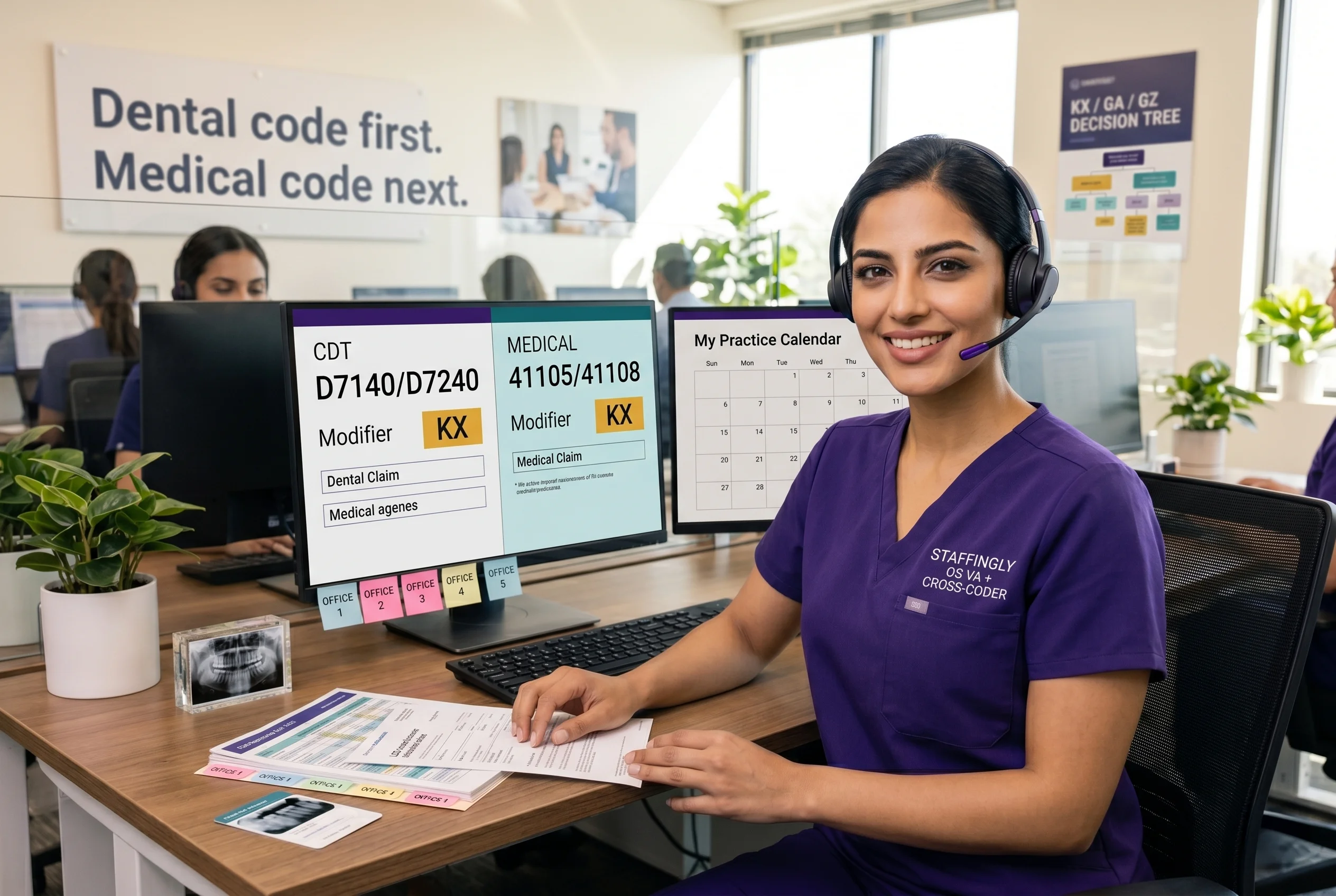
Inside the workA trained Staffingly specialist handles the workflow inside your existing dental software, with clear escalation back to your team.
How Is Staffingly’s Pediatric Sedation Billing Different?
Most outsourcers send a generic pediatric dental biller. Ours run an AAPD-aligned sedation playbook with state-specific Medicaid depth.
AAPD-aligned sedation operations
Sedation billers pre-trained on AAPD behavioral assessment guidelines, ASA Physical Status classification, sedation PA requirements per top payer, and state-specific Medicaid pediatric sedation rules before placement.
Dedicated account manager
One named contact for your practice. Weekly review, monthly KPI rollup, quarterly tuning. Not a ticket queue.
Transparent flat pricing
$399 per specialist per week single, $349 at volume, $299 enterprise. No percentage-of-collections games. No surprise fees.
2-Week Free Trial
Live work for 14 days at the same rate. Cancel before day 14, owe nothing. No annual contracts after.
How fast can your pediatric sedation billing go live? 14 days.
Three steps from first call to first cleared sedation PA. Decision point at day 14.
Days 1-3: Strategy, BAA, PMS access
15-minute strategy call to map your case mix between in-office and hospital-based sedation. Signed BAA. PMS access plus medical clearinghouse access when hospital cases are in scope.
Days 4-10: AAPD playbook + state Medicaid mapping
AAPD behavioral assessment documentation template locked. ASA classification workflow confirmed. State Medicaid sedation rules mapped per office location. Our team submits PAs alongside your in-office staff.
Days 11-14: Decision point + handoff
Pilot results reviewed: sedation PA approval rate, days to PA decision, case cancellation rate due to PA delay. Go or no-go. No penalty.
Where can you get pediatric sedation specialty billing services?
Our AAPD-aligned pediatric sedation billing team works remotely inside your dental PMS. Wherever your pediatric sedation practice is located, you get the same sedation-trained billers running the same AAPD documentation and state-specific Medicaid playbook.
One Flat Weekly Rate. No Surprises.
Dedicated virtual dental assistants at a fixed weekly cost. 45 hours per week, fully managed. No contracts, no minimums, no hidden fees.
Want to compare against an in-house hire? Use the savings calculator.
Frequently asked questions
Which CDT codes apply to pediatric sedation?
D9230 inhalation of nitrous oxide and oxygen, D9243 intravenous moderate sedation/analgesia, D9248 non-intravenous conscious sedation, D9222 deep sedation/general anesthesia first 15 minutes, D9223 deep sedation/general anesthesia each additional 15-minute increment. Plus D9420 hospital or ambulatory surgical center call when applicable.
When do pediatric sedation cases bill to CPT instead of CDT?
Hospital-based pediatric sedation cases (operating room or ambulatory surgical center) typically bill to medical insurance under CPT 99151-99157 moderate sedation by same provider. CPT 99155-99157 covers moderate sedation by a second provider. In-office cases bill to dental on D9230, D9243, or D9248.
What is AAPD behavioral assessment documentation?
AAPD guidelines call for documented behavioral assessment (often Frankl Behavior Rating Scale or equivalent) before sedation. The assessment supports medical necessity for sedation and is required by many payers for PA approval. Documentation includes patient cooperation level, prior dental experience, and parental reporting.
What ASA classification applies to pediatric sedation cases?
Most in-office pediatric sedation cases run ASA Physical Status I (healthy patient) or ASA II (mild systemic disease). Higher ASA classifications (III, IV, V) typically require hospital-based sedation by an anesthesiologist. Classification is documented at pre-sedation evaluation and reviewed at the PA stage.
How do state Medicaid programs handle pediatric sedation?
State Medicaid pediatric sedation coverage varies significantly. Some states cover D9230 nitrous only. Some cover IV moderate sedation. Some require pre-auth for all sedation. Age thresholds, ASA classification limits, and qualifying procedure lists differ by state. We track top state Medicaid programs per engagement.
How does sedation PA timing work?
Most commercial payers require pre-auth 7 to 14 days before the sedation appointment. Most state Medicaid programs require pre-auth in the same window. Some payers issue conditional approval contingent on documentation review on the day of service. Tracking the PA window prevents day-of cancellation.
How does pricing work?
Flat per-specialist weekly rate. $399 single specialist, $349 at volume (5 or more), $299 enterprise (10 or more). 2-week free trial at the same rate. No percentage-of-collections fees.
How are your pediatric sedation billers trained, and where do they work from?
Sedation billers are selected from top-tier healthcare and dental programs, pass rigorous neutral-accent English certifications, are tested on AAPD sedation guidelines, ASA classification, and state Medicaid pediatric sedation rules, and work from biometric-secured HIPAA-aware facilities. Support teams operate globally, including secured facilities.

President and CEO, Staffingly, Inc. 25+ years in IT consulting and healthcare BPO operations. One of the earliest US operators to set up an RPO/BPO delivery network in India. Leads AI-driven healthcare workflows that help dental practices and DSOs cut admin costs without compromising care.

Senior Process Associate, Staffingly, Inc. BDS from Sri Sai College of Dental Surgery, Telangana. Hands-on experience in dental front-office operations, medical billing, EHR workflows, and US specialty practice administration. Former Dental Health Facilitator at FMS Dental Hospitals and Senior Medical Billing Specialist supporting US dental practices. Reviews dental content for terminology, workflow accuracy, and compliance fit.
Security Your Compliance Officer Will Sign Off On
Staffingly is audited to SOC 2 Type II with zero exceptions and certified for ISO/IEC 27001:2022, HIPAA, and GDPR. In eight years we have never had a breach. Every workstation runs inside the Venn Blue Border secure enclave on US-based servers, screen captures and downloads are blocked by policy, and every engagement operates under a signed BAA, and Staffingly maintains $5M in professional liability (E&O) and cyber insurance as part of its enterprise risk-management program.