
Who Provides Remote ESO Support Services for EMS and Fire Agencies?
Dedicated HIPAA-trained specialists work inside your agency’s own ESO system: chasing incomplete ePCRs in ESO EHR, working claim queues in ESO Billing, calling payers on aging accounts, and keeping fire records current. Flat weekly pricing from $299 per FTE (volume based), with a trained backup included at no charge. Live in 14 days.





The Work Your Team Does in ESO, We Staff
What Is ESO?
ESO Solutions, Inc., usually shortened to ESO, is an Austin-based software company serving EMS agencies, fire departments, hospitals, and state EMS offices. Its best-known product is ESO EHR, the ePCR that ESO reports more than 10,000 agencies use to document patient care, with auto-generated narratives, a Full Patient Story view of past encounters, and documentation from a computer, tablet, or mobile device. Around the ePCR sits a wide product family: ESO Billing on the revenue side, joined by Logis Dispatch and Logis Billing after ESO acquired Logis Solutions in 2024, plus ESO Fire Incidents, Properties and Inspections, Fire Hydrants, Scheduling, Asset Management, Personnel Management, Health Data Exchange (HDE), Alerting, and built-in analytics. Emergency Reporting, the fire records platform, became part of ESO in July 2021.
That breadth is also the challenge. An agency running ESO has more queues than people: ePCRs waiting on signatures and narratives, billing work queues, payer calls, posting batches, open shifts, hydrant and inspection records, and NFIRS or NERIS incident reports all demand daily attention. When two office staff own that list next to a radio, the queues win. That is the gap this service closes.
Who Is This For?
Agencies that run on ESO and are losing office hours to it: 911 transport agencies, private and interfacility ambulance companies, fire-based EMS, hospital-based services, and county or municipal departments. It fits a single-station service that needs one trained ESO assistant as well as a multi-county operation that needs a billing desk plus a records pod.
Where ESO Agencies Lose Time and Money
A chart missing a crew signature, an incident time, or a narrative cannot go to billing. After a busy shift, nobody at the station owns the chase, so charts age for days or weeks.
See the fixThe transport was justified, but the narrative does not say why. Payers deny the level of service, and the same denial pattern shows up month after month.
See the fixFacility-responsible transports go to Medicare, Medicare-covered runs get invoiced to the facility, and the account bounces between the two while it ages.
See the fixClaims leave ESO Billing and disappear. Without a person assigned to status checks and payer calls, denials sit past appeal deadlines and AR quietly grows.
See the serviceePCR Completion and Chart Chasing
Our team monitors ESO EHR for incomplete charts and chases them to closure: missing crew and patient signatures, incident times that contradict the CAD record, blank or thin narratives, and attachments that did not make it onto the run. We track which medic owes what, follow up until the chart is complete, and hand billing a run that can actually be coded. Documentation stays the crew’s clinical record; our job is making sure it gets finished, because a late ePCR is unbillable revenue sitting in a queue.
Ambulance Billing in ESO Billing
Can you outsource the billing work inside ESO? Yes. Dedicated billers work your agency’s own ESO Billing environment, or the billing system your ESO EHR exports to: reviewing runs against payer rules before submission, working the queues ESO’s compliance and discrepancy checks flag, preparing claims for Medicare, Medicaid, and commercial payers, and keeping the submission cadence daily instead of weekly. You keep your software, your logins, and your data; we supply the trained hands.
Medical Necessity and PCS Paperwork
Non-emergency transports live or die on paperwork: the Physician Certification Statement, the medical necessity language in the narrative, and the match between the two. Our specialists review runs before submission, flag narratives that will not support the level of service billed, and chase facilities for missing or expiring PCS forms so repetitive transports keep a current certification on file. The payoff is fewer medical necessity denials and fewer write-offs on runs your crews legitimately made.
Coverage Verification and Demographics
Crews capture what they can at the scene; we finish the account afterward. Our team corrects demographics, requests face sheets from receiving hospitals, verifies Medicare, Medicaid, and commercial coverage, and identifies insurance on runs that arrive as self-pay. On skilled nursing transports we determine whether the facility or Medicare is responsible before the claim goes out, not after it bounces.
Payer Follow-Up, Denials, and AR
Submission is the start of the work, not the end. Our AR specialists run status checks on outstanding claims, call payers on aging transports, file corrected claims and appeals inside deadline windows, and work denial queues by reason code so patterns get fixed at the source. Your leadership gets an aging picture that shrinks instead of a spreadsheet nobody opens.
Payment Posting and Reconciliation
We post ERAs and paper EOBs, apply adjustments correctly, move true patient balances to statements, and reconcile deposits against postings daily. Membership and subscription payments get applied on schedule where your agency runs a program. Clean posting is what makes your AR numbers real; without it, follow-up teams chase money that already arrived.
Scheduling Backfill and Roster Admin
Agencies on ESO Scheduling still need a human working the phones when a medic calls out at 0500. Our schedulers maintain the roster, post open shifts, call down availability lists to backfill, track certifications tied to shift eligibility, and keep supervisors out of the middle of routine swaps. The unit goes out staffed, and your captains stop spending mornings on the schedule.
Fire Records and Reporting Support
For departments on the ESO fire suite, our team supports the records side: completing and quality-checking incident reports in ESO Fire Incidents, keeping occupancy and inspection data current in Properties and Inspections, maintaining hydrant records, and updating training and personnel files. Chiefs get reporting that is ready when the state or the city asks, without pulling firefighters off shift to do data entry.
Put a Dedicated ESO Team on This Work
You have seen what we cover, from unsigned ePCRs to payer follow-up. The next step is simple: meet us, pick the seats you need, and watch a trained team work your own ESO queues before you commit to anything.
Book Your 2-Week Free TrialHow Our Teams Train and Go Live on ESO
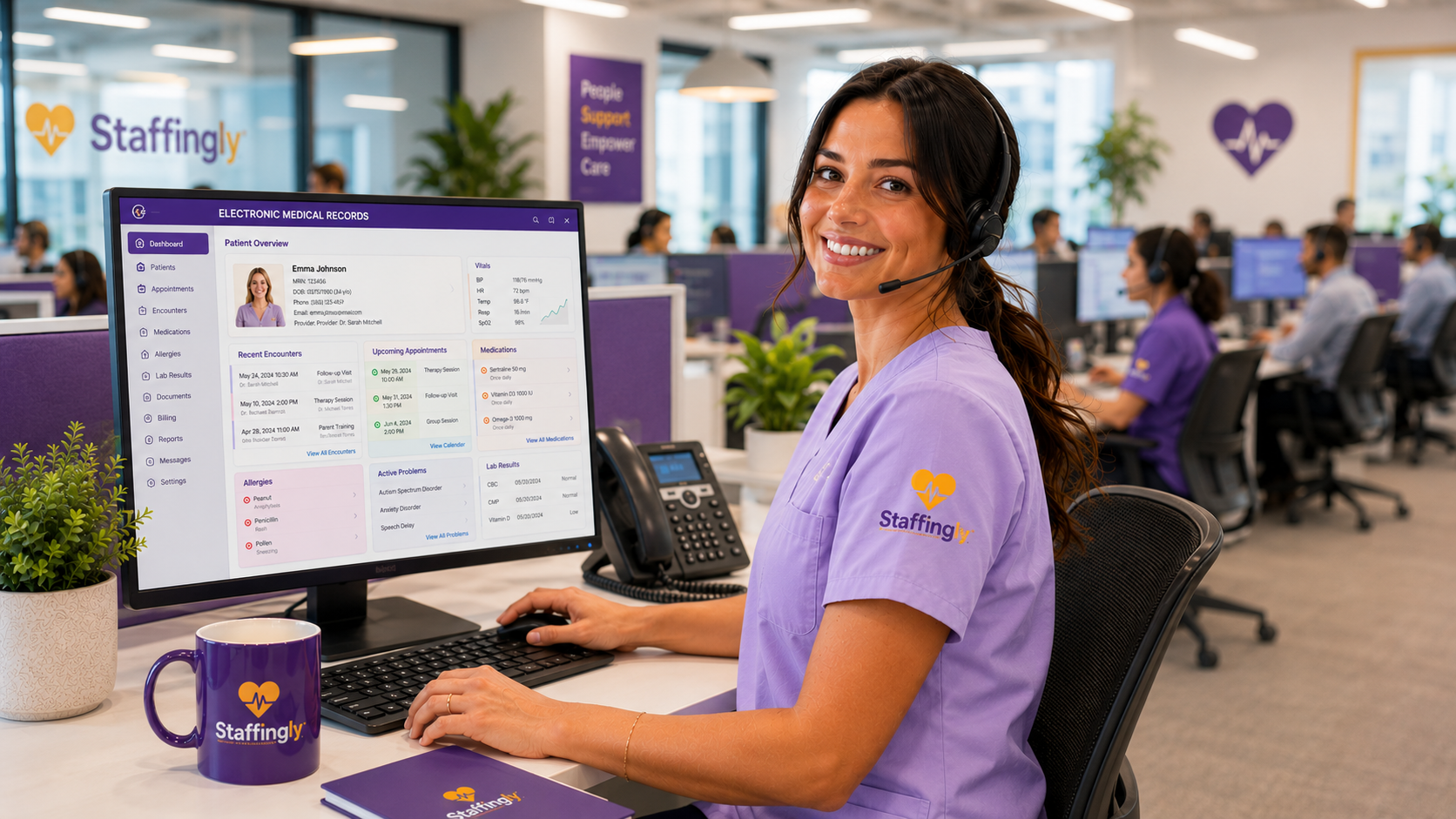
New team members study your agency’s SOPs first, then train on your ESO configuration in supervised sessions: your validation rules, your payer mix, your report formats. Production starts under a senior reviewer who checks output daily until quality holds, and a trained backup shadows the account from day one so coverage does not depend on a single person. Specialists work under an individual HIPAA agreement with named, auditable credentials in your system, never shared logins.
Why Outsource ESO Work, and Why Staffingly
Most vendors sell EMS billing alone. We staff the connected chain: ePCR completion, coverage checks, claims, follow-up, posting, scheduling, and fire records, so work stops falling between vendors.
Many ambulance billing companies price as a percentage of collections. Our model is a flat weekly fee per dedicated specialist, so a strong collections month benefits your agency, not your vendor. Do the math both ways; we will help on the call.
Signatures, times, narratives, PCS forms, and medical necessity language: our teams are trained on the specific paperwork that decides whether a transport gets paid.
Live in 14 days. 2-Week Free Trial. Replace any team member in 48 hours. 800+ providers served, 4.9 Google rating you can verify on our listing.
Agency Types We Support on ESO
911 transport agencies (chart chasing plus full-cycle billing), private and interfacility ambulance companies (PCS tracking and repetitive transport certifications), fire-based EMS (ePCR support on the medical side, records support on the fire side), hospital-based services (face sheet retrieval and payer coordination with the health system), and municipal or county departments where one office manager currently carries the whole administrative load.
Process and Onboarding
20 to 30 minutes on Teams. We map your ESO queues, payer mix, and pain points before we meet.
Named ESO user credentials per specialist, least-privilege roles, your approval on every account.
Your SOPs, your validation rules, your report formats, with supervised production from day one.
Daily production reports, weekly KPI review, month-to-month after your 2-Week Free Trial.
Security and Compliance
HIPAA-trained staff. Business Associate Agreements executed with every client. Workflows designed to support HIPAA compliance, with SOC 2 Type II attestation, ISO 27001:2022, $5M E&O and cyber liability coverage, and named individual credentials with full audit logs. Read the complete program, including our corporate structure and evaluation framework, at HIPAA and Security at Staffingly.
Flat Weekly Pricing Per Dedicated Specialist
1 to 4 dedicated ESO FTEs.
5 to 9 FTEs.
10+ FTEs.
45 hours of coverage for less than others charge for 40.
$399 per week works out to $8.87 per hour across 2,340 hours of coverage a year, flat. Your dedicated specialist covers a 9 hour day, Monday to Friday, a full hour more than a standard shift: the day starts by clearing what came in overnight, incomplete charts from the night shift, hospital record requests, and payer correspondence, and it ends past your office close so far less rolls into tomorrow. A trained backup steps in at no charge whenever they are out. Flat weekly fee per dedicated specialist, never a percentage of your collections, no setup fees.
Start with a 2-Week Free Trial. Month-to-month after, with no long-term contract.
- Salary + payroll taxes + benefits
- Recruiting + turnover replacement
- Training on EMS billing + your software
- Software seat + equipment + PTO coverage
Calculate Savings
ESO Outsourcing: Frequently Asked Questions
What tasks can a remote team handle in ESO?
Chart completion follow-up in ESO EHR, claim queues in ESO Billing, coverage verification, demographic cleanup, PCS form tracking, payer follow-up and appeals, payment posting, schedule backfill, and records upkeep in the ESO fire products. Administrative work inside ESO screens, a trained remote specialist can own.
Can you outsource ambulance billing for an agency on ESO?
Yes. Dedicated billers work inside your own ESO Billing environment, or the billing system your ESO EHR exports to: claim review, submission, denial work, appeals, AR follow-up, and posting, with daily production reporting.
Do your staff write or change patient care narratives?
No. The clinical record belongs to the crew. Our team flags incomplete or inconsistent documentation, chases signatures and missing fields, and requests corrections from the medic who ran the call. We do not author clinical content.
How do your staff access our ESO system?
Through named individual user accounts you approve, with least-privilege roles and full audit logging. No shared logins, no offline exports of PHI.
We use ESO EHR but bill in different software. Does that work?
Yes. Many agencies document in ESO and bill elsewhere. Our team works both sides: chart completion in ESO EHR and the claim cycle in whatever billing system receives the export.
How is this different from an ambulance billing company?
Two ways. Billing companies usually price as a percentage of collections and take the work into their own system; we charge a flat weekly fee per dedicated specialist and work inside yours. And we cover more than billing: chart chasing, scheduling, and fire records under the same roof.
How fast can a dedicated ESO team start?
Typically live in 14 days: access setup, training on your SOPs and validation rules, then supervised production. The engagement starts with a 2-Week Free Trial.
Is outsourced ESO work secure and HIPAA-ready?
HIPAA-trained staff, executed BAAs, workflows designed to support HIPAA compliance, SOC 2 Type II, ISO 27001:2022, and $5M in coverage. Full detail on our security page.
EMS Billing Resources for ESO Teams
From our pain-points library: the revenue problems we see most across EMS agencies.

Written By
Dan Nandan has spent 25+ years in IT consulting and healthcare BPO, was among the first in the US to build an RPO/BPO delivery network overseas, and has been featured in Computerworld. He runs the operations and the dedicated virtual teams behind the EMS documentation and billing workflows described on this page.
Connect on LinkedInSee what a dedicated ESO team changes in 14 days.
Book a strategy meeting. Dan Nandan, CEO, joins most calls personally. Real conversation, real numbers for your agency.
Claim Your 2-Week Free TrialESO, ESO EHR, and ESO Billing are trademarks of ESO Solutions, Inc. Emergency Reporting and Logis are ESO brands. Staffingly, Inc. is an independent outsourcing provider and is not affiliated with or endorsed by ESO Solutions, Inc. Staffingly works inside client-owned ESO systems under client-granted access.