
What Happened to RelayHealth, and Who Provides Remote Support Now?
RelayHealth’s medical claims network became part of Change Healthcare in 2017 and moved under Optum in 2022, while the pharmacy switch stayed with McKesson and now runs under the CoverMyMeds brand. The daily work on that lineage has not gone anywhere: dedicated HIPAA-trained teams keep eligibility, claim submission, rejection queues, ERA enrollment, and denials moving inside your own PM and clearinghouse portals. Flat weekly pricing from $299 per FTE (volume based), with a trained backup included at no charge. Live in 14 days.
What Happened to RelayHealth?
RelayHealth was McKesson’s healthcare connectivity brand: a claims clearinghouse and a network of provider, payer, and pharmacy connections used by hospitals, physician practices, and pharmacies across the country. The brand then split along two paths, and knowing which path you are on explains most of what you will find when you go looking for it today.
The medical claims side. On March 1, 2017, McKesson contributed most of its Technology Solutions businesses, including the RelayHealth medical claims network, into a new company: Change Healthcare. The clearinghouse rail itself kept a familiar name, Relay Exchange, inside the Change Healthcare product family. On October 3, 2022, Change Healthcare was acquired by UnitedHealth Group and combined with Optum, so the products practices once bought under the RelayHealth name are now sold and supported under Optum branding. The February 2024 Change Healthcare cyberattack interrupted claims flow across that network, and many practices on this lineage rerouted claims to alternate clearinghouses during the recovery.
The pharmacy side. McKesson kept RelayHealth Pharmacy, the prescription claims switch, out of the Change Healthcare deal. In May 2021, McKesson unified RelayHealth Pharmacy with CoverMyMeds, RxCrossroads, and McKesson Prescription Automation under the single CoverMyMeds brand. If your pharmacy transactions ride the old RelayHealth switch, CoverMyMeds is the name on it now.
The Clearinghouse-Side Work We Staff
Who Is This For?
Practices and billing teams whose claims history runs through the RelayHealth lineage: the clearinghouse name still sits in your PM’s EDI settings, your payer ID lists, your ERA enrollment folder, or the SOP binder your last biller left behind. That includes hospital-affiliated groups that bought RelayHealth products years ago, independent practices whose PM vendor routed claims through Relay Exchange, and teams that rerouted to a new clearinghouse after the 2024 outage and are still working through the aftermath: split AR, re-enrollment paperwork, and rejection queues that behave differently than the old ones did.
The common thread is not the software. It is a short-handed billing desk carrying transaction work, eligibility, submissions, statuses, postings, and denials, that does not slow down just because the brand on the rail changed twice.
Where Claims Teams on This Lineage Lose Time and Money
RelayHealth became Change Healthcare, then Optum, and some claims were rerouted again in 2024. When the path is unclear, rejections get chased in the wrong portal and follow-up stalls.
Remits keep flowing to old enrollment setups while payments post manually. Re-enrollment paperwork per payer is tedious, and it rarely has a named owner on a small billing desk.
Edits that used to pass now reject, and the messages read differently in the successor portal. Without someone working the queue daily, rejected claims age quietly toward timely filing limits.
Legacy clearinghouse knowledge often lived in one biller’s head. When they leave, enrollment logins, payer quirks, and workarounds leave with them, and the queue keeps arriving anyway.
Eligibility and Benefits Checks
Our team verifies coverage before the visit: 270/271 transactions through your PM or clearinghouse connection, payer portal checks where electronic responses fall short, and clean entry of plan detail back into your system. Eligibility mistakes are one of the quietest sources of downstream denials, and they multiply when a practice is mid-migration between clearinghouse rails. A dedicated specialist clears the eligibility list daily so the front desk and the billing desk stop splitting that job between them.
Claim Submission and Rejection Queues
We work the daily 837 batches out of your PM, confirm they land at the clearinghouse, and clear the edit and rejection queues before they age. That includes reading the rejection messages your successor portal produces, correcting and resubmitting, and keeping a simple log of recurring edit patterns so the same rejection stops arriving. On a lineage where the rail has changed names twice, having one team own the queue end to end is what keeps first-pass problems from becoming timely filing problems.
Claim Status and AR Follow-Up
Submitted is not paid. Our specialists run 276/277 status checks, work payer portals for the claims that go silent, and call payers on the balances that need a human on the phone. Aging follow-up runs on a schedule your manager can audit, with notes in your own system, so the AR conversation at month end is about numbers, not about whether anyone looked.
ERA and EFT Enrollment Paperwork
Enrollment is the unglamorous work that decides whether payments post themselves. We prepare and track ERA and EFT enrollment forms per payer, follow each one to confirmation, and keep a payer-by-payer register of what is enrolled where, which matters enormously for practices that changed clearinghouse routing after 2017 or after the 2024 outage. Once remits flow, we work the 835 posting exceptions and reconcile against deposits.
Denial Routing and Appeals Prep
We triage denials by CARC and RARC codes, route each one to the fix it actually needs, correction and resubmission, records request, or appeal, and prepare appeal packets with the documentation your provider signs off on. Recurring denial patterns get reported back to the practice with the upstream cause named, so the same denial stops being a monthly event. Underpayments get flagged and pursued rather than written off by default.
Put a Dedicated Claims Team on This Work
The brand on the rail changed twice; your claims work did not. Meet us, pick the seats you need, and watch a trained team work your own eligibility, rejection, and denial queues before you commit to anything.
Book Your 2-Week Free TrialHow Our Teams Train and Go Live on Your Claims Stack
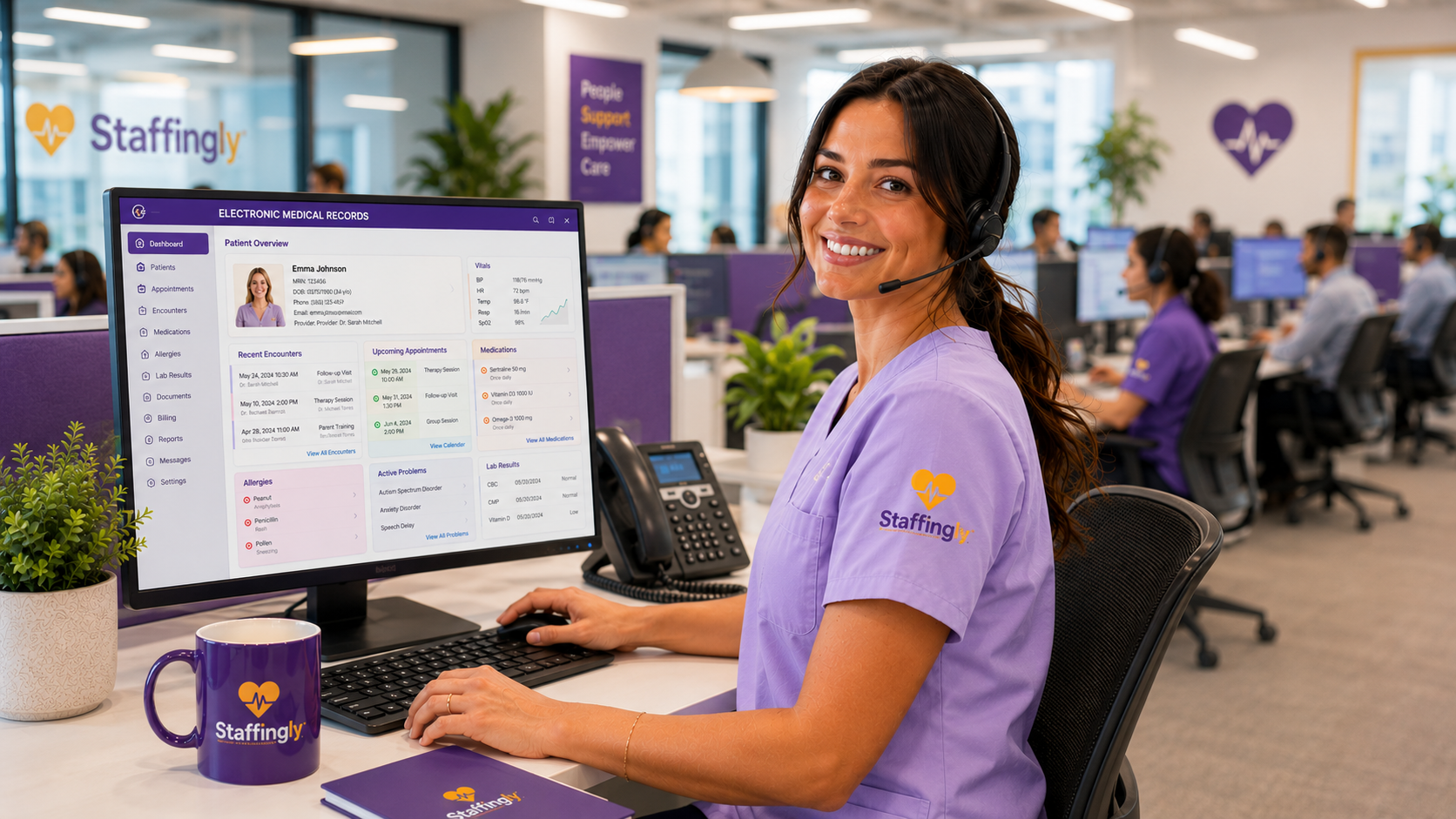
We do not assume your setup. During onboarding we document which PM you run, which clearinghouse rail your claims ride today, which payers are enrolled for ERA and where, and how your rejection and denial queues are worked now. New team members train on your SOPs plus our internal training library, then run supervised production before they own a queue. Specialists work under an individual HIPAA agreement with named, auditable credentials in your systems, never shared logins, and report production daily in the format your manager wants to read.
Why Outsource This Work, and Why Staffingly
RelayHealth became Change Healthcare, then Optum. Our teams work inside your PM and whichever clearinghouse portal is current, so another rebrand or reroute does not reset your billing desk.
A flat weekly fee per dedicated specialist, with efficiency gains accruing to the practice. No percentage of collections, no per-claim pricing surprises.
Enrollment registers, payer quirks, and rejection patterns get documented as we work, and a trained backup is included at no charge, so knowledge stops living in one person’s head.
Most teams go live in about 14 days. 2-Week Free Trial. 800+ providers served and a 4.9 Google rating you can verify on our listing.
Process and Onboarding
20 to 30 minutes on Teams. We map your PM, your current clearinghouse routing, and your queue backlog before we meet.
Named user credentials per specialist in your PM and portals, least-privilege roles, your approval on each account.
Your SOPs plus our training library; supervised production from day one, documented as we go.
Daily production reports, weekly KPI review, month-to-month after your 2-Week Free Trial.
Security and Compliance
HIPAA-trained staff. Business Associate Agreements executed with each client. Workflows designed to support HIPAA compliance, with SOC 2 Type II attestation, ISO 27001:2022, $5M E&O and cyber liability coverage, and named individual credentials with full audit logs. Read the program in detail at HIPAA and Security at Staffingly.
Flat Weekly Pricing Per Dedicated Specialist
1 to 4 dedicated FTEs.
5 to 9 FTEs.
10+ FTEs.
45 hours of coverage for less than others charge for 40.
$399 per week works out to $8.87 per hour across 2,340 hours of coverage a year, flat. Your dedicated specialist covers a 9 hour day, Monday to Friday, a full hour more than a standard shift: the day starts by clearing what arrived overnight, rejections, remits, and portal messages, and it ends past your close so far less rolls into tomorrow. A trained backup steps in at no charge whenever they are out. Flat weekly fee per dedicated specialist, never a percentage of your collections, no setup fees.
Start with a 2-Week Free Trial. Month-to-month after, with no long-term contract.
- Salary + payroll taxes + benefits
- Recruiting + turnover replacement
- Training on your payers + systems
- Software seat + equipment + PTO coverage
Calculate Savings
RelayHealth Support: Frequently Asked Questions
What happened to RelayHealth?
McKesson folded the RelayHealth medical claims network into Change Healthcare in March 2017, and Change Healthcare became part of Optum in October 2022. McKesson kept the RelayHealth pharmacy switch, which has operated under the CoverMyMeds brand since 2021.
Is RelayHealth still a clearinghouse?
Not as a standalone company. The clearinghouse rail continued inside Change Healthcare, where the Relay Exchange name persisted, and that business now sits under Optum. Many practices still see RelayHealth or Relay Exchange listed in their PM’s clearinghouse settings.
What happened to the RelayHealth pharmacy switch?
McKesson kept it out of the Change Healthcare deal. In May 2021, McKesson unified RelayHealth Pharmacy with CoverMyMeds, RxCrossroads, and McKesson Prescription Automation under the CoverMyMeds brand.
Our PM still lists RelayHealth as our clearinghouse. What does that mean?
It usually means your claims ride the Relay Exchange rail inside Change Healthcare, under Optum. Nothing about that stops us from staffing your work: our teams run eligibility, submissions, rejections, ERA enrollment, and denials in your own PM and portals regardless of the rail’s current brand.
Can you outsource clearinghouse and claims work on this lineage?
Yes. Dedicated specialists work inside your systems: daily 837 submission batches, rejection and edit queues, 276/277 status follow-up, ERA and EFT enrollment paperwork, posting exceptions, denial triage, and appeal prep, with daily production reporting.
How do your staff access our systems?
Through named individual user accounts you approve, with least-privilege roles and full audit logging. No shared logins, no offline exports of PHI.
How fast can a dedicated team start?
Most teams go live in about 14 days: access setup, workflow training on your SOPs, then supervised production. The engagement starts with a 2-Week Free Trial.
Is outsourced claims work secure and HIPAA-ready?
HIPAA-trained staff, executed BAAs, workflows designed to support HIPAA compliance, SOC 2 Type II, ISO 27001:2022, and $5M in coverage. Full detail on our security page.
Eligibility and Claims Work in Practice
Case studies from the insurance verification teams that staff this work.

Written By
Dan Nandan has spent 25+ years in IT consulting and healthcare BPO, was among the first in the US to build an RPO/BPO delivery network overseas, and has been featured in Computerworld. He runs the operations and the dedicated virtual teams behind the claims and eligibility workflows described on this page.
Connect on LinkedInSee what a dedicated claims team changes in 14 days.
Book a strategy meeting. Dan Nandan, CEO, joins most calls personally. Real conversation, real numbers for your practice.
Claim Your 2-Week Free TrialRelayHealth is a trademark of McKesson Corporation. Change Healthcare, Relay Exchange, Optum, and CoverMyMeds are trademarks of their respective owners. Staffingly, Inc. is an independent outsourcing company and is not affiliated with or endorsed by McKesson, Change Healthcare, Optum, or CoverMyMeds. Staffingly works inside client-owned systems under client-granted access.