
Cornea Prior Authorization Outsourcing
Outsource your cornea prior authorization queue to remote BPO specialists who know the difference between progression documentation and a denial. Corneal crosslinking (CPT 0402T) for keratoconus, penetrating keratoplasty (65730, 65755), endothelial keratoplasty DMEK and DSAEK (65756, 65757), and amniotic membrane grafts (65778, 65779). Tomography progression, endothelial cell count, eye bank coordination, and ocular surface failure packaged at submission.
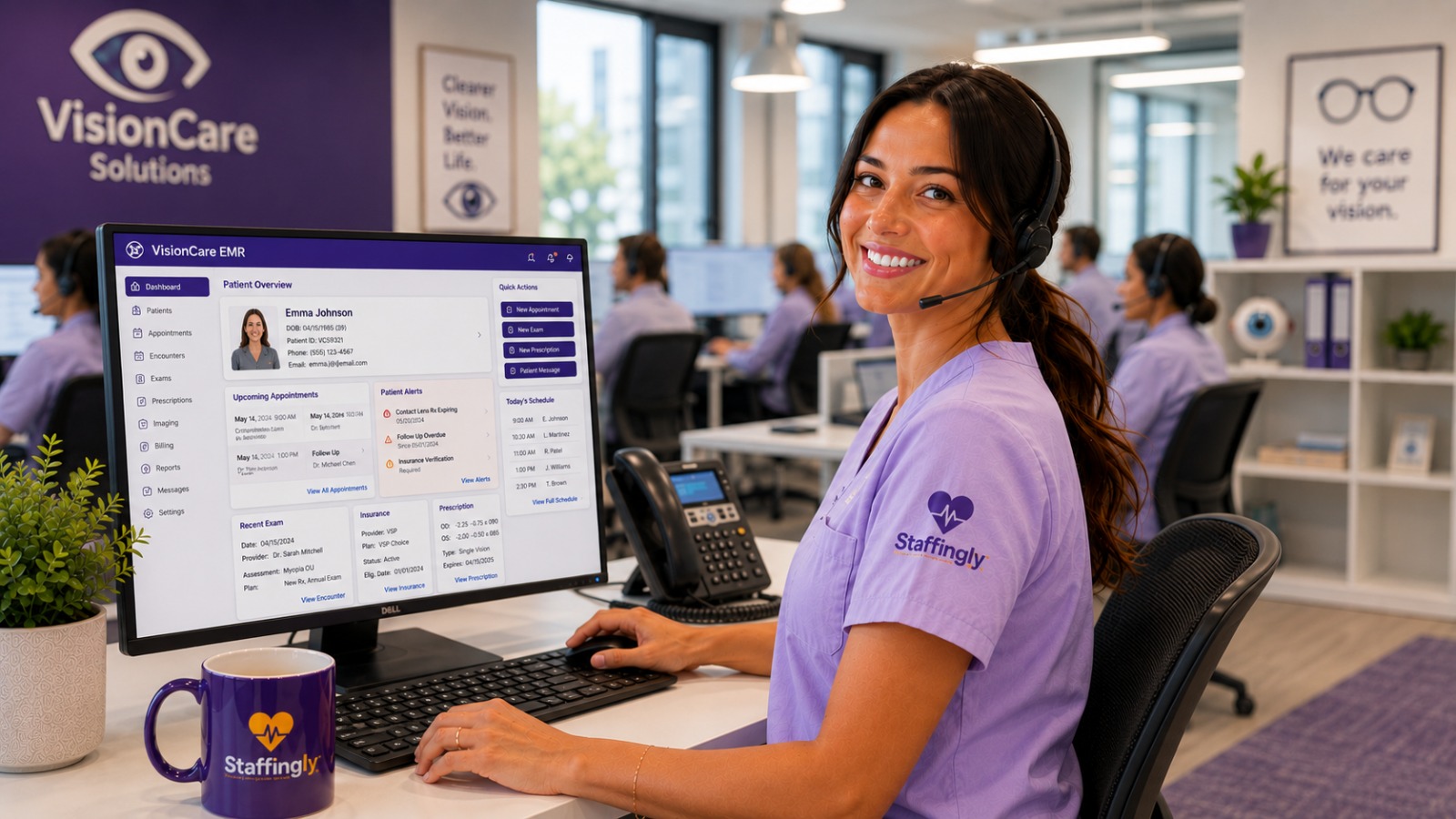
Cornea Prior Authorization, handled by a dedicated remote team
Trained specialists handle it inside your existing software, so your team stays on patient care.
With Staffingly, cornea prior authorization outsourcing means a dedicated team of trained specialists running this part of your back office. They are named to your account and work remotely as an extension of your staff, not a shared offshore pool. As a HIPAA-compliant healthcare BPO, we bill a flat weekly fee per specialist, never a percentage of your collections.
Cornea PA, progression-documented
Corneal procedures are denied more for missing documentation than for clinical reasons. CXL needs two tomography maps separated in time showing measurable ectasia progression. PKP, DMEK, and DSAEK need endothelial cell count, pachymetry, and donor tissue eye bank confirmation. Amniotic membrane grafts need prior conservative therapy failure and ocular surface severity. Mainstream PA teams know none of this. Our cornea-trained PA specialists work this queue every week.
Tell us about your practice.
Send us your situation and our team will scope the right setup, usually within one business day. No obligation.
Cornea CPT codes we PA every week
Web-verified against AAPC, CMS, and AAO current coding guidance.
Codes verified against AAPC ophthalmology coding, AMA CPT 2026, and current CMS guidance. Payer-specific medical necessity policies still apply.
| CPT / HCPCS | Procedure | Notes |
|---|---|---|
| 0402T | Collagen cross-linking of cornea (CXL) | Category III code for keratoconus / corneal ectasia progression |
| 65730 | Keratoplasty (corneal transplant); penetrating, except in aphakia or pseudophakia (PKP) | Full-thickness corneal transplant |
| 65755 | Keratoplasty; penetrating, in pseudophakia or aphakia | PKP in pseudophakic / aphakic eye |
| 65756 | Keratoplasty; endothelial (DMEK, DSAEK) | Posterior lamellar transplant for endothelial failure |
| 65757 | Backbench preparation of corneal endothelial allograft prior to transplantation | Donor tissue preparation, billed with 65756 |
| 65778 | Placement of amniotic membrane on the ocular surface; without sutures | In-office self-retaining membrane (e.g., ProKera) |
| 65779 | Placement of amniotic membrane on the ocular surface; with sutures | Surgical AMG placement in OR |
| 65760 | Keratomileusis | Refractive surgery code, sometimes used for related procedures |
| 65767 | Epikeratoplasty | Lamellar surgical procedure |
| 65772 / 65775 | Corneal relaxing incision / Corneal wedge resection for astigmatism | Astigmatism management procedures |
Three reasons our cornea PA queue avoids denial
Tomography progression packaged
CXL prior auth requires two serial corneal tomography maps (Pentacam, Galilei) showing documented ectasia progression. We pull and package both maps with K-max trend at submission.
Eye bank tissue confirmed
PKP, DMEK, and DSAEK require donor tissue eye bank confirmation tied to the OR date. We coordinate the eye bank order, tissue ID, and confirmation letter so the PA is paired with the actual tissue.
Ocular surface failure documented for AMG
Amniotic membrane grafts (65778, 65779) need prior conservative therapy failure documentation, ocular surface disease severity scoring, and persistent epithelial defect notes. We package each per payer requirement.
From imaging to tissue + OR aligned
Clinical imaging pull
For CXL: serial tomography. For PKP/DMEK/DSAEK: endothelial cell count, pachymetry, slit lamp findings. For AMG: ocular surface staining, prior therapy log.
Eye bank coordination
For transplants: donor tissue order placed. Tissue ID confirmed. Tied to OR date.
Payer criteria match
Each plan's published cornea criteria pulled. Submission language matched.
Portal submission
Portal or fax submission. Submission ID logged in EMR.
Peer-to-peer
P2P scheduled when asked. Tomography or endothelial cell count staged. Doctor briefed.
Approval & OR scheduling
Approval logged. ASC slot + tissue arrival aligned. Patient called same business day.
AI + Retina-Trained Clinicians = Faster PA Approvals
Staffingly AI and workflow automation handle the repetitive parts of eye care prior authorization. Form auto-fill, payer rule matching, step-therapy lookups, peer-to-peer scheduling. Every case still reviewed by retina-trained specialists before submission.
AI Clinical Sandbox
Validates anti-VEGF (J0178, J0177, J2778, J2777) and cataract (CPT 66984) PAs against payer rules before submission. Catches missing OCT, BCVA, step therapy.
Same-Day Submission
AI form-fill automation pulls patient data from your EMR. Submission goes out the same day you order, not the same week.
Denial Pattern Analytics
Automation tracks denial reasons by payer, drug, and CPT in real time. Practice gets a monthly denial-pattern report to fix upstream documentation.
Peer-to-Peer Auto-Routing
Automation flags every denial that qualifies for P2P. Coordinator packages OCT progression, FA, BCVA, step therapy. Physician walks into a prepped call.
- HIPAA Compliant
- SOC 2 Type II
- ISO 27001
- End-to-End Encryption
- BAA Before Pilot
How Staffingly works, in practice
Inside the work A trained Staffingly specialist handles the workflow inside your existing practice software, with clear escalation back to your team.
One Flat Weekly Rate. No Surprises.
Dedicated specialists at a fixed weekly cost. Per specialist FTE, per week. No contracts, no minimums, no hidden fees.
Want to compare against an in-house hire? Use the savings calculator.
Frequently asked questions
Should I outsource corneal surgery prior authorization?
For high-volume cornea specialists the answer is yes. Corneal crosslinking (CXL), corneal transplants (PKP, DMEK, DSAEK), and amniotic membrane grafts (AMG) all require specialty documentation that mainstream PA teams miss. CXL needs automated topography showing keratoconus progression. PKP/DMEK/DSAEK need donor tissue eye bank confirmation. AMG needs ocular surface failure documentation. We package each per payer specification.
What documentation do payers require for corneal crosslinking PA?
Payers require automated corneal topography or tomography (Pentacam, Galilei, Scheimpflug) showing documented ectasia progression over time, typically two serial maps at least 6 to 12 months apart. Plus BCVA decline, K-max increase, or contact lens intolerance documentation. We standardize the imaging packet so the submission matches each payer's published progression criteria.
How much does cornea PA outsourcing cost?
Staffingly cornea PA outsourcing is a flat weekly rate: $399 per PA specialist per week single, $349 at 5+ specialists, $299 at 10+ resources. Each specialist works 45 hours per week, fully managed, no long-term contract. The 2-Week Free Trial is included so you see real CXL, PKP, DMEK, and AMG submissions before any invoice.
Do you coordinate eye bank tissue ordering with the OR date?
Yes. For PKP (CPT 65730, 65755) and endothelial keratoplasty (CPT 65756 + 65757 backbench prep), we coordinate the eye bank tissue order with the OR scheduling team, confirm the donor tissue ID, and align the tissue arrival window with the surgical slot. The PA approval, tissue, and OR block all line up.

President and CEO, Staffingly, Inc. 25+ years in IT consulting and healthcare BPO operations. One of the earliest US operators to set up an RPO/BPO delivery network in India. Leads AI-driven optometry and ophthalmology workflows that help vision practices and multi-location groups cut admin cost without compromising care.
Security Your Compliance Officer Will Sign Off On
Staffingly is audited to SOC 2 Type II with zero exceptions and certified for ISO/IEC 27001:2022, HIPAA, and GDPR. In eight years we have never had a breach. Every workstation runs inside the Venn Blue Border secure enclave on US-based servers, screen captures and downloads are blocked by policy, and every engagement operates under a signed BAA, and Staffingly maintains $5M in professional liability (E&O) and cyber insurance as part of its enterprise risk-management program.