
ABA Billing, Credentialing & Prior Authorization Services
Outsourced ABA back office that actually works.
A specialist back-office team for your ABA practice. We run authorizations, credentialing, billing, and denials inside CentralReach, Rethink, or NPAWorks. Flat fee per specialist, no percentage of collections. Live in 2 weeks.
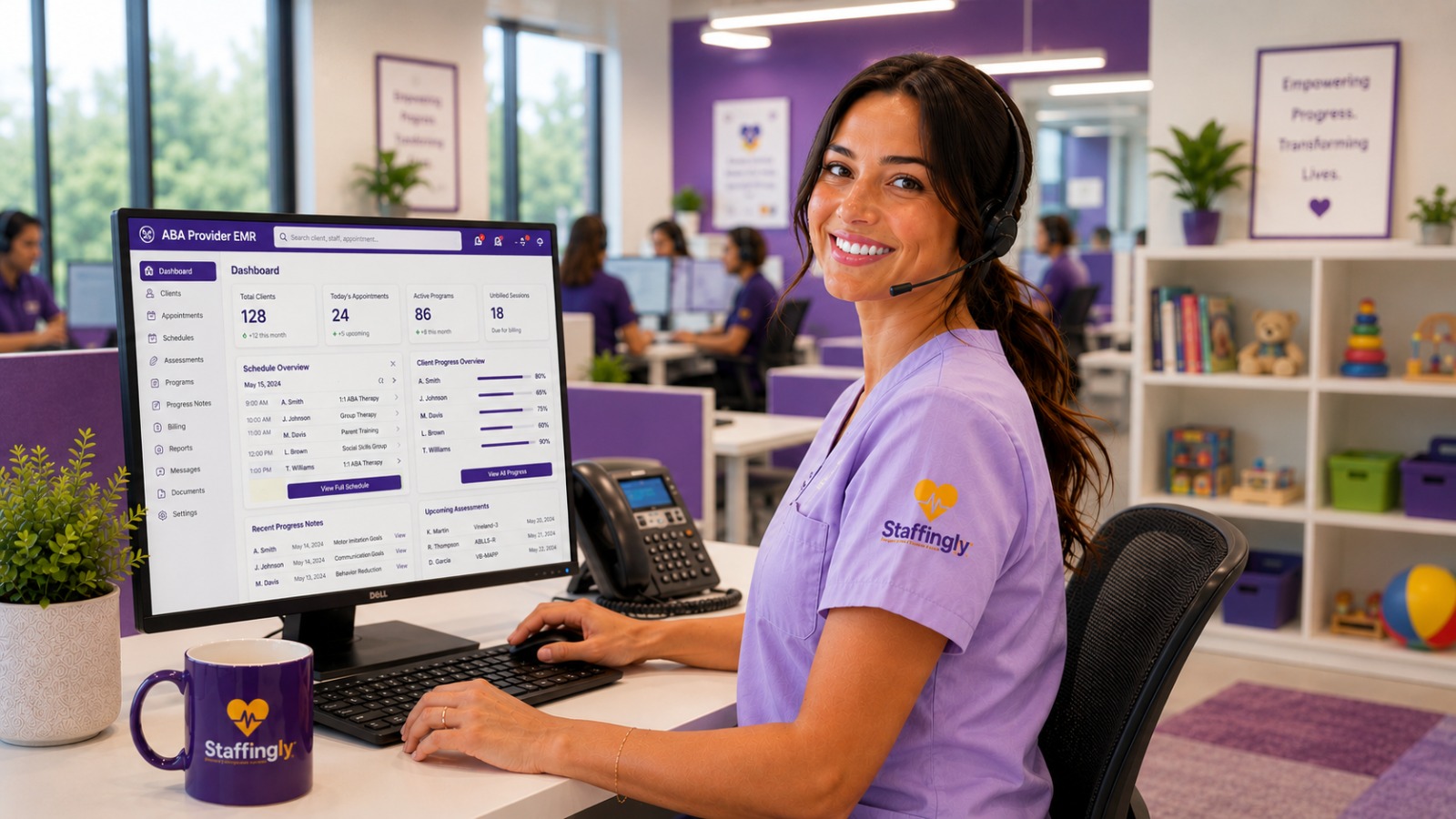
One outsourcing partner for the whole ABA back office.
Authorizations, credentialing, billing, denials, and intake, inside CentralReach, Rethink, or NPAWorks.
U.S. payer experience. Your time zone, your phone or VoIP. HIPAA secured with a signed BAA.
Tell us about your practice. We’ll project your savings in 24 hours.
Solo BCBA or multi-site group? Authorizations, credentialing, or full RCM? Send us your situation. We scope the right specialist mix.
What Is ABA Back-Office Outsourcing?
ABA back-office outsourcing is a dedicated, trained team that runs the non-clinical operations of your ABA practice so your BCBAs and RBTs can focus on care. It covers prior authorization and reauthorization, BCBA and RBT credentialing, billing and coding for CPT 97151 through 97158, denial management, eligibility verification, intake, and scheduling.
The specialists log into your own systems, including CentralReach, Rethink, NPAWorks, or AccuPoint, follow your workflows, and report to your manager. We are the operator layer that runs the work inside your software, not another tool you have to staff and learn.
The model is flat fee, not a percentage of collections. Most ABA billing vendors charge 4% to 8% of collections, which scales against you as you grow. AI handles the repetitive throughput like authorization tracking, eligibility checks, and claim scrubbing, while trained people own the exceptions: 97155 protocol work, peer-to-peer reviews, appeals, and multi-state Medicaid nuance.
Staffingly’s ABA back-office program combines trained specialists with AI-powered automation to run the operations side of your practice. Whether you need authorization coordinators who track units and expiration dates, credentialing specialists who keep BCBAs and RBTs enrolled, or billers who code CPT 97151 through 97158 correctly, our team works inside CentralReach, Rethink, NPAWorks, or your existing EHR.
All Staffingly ABA services are HIPAA, SOC 2 Type II, ISO 27001, and. We are a dedicated healthcare outsourcing partner, a HIPAA-compliant BPO with named, remote specialists rather than a shared offshore pool, billed at a flat fee per specialist, not a percentage of collections. Available across all 50 states. Pricing starts at $399 per week ($349 at volume) with a 2-Week Free Trial.
7 Things to Know Before You Outsource ABA Billing
Flat Fee, Not a Percentage of Collections
Most ABA billing vendors charge 4% to 8% of collections, which scales against you. We charge a fixed weekly rate per specialist, so higher volume never raises your billing cost.
Authorization Specialists First
Units tracked with expiration alerts, reauthorization submitted 30 to 60 days early, TRICARE ACD handled. Stop billing sessions that quietly fall outside an active authorization.
Full Compliance Stack
HIPAA + SOC 2 Type II + ISO 27001, with a signed BAA. The posture multi-site and PE-backed ABA buyers need to clear security due diligence.
We Run Your Software, We Don’t Sell One
Specialists work inside CentralReach, Rethink, NPAWorks, and AccuPoint. We are the operator layer on top of the platform you already pay for, not another tool to staff.
Medicaid and Commercial NPI Done Right
Many state Medicaid programs require the RBT’s NPI on 97153, while most commercial payers take the BCBA’s. The wrong rendering NPI is an avoidable denial we prevent up front.
Live in 2 Weeks
No training required on your end. Strategy, integration, and go-live inside your existing ABA software, all in two weeks.
2-Week Free Trial
Month-to-month after that. No long-term contracts. Walk away if it is not a fit.
Your ABA Back Office Is Bleeding Revenue
You delivered the sessions and did everything right, but the claims still bounce: an authorization quietly expired, the units ran out mid-period, a new RBT saw clients before credentialing cleared. Every gap is revenue you already earned walking back out the door.
The daily reality your practice lives in
An authorization lapsed by one day and a whole week of sessions is non-payable with no retroactive fix. Nobody flagged that the units were almost gone until you had already burned through them. One state’s Medicaid accepts your plan of care and another rejects the exact same thing. Your old biller just resubmitted denials without ever fixing what caused them.
We delivered the sessions, did everything right, and still could not bill because the authorization quietly expired. A lapse by even one day made a whole week of sessions non-payable.
children identified with autism, up from 1 in 36, driving record demand for ABA . CDC ADDM, 2025
BCBA job postings per active BCBA in 2025: 132,307 openings against 83,586 BCBAs . BACB / Lightcast
denial rate at practices without billing specialists, versus under 6% at specialized operations . industry estimate
Every time we grow, the back office becomes the thing that breaks. Adding a therapist should feel like growth, but it just means another provider to credential and more claims I cannot bill yet.
What Your ABA Team Actually Handles
An ABA back-office specialist is an operations partner who works directly inside CentralReach, Rethink, or NPAWorks. Not a chatbot, not a generic VA. Trained people handling the authorization, billing, and credentialing work your clinical team cannot keep up with.
Prior Authorization + Reauth
Initial and treatment auths, reauth 30 to 60 days early, units tracking.
Eligibility Verification
Benefits, copay, and deductible confirmed before the first session.
BCBA + RBT Credentialing
NPI, CAQH, Medicaid plus MCO enrollment, re-credentialing deadlines.
Billing & RCM
CPT 97151-97158 in 15-minute units, clean claims, denials, and AR, end to end.
Clinical Documentation
Session notes, data collection, treatment plans, and progress reports.
Intake + Waitlist
Waitlist conversion, intake coordination, scheduling aligned to auth.
Scheduling + Utilization
Cancellation recovery and RBT utilization, schedules matched to auths.
Front Desk + Records VA
Phones answered, records managed, recurring admin handled in your EHR.
Explore all 7 ABA service lines
Front office to back office, each service line is its own dedicated page with scope, workflow, pricing, and a 2-week pilot CTA.
ABA Prior Authorization & Reauthorization
Initial and treatment authorizations, reauth 30 to 60 days before expiry, units tracking with expiration alerts, TRICARE ACD support, and peer-to-peer prep.
ABA Insurance & Eligibility Verification
Benefits and eligibility confirmed before the first session, copay and deductible captured up front, and real-time checks so families avoid surprise bills.
ABA Credentialing & Payer Enrollment
NPI and CAQH setup, BCBA and RBT enrollment, Medicaid plus MCO applications, re-credentialing deadline tracking, and CAQH re-attestation so claims keep processing.
ABA Billing & RCM
CPT 97151 to 97158 in 15-minute units, correct RBT versus BCBA NPI, clean claim submission, denial management, AR follow-up, and underpayment recovery, end to end.
ABA Intake & Scheduling
Waitlist conversion, client intake, scheduling aligned to what is authorized, cancellation recovery, and RBT utilization support for growing practices.
ABA Clinical Documentation
Session-note and data-collection support, treatment-plan and progress-report formatting, and documentation QA that keeps records audit-ready inside your EHR.
ABA Virtual Assistants
Embedded back-office and front-desk support so BCBAs stop losing hours to admin: phones answered, records managed, and recurring tasks handled inside your tools.
Outsourcing across other specialties too? Explore behavioral health prior authorization, credentialing and enrollment, and revenue cycle management across medical specialties.
The flat-fee ABA back-office partner with ABA-trained specialists AND the full HIPAA + SOC 2 + ISO stack.
Most ABA billing companies charge 4% to 8% of collections and show one or two attestations. Software vendors sell you a tool and leave the staffing to you. We are the operator layer that runs your authorizations, credentialing, and claims at a flat weekly fee, on all four certifications.
The Compliance Gap Nobody Talks About
Most ABA billing vendors lean on a single attestation, usually HIPAA. That is not the same as having an audited control environment. The gap shows up the day a Medicaid auditor asks for evidence of safeguards across your entire back-office operation.
HIPAA alone is the floor
HIPAA is a federal law, not an audit. Anyone can claim HIPAA-compliant. SOC 2 require a third-party auditor.
BAA is necessary, not sufficient
A signed BAA does not guarantee the offshore vendor has the operational controls to back it up.
ISO 27001 is the cross-border floor
If your specialists work outside the US, ISO 27001 is the international information security baseline.
SOC 2 Type II is what hospitals demand
Health systems and IDNs increasingly require HITRUST CSF certification before signing.
The CMS-0057-F 7-Day Decision Window
CMS Final Rule CMS-0057-F took effect January 1, 2026. It changes prior auth turnaround for Medicare Advantage, Medicaid, CHIP, and Marketplace QHPs, which carry a large share of ABA authorizations. Most ABA practices are not ready.
Standard Decisions: 7 Calendar Days
Payers must issue prior auth decisions within 7 calendar days for non-urgent requests. Down from 14 days under the prior rule.
Expedited Decisions: 72 Hours
Urgent requests must be decided within 72 hours. Practices need clean documentation and a tracked submission queue or they will miss windows.
Reason-for-Denial Required
Payers must provide a specific reason for any denial. Practices can use that reason to file targeted appeals. but only if they capture it consistently.
Public Reporting Begins
Payers must publicly report PA metrics annually starting March 31, 2026. Practices that miss windows or get denied at high rates face audit risk.
Every Staffingly ABA authorization coordinator is trained on CMS-0057-F windows. Our submission tracker times each request against the 7-day standard and 72-hour expedited clocks, alerts on units running low and authorizations nearing expiry, and captures the denial reason for targeted appeals, all inside CentralReach, Rethink, or your EHR. Your practice does not become the bottleneck.
What an ABA Back-Office Specialist Actually Costs
Per-specialist weekly pricing that scales with your headcount. No percentage of collections. No setup fees. No long-term contracts. 2-Week Free Trial.
One dedicated specialist, with team-lead overlap and coverage-pool backup, single-location practice
5+ specialists, mid-size practice or health system region
10+ specialists, multi-location health system or PE-backed group
Percentage-of-collections comparison: most ABA billing vendors charge 4% to 8% of collections, which rises every time your revenue does. A flat weekly rate per specialist stays predictable as you scale.
Enterprise & Multi-Site: 20+ specialists at $299/week
Custom workflows, dedicated account teams, and volume terms for multi-state ABA operators, MSOs, and PE-backed autism platforms.
45 Hours of Coverage. One Flat Weekly Rate.
No hourly meters, no setup fees, no long-term contracts.
Your dedicated specialist covers a 9 hour day, a full hour more than a standard shift. The day starts by clearing everything that arrived after you closed: overnight faxes, refill requests, and portal messages, so your morning begins at zero. And the day ends past your close, absorbing the last-minute rush so nothing rolls into tomorrow. Most vendors bill that ninth hour. At Staffingly it is included.
$399 per week works out to $8.87 per hour. Typical US market rates run $9.50 to $13.00 per hour for 40 hours of coverage.
A Staffingly plan: 45 hrs × 52 weeks = 2,340 hours a year.
That is 260 additional hours every year, included in your flat rate.
$399/week × 52 = $20,748 a year ÷ 2,340 hours = $8.87 per hour.
Every plan includes a trained backup VA, a dedicated customer success manager, monthly training manual updates, HIPAA-certified staff, and Staffingly maintains $5M in professional liability (E&O) and cyber insurance.
Staffingly vs In-House vs Software vs % Billing Vendor
Six questions every ABA practice asks. Here is how each option holds up.
| What you actually care about | In-House Biller | ABA Software Only | % Billing Vendor | Staffingly ABA Team |
|---|---|---|---|---|
| What does it cost? | Salary + benefits, fixed whether busy or not | License fee, and you still staff it | 4% to 8% of collections, rises as you grow | $399/wk ($349 volume). Flat, not % of collections. |
| How fast can they help? | Weeks to hire, then train on ABA | Setup, then you run it yourself | Onboarding varies, often slow | Live in 2 weeks, inside your EHR. |
| Who owns authorizations and denials? | Your staff, until they are poached | Gives you tools, not people | Often resubmits without fixing the cause | We own units tracking, root-cause denials, and appeals. |
| Do they know ABA rules (97151-97158, RBT NPI)? | Yes, if you find and keep them | Encodes rules, no one to apply them | Generalists often miss ABA-specific rules | ABA-trained on CPT, concurrent billing, and NPI rules. |
| Is your data safe? | HIPAA is on you to enforce | Depends on the platform | Often a single attestation | HIPAA + SOC 2 + ISO 27001. BAA day 1. |
| What if it does not work out? | Hire and severance cost on you | Locked into annual contracts | Hard to exit mid-AR | 2-Week Free Trial. |
How We Bring AI Into Your ABA Practice. Safely
AI does the repetitive throughput. Trained people own the exceptions. Authorization tracking, eligibility checks, and claim scrubbing run with automation, while 97155 protocol work, peer-to-peer reviews, appeals, and multi-state Medicaid nuance stay with specialists. You get an audit trail of both.
Authorization Tracking
Automated alerts when units run low or an authorization nears expiry, before sessions become non-payable.
Real-Time Eligibility
Automated eligibility and benefit checks so coverage is confirmed before the first session.
Claim Scrubbing
Claims checked against payer and state rules, CPT units, and rendering NPI before they go out.
Denial-Pattern Detection
Recurring denial reasons surfaced so the root cause gets fixed, not just resubmitted.
Exception Flagging
Edge cases like complex medical-necessity criteria are flagged for a BCBA or specialist to handle.
Assisted Documentation QA
AI drafts and checks session-note completeness; a human reviews before anything is finalized.
Scheduling Optimization
Schedules matched to authorized units and availability, with cancellation and recall nudges.
Compliance Checks
Automated HIPAA, payer-rule, and CMS-0057-F window checks before submission.
How We Bring AI In Safely. Three Layers
- 1. BAA + Private StackAI runs inside a HIPAA-compliant environment. No PHI leaves into public LLMs.
- 2. Human-in-the-LoopAI drafts and pre-fills. A trained specialist reviews and signs off before action.
- 3. Full Audit TrailEvery AI action logged: model, input, output, reviewer, timestamp.
How Your ABA Specialist Joins Your Practice
Strategy, integration, and go-live in two weeks. No training required on your end.
Days 1-2: Strategy
We learn your ABA software, payers, state Medicaid rules, and where revenue is leaking. Your specialist is matched accordingly.
Days 3-7: Integration
Access to CentralReach, Rethink, or NPAWorks configured. Practice-specific training. Workflows and payer rules documented.
Days 8-14: Go Live
Your specialist begins handling authorizations, billing, and denials. Quality monitoring in place.
Day 15+: Pilot Wrap
Two-week pilot review. If it is a fit, month-to-month continues. If not, walk away clean.
See Your ABA Team in Action
From the morning authorization check to the end-of-day claims wrap. Your specialist works inside CentralReach, Rethink, or NPAWorks, and your team sees every task as it happens.
Authorization Tracking
Units monitored, reauthorizations filed early, and anything nearing expiry flagged before sessions become non-payable.
Eligibility & Benefits
Coverage, copay, and deductible verified before the first session, so families avoid surprise bills.
Intake & Waitlist
Intake forms, waitlist conversion, and scheduling aligned to what is authorized.
Billing & Coding
CPT 97151 to 97158 billed in 15-minute units with the correct rendering NPI and clean claim submission.
Denials & Appeals
Denials worked at the root cause, underpayments chased, and appeals filed instead of blind resubmission.
Credentialing Upkeep
CAQH re-attestation, re-credentialing deadlines, and new BCBA or RBT enrollments tracked so claims keep processing.
The Real Cost of ABA Billing. Flat Beats a Percentage
Percentage-of-collections billing looks small until you grow. The more you bill, the more you pay, for the same work. A flat weekly fee per specialist does not move when your revenue does.
How to Choose Your Outsourcing Partner
Five questions every ABA practice should ask before signing with any billing, credentialing, or RCM vendor.
Flat fee or a percentage of collections?
Percentage-of-collections scales against you. A flat weekly fee per specialist keeps cost predictable as you grow.
Do they actually know ABA rules?
Ask about CPT 97151 to 97158, concurrent 97153 and 97155, and the RBT versus BCBA NPI rule. Generalists miss these.
Do they work inside your ABA software?
The right partner logs into CentralReach, Rethink, NPAWorks, or AccuPoint. No middleware, no rip-and-replace.
Can they show all four certifications?
HIPAA + SOC 2 Type II + ISO 27001, with a signed BAA. Ask for the audit reports.
What are the contract and exit terms?
Month-to-month with a real 2-week free trial. Long-term lock-ins and hard mid-AR exits are red flags.
Trained on Every ABA Platform + Payer
Our specialists work authorizations, eligibility, and claim follow-ups across commercial plans, Medicaid MCOs, and TRICARE, inside the ABA software you already use.
ABA Software Platforms
Major Payers
Portals + Clearinghouses
The Cost of Doing Nothing in 2026
ABA practices that do not tighten their back office this year will pay for it in three places: revenue, audit exposure, and margin under tightening Medicaid rules.
Questions ABA Practice Owners Ask Us
Real questions from BCBAs, billing managers, and clinic directors. No fluff answers.
How much does outsourced ABA billing cost?
Do you work inside our existing ABA software like CentralReach, Rethink, or NPAWorks?
What is the difference between ABA billing software and ABA billing services?
How long does BCBA credentialing take?
Can you bill 97153 and 97155 at the same time?
Does Medicaid require the RBT’s NPI on ABA claims?
How often do ABA authorizations need to be renewed?
Why are my ABA claims getting denied?
Flat Fee vs Percentage of Collections
Slide to your monthly ABA collections and see what a typical 6% billing vendor costs versus a flat weekly fee.
Illustration at a 6% rate (vendors commonly charge 4% to 8%) versus one specialist at the $399/week Single rate. Your specialist mix may vary.
Stop the revenue leakage. Start the pilot.
30-minute strategy call. We map your authorization, credentialing, billing, and denial workflows, then recommend the right specialist mix. No pressure. Pilot in 2 weeks.
Written + Reviewed By

Dan Nandan is the President and CEO of Staffingly, Inc. With 25+ years in IT consulting and healthcare BPO operations, he was one of the earliest U.S. operators to set up an RPO/BPO delivery network in India over 20 years ago. Today his work centers on AI-driven healthcare workflows and helping practices across North America cut administrative costs without compromising care.

Bincy Shiiju Kuriakose is a Clinical Content Reviewer at Staffingly and a U.S. Licensed Registered Nurse (MSN, RN). NCLEX-RN certified with expertise in hospital nursing, telehealth, and nursing education. PhD scholar in Nursing at Peoples’ College of Nursing, Bhopal. Reviews every service page for medical accuracy, compliance, and evidence-based best practices.
Connect on LinkedInAuthoritative Sources & Standards (ABA)
Authoritative references for the ABA coding, authorization, credentialing, compliance, and market figures cited on this page:
- – ABA Coding Coalition: CPT 97151-97158 adaptive behavior codes
- – BACB: Certificant data and supervision standards
- – CDC ADDM Network: Autism prevalence (1 in 31)
- – HHS-OIG: Medicaid ABA improper-payment audits
- – CMS-0057-F: Interoperability and Prior Authorization Final Rule
- – HHS.gov: HIPAA Privacy Rule
Security Your Compliance Officer Will Sign Off On
Staffingly is audited to SOC 2 Type II with zero exceptions and certified for ISO/IEC 27001:2022, HIPAA, and GDPR. In eight years we have never had a breach. Every workstation runs inside the Venn Blue Border secure enclave on US-based servers, screen captures and downloads are blocked by policy, and every engagement operates under a signed BAA, and Staffingly maintains $5M in professional liability (E&O) and cyber insurance as part of its enterprise risk-management program.