
Can You Outsource LumineticsCore Billing and Scheduling Work?
Yes. Dedicated HIPAA-trained teams handle the administrative side of your LumineticsCore diabetic eye exam program: patient recall, scheduling, eligibility, CPT 92229 claims, and referral follow-up, working inside your own EHR and practice management system. Flat weekly pricing from $299 per FTE (volume based), with a trained backup included at no charge. Live in 14 days.





What Is LumineticsCore?
LumineticsCore, formerly known as IDx-DR, is an autonomous AI diagnostic system from Digital Diagnostics that detects more than mild diabetic retinopathy at the point of care. It made history in 2018 as the first AI system the FDA authorized to make a diagnostic decision without physician input. The exam is simple by design: a trained operator in your office captures two images per eye with a fundus camera, submits them, and the system returns a diagnostic result within about 30 seconds, during the same visit, with no specialist overread required.
The billing side caught up too. The AMA created CPT code 92229 for point-of-care retinal imaging with automated analysis, and CMS has since finalized a national payment rate for it. That combination, a same-visit exam plus a billable code, is why primary care practices, endocrinology groups, and health centers now run diabetic eye exam programs in-house. It also creates a new pile of administrative work that this page is about: someone has to find the eligible patients, book them, verify coverage, bill the code correctly, and close the loop on positive results.
Who Is This For?
Practices and health centers that run, or are launching, a LumineticsCore diabetic eye exam program: primary care groups with large diabetic panels, endocrinology practices, FQHCs and health systems screening at the point of care, and value-based care organizations working diabetic eye exam quality measures. If the camera is in the building but the recall list is not being worked, this service fits.
Where Screening Programs Stall
The camera can screen a patient in minutes, but only if someone works the diabetic recall list, calls patients due for their annual eye exam, and gets the exam onto the schedule. In a busy front office, that list is the first thing to go unworked.
Medicare pays a national rate for 92229, while commercial and Medicaid coverage varies by payer and plan. Claims submitted without verified benefits, or with coding gaps, come back denied, and a new service line quietly stops paying for itself.
A result of more than mild diabetic retinopathy only helps the patient if the eye care appointment actually happens. Without a named owner, referral loops stay open and follow-up calls do not get made.
Point-of-care screening can close diabetic eye exam care gaps, but only when results are documented in the chart, exclusion lists are reconciled, and the measure is reported on time. That is steady administrative work, not a one-time setup.
The Admin Work Around Your Program, We Staff
Patient Identification and Recall
A screening program lives or dies on its list. Our team works the diabetic patient registry in your own EHR: identifying patients due for an annual diabetic eye exam, filtering out those already under eye care per your protocol, and running the recall outreach, calls, reminders, and rebooking, in your practice’s name. The benefit is a camera that stays busy because the pipeline of eligible patients is somebody’s actual job.
Scheduling the Exam Into the Visit
The strength of point-of-care screening is that the exam can happen during a visit the patient already has. We coordinate exactly that: flagging eligible patients on upcoming schedules so the exam is planned into the appointment, booking dedicated screening slots where your workflow uses them, confirming patients ahead of time, and rescheduling no-shows so they do not fall out of the program. Your in-office operator runs the exam; we make sure there is a patient in the chair.
Eligibility and Benefits for CPT 92229
Coverage for autonomous retinal imaging is real but uneven: Medicare pays a national rate for CPT 92229, and commercial and Medicaid coverage varies by payer and plan. We verify eligibility and plan-level benefits before the visit, document copay and coverage detail in your system, and flag patients whose plans need extra handling, so the front desk is not guessing on the day of the exam and the claim does not start life as a denial.
Claims and Denial Follow-Up
Dedicated billers work the 92229 claims inside your own practice management system alongside the rest of the visit’s charges: charge entry per your coding guidance, claim scrubbing and submission, payment posting, and denial follow-up when a payer rejects the code or bundles it incorrectly. Because the same team also verified the benefits, denials get worked with context instead of starting from zero. For the full picture of our billing bench, see Outsourced Revenue Cycle Management Services.
Referral Coordination for Positive Results
When the system returns a result of more than mild diabetic retinopathy, your provider decides the clinical next step; we make the administrative side of that decision happen. Our team prepares the referral per your protocol, calls the patient, books the ophthalmology or optometry appointment, sends records the specialist needs, and tracks every open referral on a shared log until the loop is closed and the visit is confirmed.
Documentation Routing and Quality Reporting
Screening results only count when they land in the right place. We route exam results into the chart per your documentation SOPs, keep the diabetic eye exam care-gap lists current, reconcile completed exams against your quality measure worklists, and prepare the recurring reports your manager and your value-based care contracts actually use. This is administrative routing and list work, not interpretation, and it is the difference between a program that runs and a program that also proves it ran.
Put a Dedicated Team on Your Program’s Admin Work
Your camera and your operator handle the exam. Meet us, pick the seats you need, and watch a trained team work your recall list, benefits checks, and 92229 claims before you commit to anything.
Book Your 2-Week Free TrialHow Our Teams Train and Go Live on Your Program
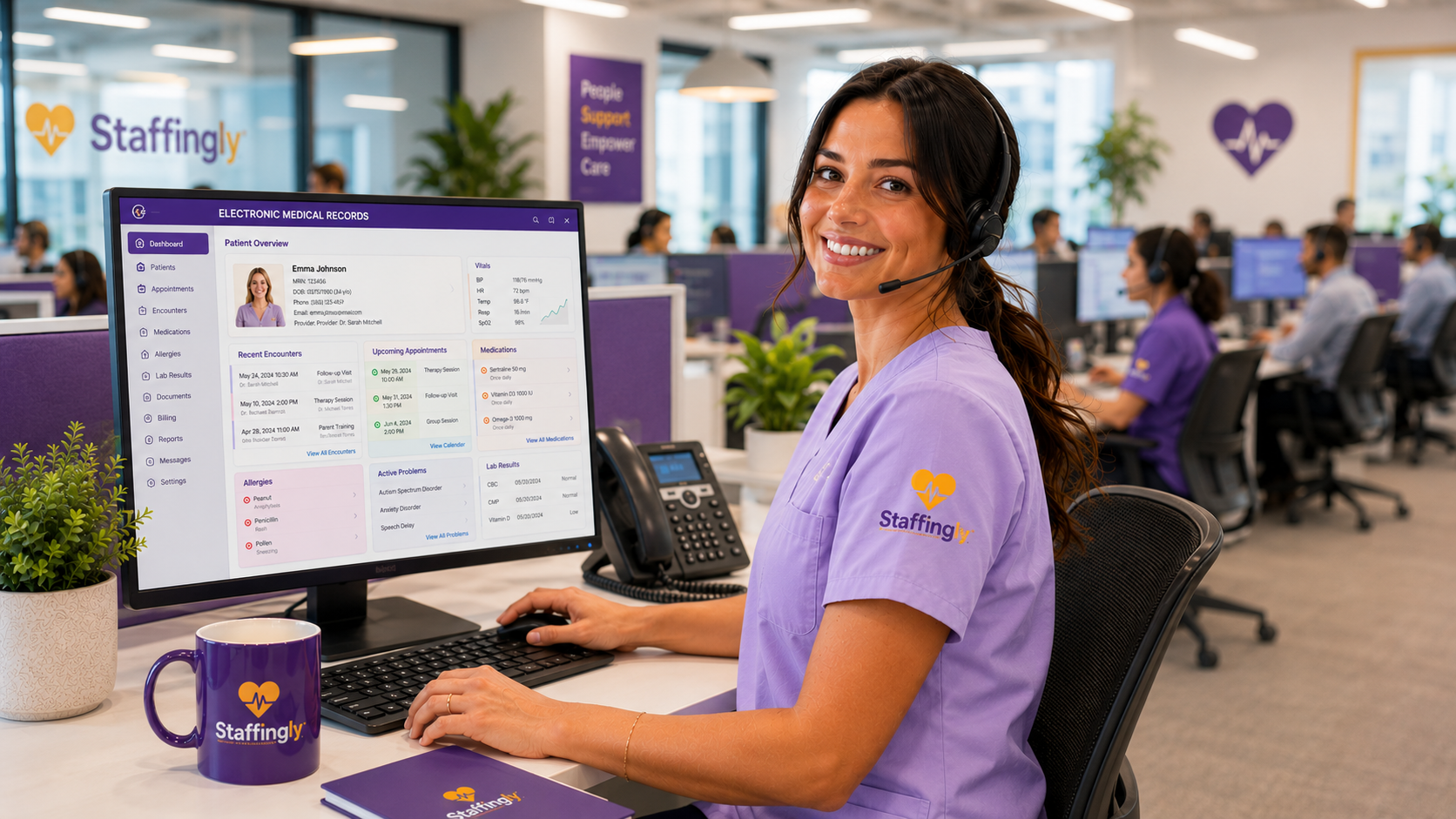
Before anyone touches a production system, new team members train on your SOPs through our SOP library, live client training sessions, and supervised practice runs. For a screening program that means learning your recall protocol, your scheduling rules, your payer mix for 92229, and your referral pathways before day one of live work. Each specialist works under an individual HIPAA agreement with named, auditable credentials in your systems, never shared logins, and a trained backup is ready at no charge whenever your specialist is out. Daily production reporting, in your format, from the first week.
Why Outsource This Work, and Why Staffingly
The exam takes minutes; the recall, benefits, claims, and referral work around it takes staff hours every week. We staff that work as a dedicated job, so the program is not competing with the phones for front-desk attention.
A flat weekly fee per dedicated specialist, with no setup fees and no percentage of collections. A new service line like 92229 screening stays easy to model: the cost is fixed, the volume upside is yours.
The same pod covers the front-office side (recall, scheduling, confirmation) and the revenue side (benefits, claims, denials), so nothing is handed between vendors mid-workflow.
Most teams go live in about 14 days. 2-Week Free Trial. Replace any team member in 48 hours. 800+ providers served, 4.9 Google rating you can verify on our listing.
Process and Onboarding
20 to 30 minutes on Teams. We map your screening workflow, patient volume, and payer mix before we meet.
Named user credentials per specialist in your EHR and practice management system, least-privilege roles, your approval on every account.
Your recall protocol, scheduling rules, 92229 payer detail, and referral pathways, with supervised production from day one.
Daily production reports, weekly KPI review, month-to-month after your 2-Week Free Trial.
Security and Compliance
HIPAA-trained staff. Business Associate Agreements executed with every client. Workflows designed to support HIPAA compliance, with SOC 2 Type II attestation, ISO 27001:2022, $5M E&O and cyber liability coverage, and named individual credentials with full audit logs. Read the complete program, including our corporate structure and evaluation framework, at HIPAA and Security at Staffingly.
Flat Weekly Pricing Per Dedicated Specialist
1 to 4 dedicated FTEs.
5 to 9 FTEs.
10+ FTEs.
45 hours of coverage for less than others charge for 40.
$399 per week works out to $8.87 per hour across 2,340 hours of coverage a year, flat. Your dedicated specialist covers a 9 hour day, Monday to Friday, a full hour more than a standard shift: the day starts by clearing what arrived after you closed, overnight faxes, refill requests, and portal messages, and it ends past your close so far less rolls into tomorrow. A trained backup steps in at no charge whenever they are out. Flat weekly fee per dedicated specialist, never a percentage of your collections, no setup fees.
Start with a 2-Week Free Trial. Month-to-month after, with no long-term contract.
- Salary + payroll taxes + benefits
- Recruiting + turnover replacement
- Training on your specialty + EMR
- EMR seat + equipment + PTO coverage
Calculate Savings
LumineticsCore Support: Frequently Asked Questions
Can you outsource the administrative work around a LumineticsCore program?
Yes. The exam stays with your trained in-office operator and the FDA-cleared AI. A dedicated remote team can own the administrative side: diabetic patient recall, scheduling, eligibility and benefits for CPT 92229, claim submission and denial follow-up, referral coordination for positive results, and quality-measure list work, all inside your own EHR and practice management system.
Do Staffingly staff operate the camera or take part in the exam?
No. LumineticsCore exams are performed in your office by your trained operator, and the AI produces the diagnostic result. Staffingly staff do not operate the camera, do not interpret images or results, and do not provide clinical services. The boundary is written into the SOW.
What CPT code applies to a LumineticsCore exam?
CPT 92229 covers point-of-care retinal imaging with automated analysis. CMS has finalized a national payment rate for the code under Medicare. Our team verifies each patient’s plan before the visit and works the claims in your practice management system.
Does insurance cover CPT 92229?
Medicare pays a national rate; commercial and Medicaid coverage varies by payer and plan. That variation is exactly why benefits verification before the visit matters: we document coverage and copay detail per patient so claims do not start life as denials.
What happens when a patient screens positive?
Your provider decides the clinical next step. Our team handles the administrative follow-through: preparing the referral per your protocol, calling the patient, booking the ophthalmology or optometry appointment, sending records, and tracking the referral until the loop closes.
Do your staff work inside LumineticsCore itself?
The administrative work lives in your EHR and practice management system: recall lists, schedules, eligibility, claims, referrals, and reports. Exam results are routed into the chart per your documentation SOPs. Access to any system is through named individual accounts you approve, with least-privilege roles and full audit logging.
Is this secure and HIPAA-ready?
HIPAA-trained staff, executed BAAs, workflows designed to support HIPAA compliance, SOC 2 Type II, ISO 27001:2022, and $5M in coverage. Full detail on our security page.
How fast can a dedicated team start, and what does it cost?
Most teams go live in about 14 days: access setup, training on your workflows, then supervised production. Pricing is a flat weekly fee per dedicated specialist, $399 for 1 to 4 FTEs, $349 for 5 or more, $299 for 10 or more, starting with a 2-Week Free Trial.

Written By
Dan Nandan has spent 25+ years in IT consulting and healthcare BPO, was among the first in the US to build an RPO/BPO delivery network overseas, and has been featured in Computerworld. He runs the operations and the dedicated virtual teams behind the administrative workflows on this page.
Connect on LinkedInSee what a dedicated team changes in 14 days.
Book a strategy meeting. Dan Nandan, CEO, joins most calls personally. Real conversation, real numbers for your practice.
Claim Your 2-Week Free TrialLumineticsCore and IDx-DR are trademarks of Digital Diagnostics Inc. Staffingly, Inc. is an independent outsourcing company and is not affiliated with or endorsed by Digital Diagnostics. Staffingly provides administrative support only and does not perform, operate, or supervise any diagnostic examination.