
 Book a Demo to Build Your Team Today!
On-Demand Outsourcing BPO Services for Healthcare Providers With 24/7 Coverage!
Save up to 70% on staffing costs!
Browse Specialty Staffing Services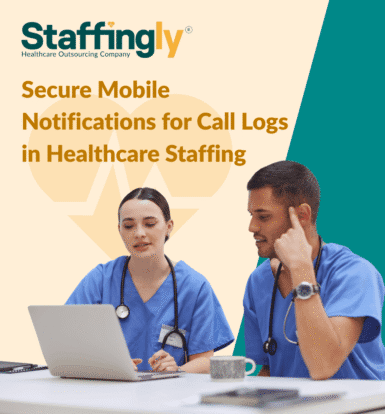


Secure Mobile Notifications for Call Logs in Healthcare Staffing
In today’s fast-paced workplace, seamless and secure access to information isn’t just convenient it’s essential. Consequently, mobile notifications have emerged as a transformative solution, freeing professionals from being tethered to their desktops and enabling immediate, secure access to critical call logs directly on their mobile devices. The Shift from Desktop Dependency For years, organizations relied primarily on desktop-based systems to access, track, and manage call logs, thus keeping workers tied to their desks and limiting their responsiveness. However, as workplace
 Sophia Wilson
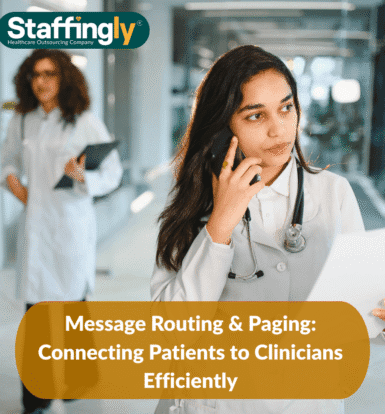
Message Routing & Paging: Connecting Patients to Clinicians Efficiently
In a busy clinical environment, fast and accurate message routing can make all the difference for patient care. Paging and message routing systems help ensure that critical updates, urgent patient needs, and routine requests are directed to the right provider or department without delays. Whether handled manually by live agents or automated through secure AI tools, this process is key to keeping communication seamless and HIPAA-compliant. Steps: How Does Clinical Message Routing & Paging Work? Initial Patient Call or Message
 William Brown

How One Frustrated Patient Call Led Us to Bilingual Support ?
In healthcare, language barriers are more than just a communication issue; they can lead to frustration, miscommunication, and ultimately diminished trust between patients and providers. One such call from a frustrated Spanish-speaking patient highlighted the gaps in support for non-English-speaking communities. This experience led to a significant shift in how we approach patient care—introducing bilingual support to better serve Spanish-speaking patients and restore trust. This article explores the importance of bilingual support in healthcare, the benefits it provides to both
 Emma Davis
Trained Medical Agents: Why Healthcare Calls Need Specialists
A HIPAA-compliant answering service is a specialized solution for healthcare providers that handles patient calls, messages, and scheduling while ensuring strict compliance with the Health Insurance Portability and Accountability Act (HIPAA). These services use encrypted technology, secure workflows, and trained staff to protect Protected Health Information (PHI) at every touchpoint. Think of it as a secure extension of your practice’s front desk—available 24/7. Steps: How Does a HIPAA-Compliant Answering Service Work? Initial Assessment & Onboarding:The healthcare provider signs a Business
William Brown

Night Shift Patients Actually Call at 9 PM Seriously
When a busy family medicine practice enabled after-hours phone and online scheduling, administrators expected occasional off-hour requests. Instead, they saw a consistent spike at exactly 9 PM—especially from nurses finishing late shifts, manufacturing staff completing evening runs, and parents balancing bedtime routines. This unexpected demand revealed a hidden patient segment that can now be served thanks to Staffingly‘s seamless 24/7 scheduling solutions. Uncovering the Demand: Real-Time Data Insights After implementing Staffingly‘s round-the-clock scheduling and call coverage system, a mid-Atlantic clinic
Emma Davis
What Happens If Coverage Is Inactive at Time of Service?
A patient, Mark, checks in for his routine visit. He hands over his insurance card, confident everything is fine. The front desk runs an eligibility check—and gets a red flag: coverage inactive. Now the clock is ticking. The waiting room is full. Mark is confused. The front desk is scrambling. The doctor’s schedule is about to fall apart. This is the real-world ripple effect of inactive insurance coverage at the time of service. The Growing Challenge of Inactive Coverage In
William Brown
How Virtual Medical Assistants Are Changing Healthcare—One Task at a Time
Imagine walking into your exam room and giving your full attention to your patient—no typing, no toggling between screens, no distractions. Meanwhile, an AI scribe is documenting the entire visit in real time, and once it’s over, a Virtual Care Assistant (VCA) is already scheduling follow-ups, refilling prescriptions, and sending out personalized care summaries. This isn’t the future anymore. It’s 2025, and this is now standard care. From Optional to Essential Healthcare has hit a tipping point. Rising patient volumes,
William Brown
Reducing Errors in Healthcare Emergencies with Call Protocols
A Common Emergency Breakdown At a regional urgent care facility in Charlotte, North Carolina, the administrative lead Sarah Wells recalls the chaos of real emergency calls. “Staff froze. People forgot key questions. Every second felt like an hour,” she explains. Despite regular training, emergencies were unpredictable—and staff members were overwhelmed. Calls about seizures, chest pain, child injuries, or medication overdoses required speed, clarity, and calm. But instead, clinics found themselves stuck in hesitation loops, making panicked calls or fumbling through
Sophia Wilson
 Read Case Studies
Ready to Build Your Team?

Categories

Recent Posts
- Revenue Cycle Management: The Complete Guide to Maximizing Your Practice’s Financial Health
- Prior Authorization Is Costing Your Practice 16+ Hours Per Week: Here’s How to Fix It
- How AI Voice Bots Are Fixing the Healthcare Front Desk?
- How To Cut Claim Denials In Half Without Adding More Staff?
- How AI Chatbot Services Are Redefining Patient Communication for Clinics?

 Virtual Medical Assistants
 Insurance Verification
 Prior Authorization (AI)
 Medical Scribing (AI)
 Telemedicine Services
 Medical Data Entry
 Medical Coding
 Revenue Cycle Management