
 Book a Demo to Build Your Team Today!
On-Demand Outsourcing BPO Services for Healthcare Providers With 24/7 Coverage!
Save up to 70% on staffing costs!
Browse Specialty Staffing ServicesSummarize this blog post with:
How Do Scripted Responses Improve Communication with Non-English Patients in Healthcare?
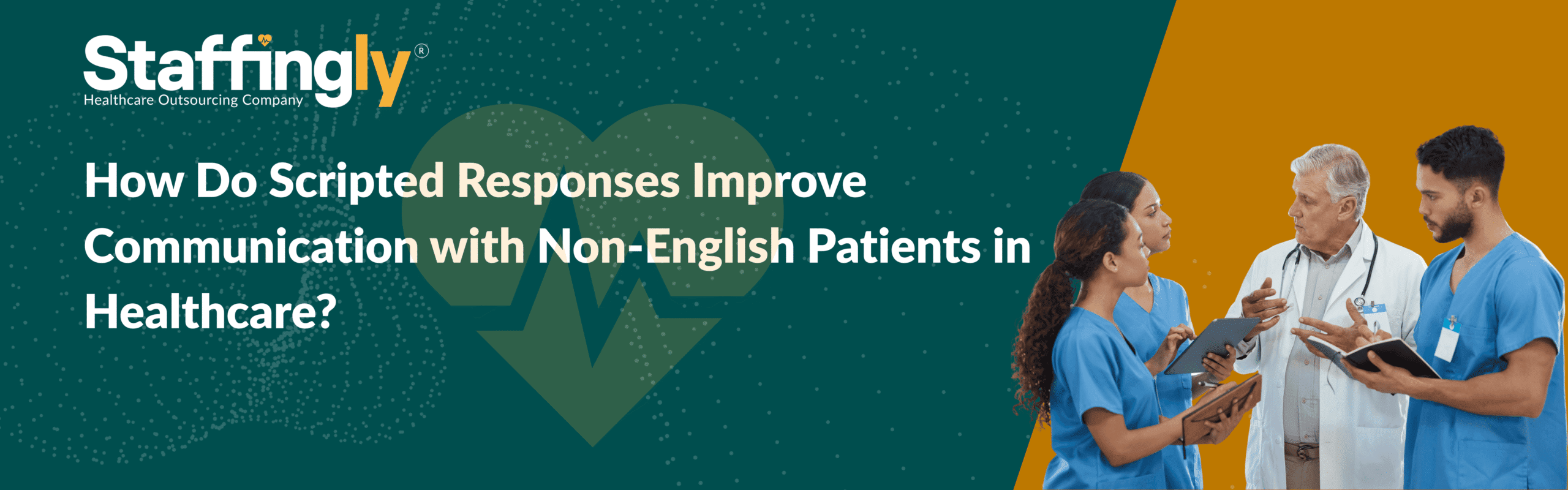
Scripted responses are predefined, standardized messages or dialogues that healthcare providers use to communicate with patients. These scripts are designed to convey essential information, such as medical instructions, appointment details, and consent forms, in a way that is simple, clear, and easy to understand. In the context of non-English-speaking patients, healthcare providers typically translate these scripts into the patient’s preferred language and often use them alongside interpreters or translation services.
| LEP Patient Communication Metric | Traditional Ad-Hoc Communication | Scripted Responses + Interpretation | Patient Outcome Improvement |
|---|---|---|---|
| US Limited English Proficiency Population | 26 million LEP residents (8% ages 5+) | Growing need for multilingual services | Access to preferred language providers |
| US Households Speaking Non-English | 1 in 5 American households (20%) | Diverse linguistic requirements | Breaking down language barriers critical |
| UK Population Speaking Limited English | 21.47% limited, 0.26% no English at all | NHS language support services | Reduce vulnerability & health inequalities |
| Clinician Monthly LEP Patient Encounters | 67.4% have ≥1 encounter per month | Standardized scripts ensure consistency | Frequent encounters require tools |
| Professional Language Line Usage | Only 8.7% always use, 17.4% often use | 45.6% use rarely, 28.3% never use | Scripted responses improve access |
| Ad-Hoc Interpretation Methods | 95.6% use friends/relatives, 76.1% online | Increased errors & miscommunication risk | Professional interpretation needed |
| Language Concordant RN Visits | Only 18.1% RN, 26.7% PT with LEP patients | 13.1% Spanish speakers language concordant | Scripts bridge concordance gaps |
| Human Interpreter Access | 8.9% Spanish, 3.0% Korean, 2.5% Chinese | Limited interpreter availability | Scripted responses augment services |
| Medication Confusion from Language Barriers | 35% confused about medication usage | Clear scripted instructions in native language | Reduced medication errors & confusion |
| Adverse Medication Reactions | 16% suffered bad reactions due to misunderstanding | Standardized dosage/usage explanations | Improved medication adherence & safety |
| Healthcare Access Barriers | 65% non-English speakers face barriers | 20% avoid care fearing misunderstanding | Scripts increase access & reduce fear |
| LEP Patient Health Status | Worse overall health vs. English proficient | Preferred language access helps disparities | Improved health care experiences |
| Patient Satisfaction with Interpretation | Lower than language-concordant encounters | Remote simultaneous medical interpretation | Increased satisfaction & privacy protection |
| Patient Comprehension with Interpretation | Less than language-concordant encounters | Scripted responses simplify medical jargon | Enhanced understanding & decision-making |
| Privacy Protection with Interpretation | 38% usual & customary interpretation methods | 51% remote simultaneous medical interpretation | Better privacy perception with technology |
| Treatment Non-Adherence Risk | Higher risk with language barriers | Clear treatment plan scripts translated | Improved adherence & outcomes |
| Medical Errors Resulting in Physical Harm | Higher risk with LEP patients | Standardized scripts reduce errors | Enhanced patient safety |
| Hospital Length of Stay | Longer stays for LEP patients | Efficient discharge instructions via scripts | Reduced length of stay |
| Hospital Readmission Rates | Increased readmissions vs. English proficient | Clear post-care scripted instructions | Decreased readmission rates |
| Healthcare Provider Communication Stress | Stress & burnout from language barriers | Scripts streamline communication process | Reduced provider burden & burnout |
How to Implement Scripted Responses in Healthcare Settings?
Integration with Interpretation Services
Healthcare providers should combine scripted responses with professional interpretation services, whether in person or via phone or video. Providers can use scripts as a foundation for communication, while interpreters ensure accurate translation into the patient’s language. This collaboration improves the quality of communication and prevents the loss of important health information in translation.
Training Healthcare Providers
For scripted responses to work effectively, healthcare providers need proper training. Training should cover not only how to use the scripts but also how to deliver them with empathy and cultural sensitivity. Providers should learn to speak clearly, maintain eye contact, and use appropriate non-verbal cues. Effective training ensures providers deliver scripted responses in a way that promotes trust and understanding.
Regular Review and Update of Scripts
Healthcare providers must regularly review and update scripted responses to keep pace with evolving medical knowledge, updated procedures, and the latest terminology. As patient demographics change, healthcare organizations may need to adjust scripts to meet the specific needs of diverse cultural and linguistic groups. Regular updates ensure scripts remain relevant and effective.
How Outsourcing Can Enhance the Implementation of Scripted Responses?
Outsourcing can improve the implementation of scripted responses, particularly for healthcare organizations serving a high volume of non-English-speaking patients. Here’s how outsourcing helps:
Access to Expertise in Multilingual Services
By outsourcing to specialized language service providers, healthcare organizations gain access to experts in multilingual communication. These providers offer translation and interpretation services in multiple languages, ensuring scripts are accurately translated and culturally appropriate for different patient populations. Outsourcing reduces the risk of communication errors and enhances the patient experience.
Cost Savings
Outsourcing the development and management of scripted responses can be more cost-effective than maintaining an in-house translation team. Healthcare organizations can leverage the specialized skills of outsourced providers without bearing the overhead costs of internal teams. Additionally, outsourced services can scale to meet fluctuating patient demands, without the need for additional staffing resources.
Improved Efficiency and Focus on Core Healthcare Activities
By outsourcing the management of scripted responses and interpretation services, healthcare providers can focus more on patient care and clinical activities. Outsourcing reduces administrative burdens on healthcare staff, allowing them to devote more time to direct patient care. Providers can be confident that non-English-speaking patients will receive high-quality communication from experts, improving service quality.
Scalability
Outsourcing also enables healthcare organizations to scale language services easily. Whether responding to increased patient volumes or expanding language offerings, outsourced providers can quickly adjust to meet these demands. This flexibility ensures healthcare organizations can continue delivering high-quality communication to an increasingly diverse patient population.
Quality Control and Compliance
Outsourced providers who specialize in healthcare communication understand the importance of patient confidentiality, including HIPAA compliance. They ensure that all scripted responses and translations adhere to these standards, protecting patient information. Outsourcing partners also regularly review and update scripts to comply with changing regulations, helping healthcare providers stay compliant with legal and medical guidelines.
Benefits of Scripted Responses for Non-English-Speaking Patients
Consistency and Accuracy
Scripted responses ensure that healthcare providers deliver consistent, accurate information. Providers can use predefined scripts to guarantee all patients receive the same information. This method minimizes the risk of miscommunication and medical errors, especially when providers must discuss medications, treatment plans, or follow-up care. Consistency is vital in healthcare settings because incorrect information can lead to serious complications.
Improved Efficiency
Scripted responses streamline communication. When healthcare providers follow a set script, they convey essential information more quickly, avoiding lengthy explanations or repetitive questioning. This efficiency is particularly valuable in busy healthcare environments, where time is often limited. Scripted responses ensure providers share critical information clearly and concisely, saving both the healthcare provider’s and the patient’s time.
Cultural Sensitivity
Effective communication involves both language and cultural understanding. Scripted responses can account for cultural nuances when communicating with non-English-speaking patients. Healthcare providers can adapt scripts to use culturally appropriate language and address specific patient needs, building trust and making patients feel respected and valued. For example, scripts may reference culturally sensitive topics or common practices to improve patient comfort and engagement.
Support for Limited English Proficiency (LEP) Patients
For patients with limited English proficiency (LEP), understanding complex medical terms can be difficult. Scripted responses simplify medical jargon, making it easier for LEP patients to understand their health conditions and treatment options. This simplification reduces confusion and helps patients make informed decisions about their care. Scripts can also include visual aids or simpler language to further support comprehension.

Real-World Applications of Scripted Responses
Scripted responses can serve multiple functions in a healthcare setting:
Appointment Scheduling and Reminders: Healthcare providers can use scripted responses to confirm appointments, provide directions to the facility, or remind patients of upcoming visits. This helps reduce no-show rates and ensures patients understand where and when to go for care.
Patient Education: Scripted responses can help healthcare providers explain medical conditions or treatment plans in simple terms. These responses make it easier to communicate diagnoses, medications, and treatment options.
Consent Forms and Legal Information: Scripted responses help healthcare providers ensure patients fully understand informed consent, especially for high-stakes procedures. These scripts simplify complicated medical or legal language so patients can make informed decisions.
Post-Care Instructions: After procedures or treatments, healthcare providers can use scripted responses to provide clear post-care instructions, medication schedules, or lifestyle changes. This ensures patients understand follow-up care and helps prevent complications.
What Did We Learn?
Scripted responses are a powerful tool for improving communication with non-English-speaking patients in healthcare. By ensuring consistent, efficient, and culturally sensitive communication, healthcare providers can improve patient understanding, reduce errors, and enhance patient satisfaction. When combined with interpretation services, training for healthcare providers, and regular script updates, scripted responses can bridge language barriers, helping to deliver better healthcare outcomes for all patients, regardless of their language proficiency. Additionally, outsourcing these services to specialized providers can further streamline the process, offering expertise, cost savings, scalability, and compliance. With the right implementation, scripted responses can significantly enhance communication, leading to improved patient care and a more inclusive healthcare environment.
What People Are Asking?
-
What are scripted responses in healthcare?
Predefined messages used to convey essential information clearly to patients. -
How do scripted responses improve communication with non-English patients?
They ensure consistency, clarity, and cultural sensitivity for better understanding. -
What are the benefits of using scripted responses?
Consistency, efficiency, cultural sensitivity, and easier communication for LEP patients. -
How can healthcare providers implement scripted responses effectively?
By integrating interpretation services, training staff, and updating scripts regularly. -
How does outsourcing enhance scripted responses?
It provides expert translation, reduces costs, and ensures compliance and scalability.
Disclaimer:
For informational purposes only; not applicable to specific situations.
For tailored support and professional services
Please contact Staffingly, Inc. at (800) 489-5877
Email: support@staffingly.com
About This Blog: This Blog is brought to you by Staffingly, Inc., a trusted name in healthcare outsourcing. The team of skilled healthcare specialists and content creators is dedicated to improving the quality and efficiency of healthcare services. The team passionate about sharing knowledge through insightful articles, blogs, and other educational resources.
 Read Case Studies
Ready to Build Your Team?

Categories

Recent Posts
- Revenue Cycle Management: The Complete Guide to Maximizing Your Practice’s Financial Health
- Prior Authorization Is Costing Your Practice 16+ Hours Per Week: Here’s How to Fix It
- How AI Voice Bots Are Fixing the Healthcare Front Desk?
- How To Cut Claim Denials In Half Without Adding More Staff?
- How AI Chatbot Services Are Redefining Patient Communication for Clinics?

 Virtual Medical Assistants
 Insurance Verification
 Prior Authorization (AI)
 Medical Scribing (AI)
 Telemedicine Services
 Medical Data Entry
 Medical Coding
 Revenue Cycle Management