

 Book a Demo to Build Your Team Today!
On-Demand Outsourcing BPO Services for Healthcare Providers With 24/7 Coverage!
Save up to 70% on staffing costs!
Browse Specialty Staffing Services


Real-Time Patient Cost Estimator: Enhancing Transparency in Healthcare Revenue Cycle Management
As healthcare shifts toward a more consumer-driven model, patients are demanding clarity—not just in their care, but in their costs. One of the most impactful innovations supporting this shift is the Real-Time Patient Cost Estimator, a tool increasingly integrated into Revenue Cycle Management (RCM) systems. This technology enables providers to deliver accurate, up-front out-of-pocket cost estimates before services are rendered. In doing so, it strengthens financial transparency, boosts collections, and improves the overall patient experience. What is a Real-Time Patient
 Noah Thomas
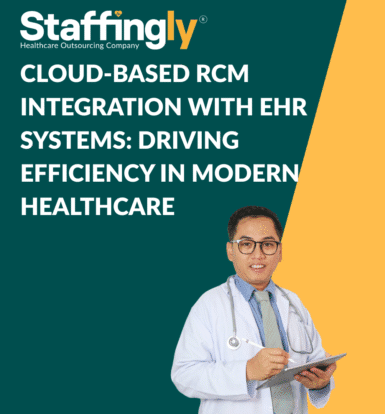
Cloud-Based RCM Integration with EHR Systems: Driving Efficiency in Modern Healthcare
In today’s fast-evolving healthcare environment, operational efficiency and financial performance are paramount. As healthcare organizations strive to deliver high-quality care, they must also ensure timely reimbursements and cost-effective administration. This is where the integration of cloud-based Revenue Cycle Management (RCM) solutions with Electronic Health Record (EHR) systems plays a transformative role. By seamlessly connecting clinical data with financial workflows, cloud-based RCM-EHR integration offers a scalable, secure, and efficient way to improve revenue capture, reduce administrative burden, and enhance patient satisfaction.
Noah Thomas

What makes radiology prior authorizations uniquely complex for clinics?
It’s 8:30 AM at a diagnostic imaging center. A patient urgently needs an MRI to rule out a spinal injury. The technician preps the machine. The physician is ready. But the scan gets delayed not due to a clinical issue, but because the insurance prior authorization (PA) hasn’t cleared. Sound familiar? This scenario plays out daily across radiology centers, where the biggest barrier to timely imaging isn’t patient readiness it’s administrative backlog. What Is Prior Authorization? Prior authorization is a
 Sophia Wilson

Can Outsourcing Cut Administrative Costs for Clinics and Hospitals?
It’s Monday morning at a busy outpatient clinic. Phones are ringing off the hook, front-desk staff are buried in paperwork, and the billing coordinator is once again working overtime. Despite packed patient schedules, profit margins remain tight. Providers, already stretched thin, are overwhelmed by administrative overload. The question isn’t if help is needed it’s how to get it without blowing the budget. That’s exactly where digital healthcare outsourcing comes in. More clinics and hospitals are turning to this strategy to
Sophia Wilson

Is Your Prior Authorization Process HIPAA Compliant While Improving Approval Speed?
The clinic was buzzing. Dr. Patel had just diagnosed a patient with a condition requiring an urgent MRI. But the real bottleneck wasn’t the scan—it was the prior authorization. The front desk scrambled to submit paperwork, fax forms, and make calls. Meanwhile, the patient waited days. The delay wasn’t just frustrating—it was risky. In today’s fast-paced healthcare world, speed matters. But so does compliance. Especially when dealing with protected health information (PHI), every click, call, and form needs to meet
 Venkata Ramarao Sanka

Is your outsourced medical coding process HIPAA-certified and efficient?
The audit report wasn’t what the clinic expected. Over 15% of the claims submitted in the last quarter were either under-coded or missing supporting documentation. Worse, some PHI had been shared with a third-party vendor that wasn’t HIPAA-compliant. The billing backlog grew, reimbursements slowed, and trust was lost—not just with the payers, but with patients too. All of this stemmed from a common oversight: outsourcing medical coding to a partner that wasn’t certified or secure enough. Why Outsourced Coding Deserves
 Emma Davis

Are Your Remote Medical Scribes HIPAA Secure When Handling Patient PHI?
It was a busy Monday morning. Dr. Nguyen was juggling back-to-back appointments when he noticed something alarming: a patient note from his remote scribe included sensitive mental health details—typed into the wrong chart. It wasn’t malicious. Just a mistake. But it raised serious questions about compliance, data safety, and who’s really accountable when remote scribes manage protected health information (PHI) from afar. Remote medical scribes can make clinical workflows faster and more efficient—but without HIPAA-secure processes, they can also become
Venkata Ramarao Sanka

How to Cut Costs with Virtual Medical Assistants and Free Up Time for Better Patient Care?
The phones wouldn’t stop ringing. Mrs. Gomez, the front desk coordinator, was juggling insurance verifications, rescheduling a last-minute cancellation, and chasing down a claim from last month—all while trying to calm a frustrated walk-in patient. The clinic was growing, but so were the administrative bottlenecks. Hiring more in-house staff? Too expensive. Then her clinic partnered with a Virtual Medical Assistant (VMA)—and suddenly, the phones were answered, billing errors dropped, and the stress lifted. All without adding a single desk. Why
Venkata Ramarao Sanka
 Read Case Studies
Ready to Build Your Team?

Categories

Recent Posts
- Revenue Cycle Management: The Complete Guide to Maximizing Your Practice’s Financial Health
- Prior Authorization Is Costing Your Practice 16+ Hours Per Week: Here’s How to Fix It
- How AI Voice Bots Are Fixing the Healthcare Front Desk?
- How To Cut Claim Denials In Half Without Adding More Staff?
- How AI Chatbot Services Are Redefining Patient Communication for Clinics?

 Virtual Medical Assistants
 Insurance Verification
 Prior Authorization (AI)
 Medical Scribing (AI)
 Telemedicine Services
 Medical Data Entry
 Medical Coding
 Revenue Cycle Management