

 Book a Demo to Build Your Team Today!
On-Demand Outsourcing BPO Services for Healthcare Providers With 24/7 Coverage!
Save up to 70% on staffing costs!
Browse Specialty Staffing ServicesSummarize this blog post with:
How does HIPAA ensure patient data safety in virtual scribing?

Virtual medical scribes are transforming the healthcare industry by joining patient visits from secure locations to capture notes, orders, and codes. This technology allows healthcare providers to focus more on patient care instead of administrative tasks. But the primary concern for clinics remains: Is patient data safe?
💬 “If a scribe isn’t onsite, how do we ensure nothing leaks?”
This guide breaks down how HIPAA protects patient health information (PHI) in virtual scribing and the essential controls healthcare providers should require from any scribing partner.

What HIPAA Actually Requires ?
Protected Health Information (PHI) refers to any patient data tied to care, payment, or operations. In virtual scribing, PHI typically flows through Electronic Health Records (EHR), secure audio streams, and task management tools. HIPAA regulates how this PHI is accessed, transmitted, stored, and destroyed.
The core HIPAA pillars for virtual scribing include:
-
Privacy Rule: Use or disclose only the minimum necessary PHI.
-
Security Rule: Implement administrative, physical, and technical safeguards for ePHI.
-
Breach Notification Rule: Detect, document, and report incidents promptly.
HIPAA Safeguard
How It’s Applied in Virtual Scribing
Risk Prevented
Compliance Outcome
Business Associate Agreement
Defines PHI use, breach response, subcontractor rules
Uncontrolled data sharing
Legal accountability
Role-based access (RBAC)
Scribes access only visit-specific data
Over-permissioned users
Minimum necessary standard
Encrypted audio & EHR access
TLS encryption, no local recordings
Interception or leakage
Secure PHI transmission
Device & workspace controls
Encrypted devices, no local storage
Lost or stolen data
Physical & technical safeguards
MFA & session monitoring
Multi-factor login and timeouts
Credential misuse
Strong authentication
Audit logs & reviews
Tracked access, alerts, quarterly audits
Undetected misuse
Audit readiness
| HIPAA Safeguard | How It’s Applied in Virtual Scribing | Risk Prevented | Compliance Outcome |
|---|---|---|---|
| Business Associate Agreement | Defines PHI use, breach response, subcontractor rules | Uncontrolled data sharing | Legal accountability |
| Role-based access (RBAC) | Scribes access only visit-specific data | Over-permissioned users | Minimum necessary standard |
| Encrypted audio & EHR access | TLS encryption, no local recordings | Interception or leakage | Secure PHI transmission |
| Device & workspace controls | Encrypted devices, no local storage | Lost or stolen data | Physical & technical safeguards |
| MFA & session monitoring | Multi-factor login and timeouts | Credential misuse | Strong authentication |
| Audit logs & reviews | Tracked access, alerts, quarterly audits | Undetected misuse | Audit readiness |
How HIPAA Keeps Virtual Scribing Safe (When Done Right) ?
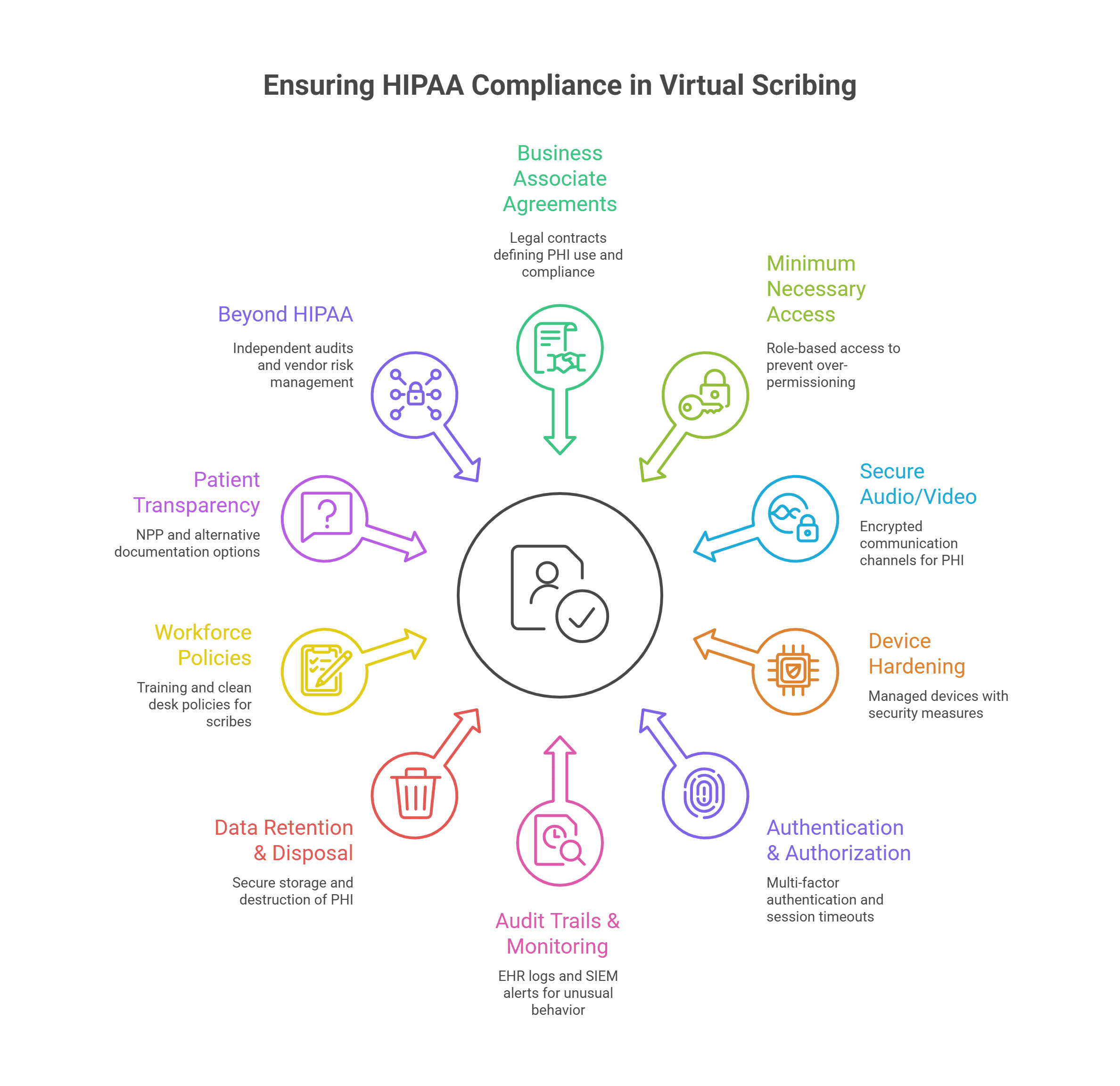
1) Business Associate Agreements (BAAs)
Virtual scribe vendors are Business Associates under HIPAA. Your clinic must have a BAA that:
-
Defines permitted use of PHI (scribing only; no re-use for training without de-identification).
-
Requires reporting of breaches and cooperation.
-
Ensures subcontractor compliance (downstream BAAs).
2) Minimum Necessary + Role-Based Access
-
Scribes receive only the least-privileged access in the EHR (no billing setup, no export rights).
-
Task tools show only the fields necessary to complete documentation.
-
No PHI is shared in general chat channels, screenshots, or sticky notes.
3) Secure Audio/Video Intake
-
Encrypted sessions (using TLS for transport and approved telehealth platforms).
-
No local recordings on scribe devices unless explicitly authorized and stored within the covered entity’s environment.
-
Dictation audio must be encrypted end-to-end, with access logs.
4) Device & Workspace Hardening (Physical + Technical)
-
Managed devices with full-disk encryption, auto-lock, patching, and remote wipe capabilities.
-
Screen privacy policies, no shoulder-surfing, and camera-off unless required.
-
Zero data retention on scribe laptops (work only inside the EHR, disable local downloads).
-
Network controls like VPN/zero-trust protocols and no use of public Wi-Fi.
5) Authentication & Authorization
-
Multi-Factor Authentication (MFA) for all logins and periodic re-authentication for high-risk actions.
-
Session timeouts and IP/geo-location rules to prevent credential abuse.
6) Audit Trails & Monitoring
-
EHR audit logs track who viewed or changed information, and when.
-
Security Information and Event Management (SIEM) alerts monitor unusual activity (e.g., bulk chart openings, off-hours access).
-
Quarterly access reviews and immediate removal of access upon role changes or terminations.
7) Data Retention & Disposal
-
Scribe work product stays within the EHR; vendors should not retain PHI.
-
Automatic deletion of temporary files or caches.
-
Certified media destruction for end-of-life hardware.
8) Workforce Policies, Training, Sanctions
-
Annual HIPAA training, with documented proficiency.
-
Clean desk and no-paper policies for remote scribing.
-
Progressive discipline for violations, detailed in the BAA.
9) Patient Transparency & Consent
-
The Notice of Privacy Practices (NPP) must mention the use of virtual scribes.
-
Patients should have an alternative option, such as a scribe-free visit or provider documentation upon request.
10) Beyond HIPAA (Defense-in-Depth)
-
Independent audits (SOC 2 Type II, ISO 27001).
-
Vendor risk management, including security questionnaires, penetration tests, and insurance coverage (cybersecurity and errors & omissions).
-
For behavioral health/SUD providers, consider 42 CFR Part 2 applicability.
Where Virtual Scribing Usually Fails (and How to Avoid It)
-
Shadow Tools: Notes in non-HIPAA chat apps → Lock down permitted apps.
-
Local Files: Dictation saved on desktops → Implement storage policies and Data Loss Prevention (DLP).
-
Over-Permissioned Access: Scribes with export rights → Regular Role-Based Access Control (RBAC) audits.
-
Unmonitored After-Hours Access: No alerts for unusual access → Implement SIEM and alerts.
-
Ambiguous BAAs: Gaps with subcontractors → Ensure downstream BAAs are signed.
HIPAA-First Virtual Scribing with Staffingly
Virtual scribing should be seamless for patients and robust in compliance. Staffingly provides HIPAA-trained scribes, managed devices, zero-retention workflows, MFA-driven EHR access, and 24/7 monitoring, allowing your team to document more efficiently while protecting PHI.
What Did We Learn?
Virtual scribing is HIPAA-safe when privacy (minimum necessary) and security (admin, physical, and technical safeguards) work together. The BAA serves as the central control, while RBAC, MFA, logging, and zero retention form the critical guardrails.
Most risks aren’t exotic—they stem from everyday workflow leaks, but strong policies and the right tools can prevent them.
What People Are Asking
Q: Do we need patient consent for a virtual scribe?
A: Inform patients via your NPP and honor requests for scribe-free visits. For sensitive services, consult counsel regarding state/Part 2 nuances.
Q: Can scribes work from home securely?
A: Yes, as long as they use managed, encrypted devices, approved networks, privacy screens, and have no local PHI storage, with audits to confirm security.
Q: Are AI tools allowed in scribing?
A: Yes, if they comply with HIPAA, are covered by the BAA, avoid using identifiable data for training, and ensure PHI remains within your environment.
Q: Who owns the notes?
A: The covered entity. Scribes create documentation within your EHR; vendors should not retain PHI.
Q: How do we prove compliance if audited?
A: Provide BAAs, training records, role maps, device/MDM reports, audit logs, incident response plans, and third-party attestations.
Disclaimer
For informational purposes only; not applicable to specific situations.
For tailored support and professional services
Please contact Staffingly, Inc. at (800) 489-5877
Email: support@staffingly.com
About This Blog: This Blog is brought to you by Staffingly, Inc., a trusted name in healthcare outsourcing. The team of skilled healthcare specialists and content creators is dedicated to improving the quality and efficiency of healthcare services. The team passionate about sharing knowledge through insightful articles, blogs, and other educational resources.
 Read Case Studies
Ready to Build Your Team?

Categories

Recent Posts
- Revenue Cycle Management: The Complete Guide to Maximizing Your Practice’s Financial Health
- Prior Authorization Is Costing Your Practice 16+ Hours Per Week: Here’s How to Fix It
- How AI Voice Bots Are Fixing the Healthcare Front Desk?
- How To Cut Claim Denials In Half Without Adding More Staff?
- How AI Chatbot Services Are Redefining Patient Communication for Clinics?

 Virtual Medical Assistants
 Insurance Verification
 Prior Authorization (AI)
 Medical Scribing (AI)
 Telemedicine Services
 Medical Data Entry
 Medical Coding
 Revenue Cycle Management