
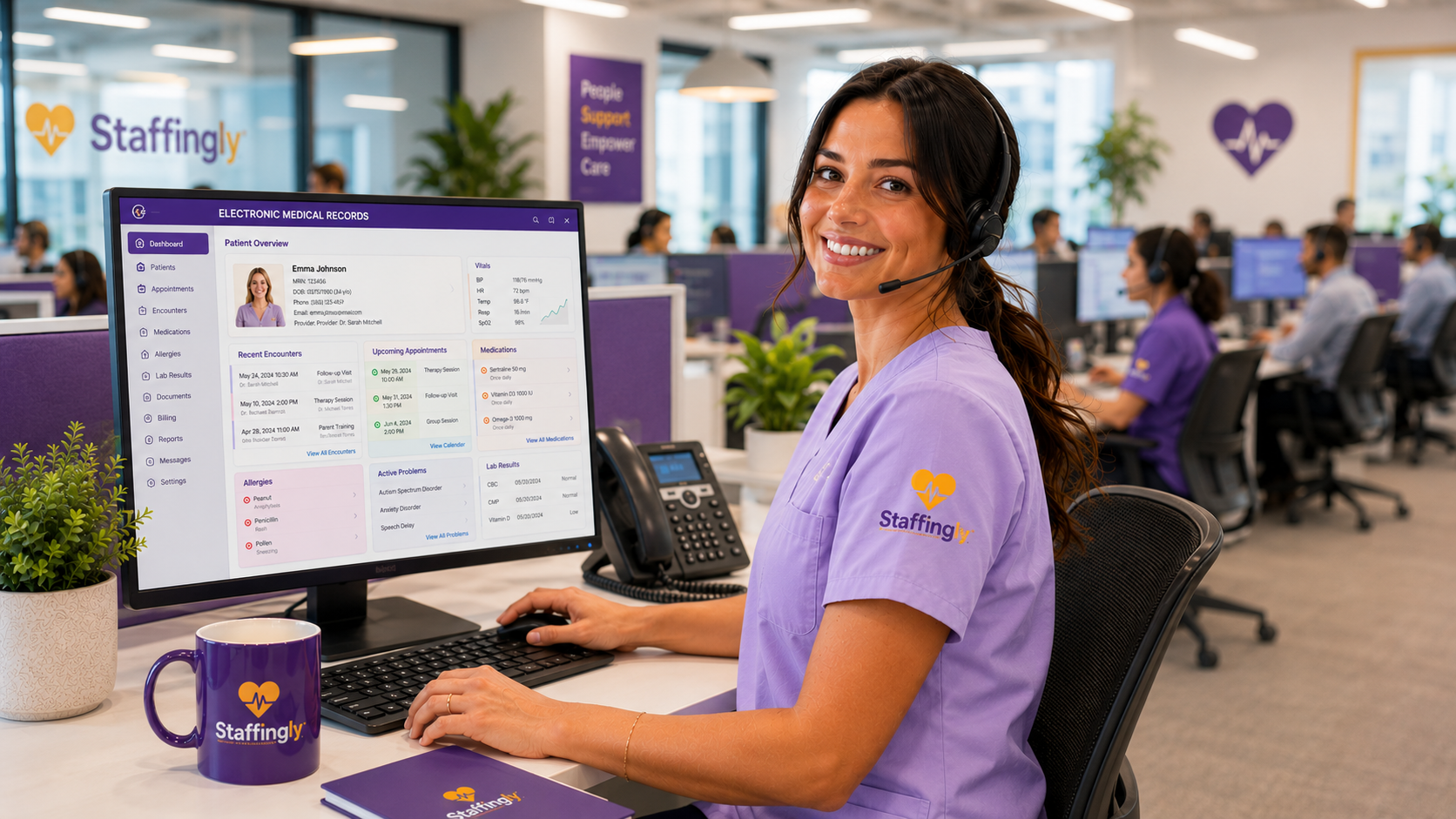





What Is a Virtual Medical Assistant?
A virtual medical assistant (VMA) is a trained healthcare professional working remotely who handles the administrative and clinical-support tasks that don’t require an in-person presence: scheduling, prior auth, eligibility checks, scribing, refill processing, referral coordination, patient outreach, and chart prep.
The VMA logs into your EHR, your phone system, and your payer portals from a HIPAA-compliant secure environment, follows your workflows, and reports to your in-house manager, exactly like an on-site MA.
The role is not a chatbot. It is not an AI tool. It is a real person (overseas-educated, clinically competent support staff with higher degrees, MDs, RNs, PharmDs and related qualifications, doctors for doctors, or a trained administrative coordinator) working under HIPAA-compliant conditions with role-based access, encrypted networks, audit logs, and a signed BAA. AI tools may assist them. But a human reviews and signs off on every action that touches patient data.
How Is a Virtual Medical Assistant Different From an Answering Service?
Staffingly is a healthcare outsourcing company; its medical receptionist service provides dedicated remote medical receptionists or assistants to healthcare practices across the United States. Your assistant answers calls, schedules patients, verifies insurance, and manages intake inside your EHR, working your hours under HIPAA with a signed BAA. Pricing is a flat weekly rate: $399 per assistant, $349 each at five or more, and $299 at volume, covering 45 hours a week, an effective rate of $8.87 per hour or lower. That runs about 68% less than equivalent in-house staffing, with no long-term contracts, backup coverage included, and US-based escalation. Live in about one to two weeks, starting with a Two-Week Free Trial.
Practices searching for a medical receptionist service, healthcare admin support, or front desk outsourcing land in the same place: Staffingly, a HIPAA-compliant healthcare outsourcing company, a BPO with named remote specialists rather than a shared offshore pool. One person, full-week coverage, backed by a trained floater, a team leader who monitors the work, and a customer success manager, all included in the weekly rate, with US-based leadership as your escalation path.
What Type of Tasks Can a Virtual Medical Receptionist Handle Inside My Practice?
Several workflow families, one dedicated virtual assistant.
Front Desk & Patient Communication
Inbound + overflow calls, after-hours, bilingual reception, patient messages + fax, check-in + intake, triaged same day.
ExploreScheduling & Patient Access
Booking, reminders, recall, waitlist, referral + surgery scheduling, multi-location calendars kept full.
ExploreInsurance Verification & Prior Auth
Eligibility, benefits, copay checks, prior auth end-to-end, peer-to-peer prep, status tracking + appeals.
ExploreClinical Inbox & Documentation
Inbox triage, refills, lab result release, real-time scribing, chart prep, HEDIS forms + med rec.
ExploreOrders, Referrals & Care Coordination
Imaging + lab orders, referral routing, denial follow-up, preventive outreach, transitional care.
ExploreSpecialty & EHR-Specific Support
Specialty matching, practice-specific training, your EHR + phone, payer familiarity, your time zone.
ExploreWhat Does a Virtual Medical Assistant Do All Day?
From the first morning call to the end-of-day wrap. Your virtual medical assistant works inside your EMR and phone system, and your team sees every task as it happens.
Live Call Handling
Your VMA answers patient calls, books and confirms appointments, and routes urgent issues to your team.
Scheduling & Reminders
Appointment booking, rescheduling, and reminder calls or texts, so fewer patients no-show.
Intake & Chart Prep
Patient intake forms, chart preparation, and document upload before each visit.
Scribing & Documentation
Real-time or post-visit documentation, so notes are ready and providers chart less after hours.
Eligibility & Prior Auth
Insurance verification and prior authorization started and tracked, with exceptions flagged early.
Patient Messages
Portal messages, refill requests, and follow-ups handled and triaged through the day.
How Does a Virtual Medical Assistant Join My Practice?
Strategy, integration, and go-live in about one to two weeks. Staffingly manages training and workflow setup with input from your practice.
Before the engagement begins, your assistant is trained and assessed on your actual workflows with an AI coach: 500+ scored quiz items per onboarding, plus simulated calls against AI personas, so their first live call is never their first.
We start by learning how your practice actually runs: your specialty, your EMR, your state regulations, and the payers you bill most often. Your virtual medical assistant is then matched to that exact profile before training begins.
Your assistant is set up inside your EMR and phone system, then trained on your practice-specific workflows. Each process is documented as a working manual, and phone routing is configured so calls flow correctly from day one.
Your virtual medical assistant begins handling live calls, scheduling, and insurance verifications as part of your team, with a team leader monitoring quality through the first days so nothing slips while the routine settles in.
We review the Two-Week Free Trial together and look at what the numbers say. If it is a fit, service simply continues month-to-month. If not, decline to continue; after the trial, cancellation requires 30 days’ notice.
How Much Does a Virtual Medical Assistant Cost?
Per-role weekly pricing that scales with your headcount. No setup fees. No long-term contracts. Two-Week Free Trial.
1-4 VMAs, single-location practice
5-9 VMAs, multi-provider group or specialty practice
10-19 VMAs, multi-location group
In-house comparison: $55K to $84K fully loaded per US-based front-desk or clinical hire. Per-VMA pricing typically saves about 68% annually.
Pricing Starts at $299.00/Week & Up. 45 Hours of Coverage. One Flat Weekly Rate. With variation going up to $399.00/week by team size. Open Full Savings Calculator
Pricing Starts at $299.00/Week & Up. 45 Hours of Coverage. One Flat Weekly Rate. With variation going up to $399.00/week by team size.
No hourly meters, no setup fees, no long-term contracts. After the Two-Week Free Trial, service continues month-to-month and may be cancelled with 30 days’ notice.
Your dedicated specialist covers a 9 hour day, a full hour more than a standard shift. The day starts by clearing everything that arrived after you closed: overnight faxes, refill requests, and portal messages, so your morning begins at zero. And the day ends past your close, absorbing the last-minute rush so nothing rolls into tomorrow. At Staffingly that ninth hour is included in the flat rate.
$399 per week works out to $8.87 per hour for 45 hours of weekly coverage.
The Math, Verified
- Standard US full-time year: 40 hrs × 52 weeks = 2,080 hours, the industry-standard basis for computing hourly pay. (The federal government itself uses a 2,087-hour divisor per the U.S. Office of Personnel Management.)
- A Staffingly plan: 45 hrs × 52 weeks = 2,340 hours a year.
- That is 260 additional hours every year, included in your flat rate.
- $399/week × 52 = $20,748 a year ÷ 2,340 hours = $8.87 per hour.
Every plan includes a trained backup VA, a dedicated customer success manager, HIPAA-trained staff, and Staffingly maintains $5M in professional liability (E&O) and cyber insurance.
Enterprise & Multi-Location: $299 per VMA per Week at 10+
Custom workflows, dedicated account teams, and volume terms for MSOs, hospital groups, FQHCs, and multi-location organizations. See what a 12-provider MSO actually saved: inbox time down 70 percent
What Type of Outsourcing Support Is Provided for Spanish-Speaking Patients?
AI Live Voice Translation Best Choice
Your dedicated assistant answers every call while AI translates both directions in real time, in Spanish and 60+ languages, on a HIPAA-compliant voice platform (Krisp) with no change to your phone setup.
Spanish Call Transfers
Spanish conversations warm-transfer to our shared Spanish-speaking team, working from your practice notes and workflows, within your 45 hours of weekly coverage.
Dedicated Bilingual Assistant
One person handles every call in fluent English and Spanish, trained on your workflows and EHR. Allow approximately three weeks for onboarding.
All three options operate under HIPAA-compliant controls with a signed BAA. Book A Strategy Call and we will map it to your Needs.
Which Virtual Medical Assistant Services Can I Outsource?
Browse every VMA service by category. Pick a tab to expand the list.
How Do Humans and AI Work Together Safely?
Your assistant works alongside HIPAA-compliant AI tools built for healthcare. AI handles the repetitive lift, a real human reviews every action, and you get an audit trail of both.
Auto-Categorization
AI sorts incoming calls, faxes, refills, and portal messages by type and urgency.
Automated Intake
Forms and demographics pre-processed for human review before the visit.
Reminders + Recall
Outreach queues built automatically, worked by your assistant.
Compliance Checks
Automated HIPAA and payer-rule checks before anything goes out.
AI assists. Healthcare educated humans decide. Nothing is submitted without human review.
What Do Providers Say About Virtual Medical Assistant Outsourcing?
★★★★★
4.9 Google Ratings

“We were four months behind on prior authorizations which is very difficult because I deal with a lot of specialty medications, growth hormone, diabetes. I was desperate. We finally found Staffingly and to be honest they are part of my team now. They have made my life so much easier. I don’t have the stress of the prior auths anymore. It has been a game changer for my practice for sure.”

“I just want to take the opportunity to recognize and thank Staffingly. They have truly been an asset to the company. They have consistently demonstrated care and passion when serving our customers. Thank you Staffingly.”

“We have outsourced more than 100 staff members to Staffingly across critical departments like billing, prior authorizations, clarifications, customer service, purchasing and more. Staffingly excels at every process. Their team handles inquiries from long-term care facilities including doctors, nurses and directors of nursing with incredible efficiency.”

“I want to acknowledge the great work from the Staffingly staff in the prior authorization department. Each one of them is unique at what they are doing. They are all doing a phenomenal job with a touch of passion and care. They go above and beyond to make sure that the work gets done the right way.”

“I haven’t gotten a single phone call today. All calls route through Staffingly.”

“All my care logs are checked and claims file automatically now.”
Looking for outcomes? See Success Stories · Read Case Studies
Frequently Asked Questions About Virtual Medical Assistants
Real questions from real practice managers. No fluff answers.
How fast can a Staffingly VMA go live in my practice?
What does a Staffingly VMA actually cost?
Is patient data safe? What about HIPAA?
Which EHRs, payers, and portals do Staffingly VMAs support?
Do you have Spanish-speaking virtual medical assistants?
What happens when patients start praising the assistant by name
Ready to Stop the Monday Backlog?
How Do Virtual Medical Assistant Options Compare?
Facts, compliance, and buyer guide, in one place.
VMA vs In-House vs AI vs Offshore
Six questions every practice asks. Here is how each option holds up.
| What you actually care about | Hiring In-House | AI-Only Tool | Generic Offshore VA | Staffingly VMA |
|---|---|---|---|---|
| What does it cost? | Costs and benefits vary by market and employer | Pricing varies by product | Per-task pricing varies by vendor; verify in writing | $399/week; $349 each at 5+; $299 each at 10+. |
| How fast can they help? | Recruitment and training time vary by market | Capabilities vary by product | Timelines vary by vendor | Live in about 1-2 weeks, fully trained. |
| Is patient data safe? | Compliance obligations rest with the employer | Varies by tool; verify HIPAA handling in writing | Varies by vendor; verify in writing | HIPAA + SOC 2 Type II + ISO 27001. BAA day 1. |
| Are they trained for healthcare? | Depends on the individual hire | Human-review requirements vary by product | Healthcare training varies by vendor | RNs, PharmDs, MD-trained admins. |
| Do they know your EHR and payers? | Training requirements vary by hire | Integration varies by product | Platform experience varies by vendor | A broad range of major EHRs and payer portals, day 1. |
| What if it does not work out? | Termination obligations vary by market and employer | Contract terms vary; verify before signing | Exit terms vary; verify before signing | Two-Week Free Trial. |
Quick Facts and Industry Context
Operational, staffing, cost, and regulatory context for practices evaluating a virtual medical assistant model.
of practice leaders say medical assistants are the hardest position to hire
MGMAmedian turnover rate for clinical support staff. One in three walks out every year
MGMAreplacement cost per open MA position before you even start training
SHRMAnnual prior auth admin cost across U.S. practices, up roughly 30% over 2022.
HOM RCM 2026Daily EHR time per physician per 8 scheduled hours, including 7.8 min/visit on inbox.
JAMA Network OpenCost to replace a single physician lost to burnout. MA churn adds $5K-$10K each.
AMA Burnout CalcCMS-0057-F standard decision window for covered medical-service prior authorizations.
CMS Final RuleRead the full industry context
Your Front Desk Is Drowning
You spend months training a medical assistant. Then they get poached for a $2 raise. You are back to posting ads, interviewing, and onboarding while your remaining staff burns out picking up the slack.
The daily reality your front desk lives in. Your staff spent 47 minutes on hold with Aetna yesterday just to get a prior auth status. The Availity portal timed out three times during eligibility checks. Your biller discovered United changed their modifier requirements again and nobody told you. The fax machine is still the only way to reach that one Medicaid MCO.
These ladies are mentally and physically worn out and there is no light at the end of the tunnel. Lunches being brought in, ice cream parties, gift cards only go so far. They need people to help with their workload, and right now I have nothing to give them.
In my own office, we have to rotate prior authorization duties among staff because it is such a painful job that nobody could really do that all day long. It is delaying really important care that patients need.
The Cost of Doing Nothing in 2026
Practices that don’t fix their staffing model this year will pay for it in three places: revenue, retention, and compliance.
How Do I Evaluate a Virtual Medical Assistant Partner?
True whoever you hire. Use it as your checklist when you compare vendors, including us.
6 Things You Need to Know Before You Hire
Full Compliance Stack
Full compliance stack: HIPAA + SOC 2 Type II + ISO 27001. Ask any other vendor for proof of all three. we will wait.
Prior Auth Specialists First
Cut your 13-hour weekly PA burden in half. AI-assisted, all payers, peer-to-peer support included.
Overseas-Educated Clinical Talent
RNs, PharmDs, MD-trained admins. Not call center agents who took a 2-week medical terminology course.
Save About 68% Per Staff Member
Loaded VMA cost approximately $1,729 per month on average, about 68% less than equivalent in-house staffing costs.
Works Inside Your EMR
Athenahealth, eClinicalWorks, Epic, Cerner, NextGen, AdvancedMD, Kareo, DrChrono, ModMed and additional platforms based on client workflow.
Live in About 1-2 Weeks, Two-Week Free Trial
Staffingly manages training and workflow setup with input from your practice. Strategy, integration, and go-live typically take approximately one to two weeks, starting with a Two-Week Free Trial. At the end of the Two-Week Free Trial, continue month-to-month or decline to continue. After the trial, cancellation requires 30 days’ notice.
The Real Cost of a VMA. Cut It About 68%
Most practices underestimate the true loaded cost of an in-house MA. Recruiting, training, taxes, benefits, equipment, and turnover stack up fast.
How to Choose Your Outsourcing Partner
Five questions every practice should ask before signing with any VMA, BPO, or RCM vendor.
What credentials do their staff actually have?
Ask specifically. “Healthcare trained” is vague. Look for overseas-educated MDs, RNs, PharmDs.
Can they show all three certifications?
HIPAA + SOC 2 Type II + ISO 27001. Ask for audit reports.
Do they work inside your EMR?
The right partner logs into Epic, Athena, eClinicalWorks, Cerner, NextGen, AdvancedMD. No middleware.
What are the contract and exit terms?
Month-to-month with a real 2-week free trial. Long-term lock-ins are red flags.
How fast can they actually go live?
Real operators go live in one to two weeks. Six to eight weeks means rebuilding the bench.
How a pediatrics practice took call answer rate from 70% to over 95%
What Pain Points Do Virtual Medical Assistants Solve?
Every one of these starts as a real front-desk problem reported by practices. Each link goes to a full write-up: why it keeps happening, what it costs, and how a dedicated assistant fixes it permanently.
“The calls I worry about are the ones I never see. A parent calls at lunch, gets voicemail, does not leave a message, and just takes the kid to urgent care. There is no slip, no message, nothing in the system. We only find out weeks later when the urgent-care note comes through, if it comes through at all. How do you fix a problem you cannot even count?”
Office manager, pediatric practice · from Discussions by Providers (lightly edited provider report)
2026 Compliance · in effect January 1, 2026
The CMS-0057-F 7-Day Decision Window
CMS Final Rule CMS-0057-F took effect January 1, 2026. It changes prior authorization turnaround for medical items and services under Medicare Advantage, Medicaid, CHIP, and Marketplace QHPs. Prescription-drug prior authorization follows separate payer-specific rules. Most practices are not ready.
- Standard decisions: 7 calendar days. Payers must issue prior auth decisions within 7 calendar days for non-urgent requests, down from 14 days under the prior rule.
- Expedited decisions: 72 hours. Urgent requests must be decided within 72 hours. Practices need clean documentation and a tracked submission queue or they will miss windows.
- Reason-for-denial required. Payers must provide a specific reason for any denial. Practices can use that reason to file targeted appeals, but only if they capture it consistently.
- Public reporting begins. Payers must publicly report PA metrics annually starting March 31, 2026.
What our virtual medical assistants do about it. Our assistants are trained on CMS-0057-F windows. For covered medical-service PAs, the submission tracker times each request against the 7-day standard and 72-hour expedited clocks, escalates anything at risk, and captures the denial reason for appeals. The portal-automation layer (Availity, NaviNet, and CoverMyMeds for prescription-drug PAs, which follow payer-specific timelines) submits and re-checks status where the payer supports it, without your team manually polling. Your practice does not become the bottleneck.
Also this month: one front desk sick day can wreck a whole clinic read the full pain point · 80.7% of appealed Medicare Advantage denials were overturned in 2024, yet only 11.5% were appealed see the 2026 Prior Authorization Burden Report.
What Are Providers Asking About Virtual Medical Assistants?
Real questions from practice owners and managers, answered in brief. Every answer reflects the same verified facts published across this page.
What is a virtual medical receptionist?
A virtual medical receptionist, also called a virtual medical assistant, is a trained remote professional who answers your practice’s phones, schedules patients, and manages front-desk work inside your EHR, on your hours, under HIPAA-compliant controls with a signed BAA.
What does a virtual medical assistant do?
Inbound and overflow calls, scheduling and recalls, insurance verification, prior authorization support, refill and portal-message triage, intake, and chart prep. One dedicated assistant covers 45 hours a week as part of your team.
How does a remote medical assistant work in a practice?
A remote medical assistant logs into your EHR and phone system like in-office staff, follows your documented workflows, and works your time zone. A team leader monitors the work, and a trained backup covers absences.
Is a virtual medical assistant the same as a medical receptionist?
They overlap. A virtual medical assistant covers the front-desk duties of a medical receptionist, including phones, scheduling, and check-in, and can extend into insurance verification, prior authorizations, and clinical-support tasks an in-office receptionist may not have time to handle.
Can a medical virtual assistant work inside my EHR?
Yes. Assistants work directly inside major EHR platforms such as Epic, Athenahealth, eClinicalWorks, Cerner, and NextGen. They are matched to the client environment and trained on the practice’s documented workflows as part of onboarding.
Can a healthcare virtual assistant handle prior authorizations?
Yes. Prior authorization support can include preparing and submitting requests with the available documentation, tracking status through payer portals such as Availity and CoverMyMeds, and capturing denial reasons for follow-up or appeals.
Is a remote medical receptionist HIPAA compliant?
A remote medical receptionist from Staffingly operates under HIPAA-compliant controls with a signed BAA, SOC 2 Type II reporting, and active ISO/IEC 27001:2022 certification. Specific controls apply according to the client environment, facility, device, and workflow.
How quickly can a virtual medical office assistant start?
Typical onboarding and go-live take approximately one to two weeks, starting with a Two-Week Free Trial.
How much does an outsourced medical receptionist cost?
Staffingly pricing is $399 per week per assistant, $349 each at five or more, and $299 each at ten or more, covering 45 hours a week. This is typically about 68% less than equivalent in-house staffing costs.
When should a practice hire a virtual front desk assistant?
A practice may need virtual front-desk support when calls go unanswered during busy periods, scheduling and refill work backs up, administrative work competes with patient care, or repeated turnover keeps restarting training and workflow setup.
Authoritative Sources & Standards (VMA)
Authoritative references for compliance, clinical, and operational standards cited on this page and across the cluster:
Is a Virtual Medical Assistant HIPAA-Compliant and Secure?
SOC 2 Type II · ISO/IEC 27001:2022 · HIPAA
Staffingly maintains active ISO/IEC 27001:2022 certification and operates under HIPAA-compliant controls, SOC 2 Type II reporting, and signed BAAs. Zero known reportable data breaches to date, based on company records as of July 2026. Security controls apply according to the relevant entity, client environment, facility, device, and workflow: Venn Blue Border secure-enclave workstations on US-based servers with screen-capture and download blocking are used where applicable, and Staffingly maintains $5M in professional liability (E&O) and cyber insurance as part of its enterprise risk-management program.
The compliance gap nobody talks about. Relying on a single attestation, usually HIPAA alone, is not the same as having an audited control environment. The gap shows up the day a payer auditor asks for evidence of safeguards across your entire offshore operation.
- HIPAA alone is the floor. HIPAA is a federal law, not an audit. Anyone can claim HIPAA-compliant; SOC 2 requires a third-party auditor.
- A BAA is necessary, not sufficient. A signed BAA does not guarantee the offshore vendor has the operational controls to back it up.
- ISO 27001 is the cross-border floor. If your VMAs work outside the US, ISO 27001 is the international information security baseline.
- SOC 2 Type II is what hospitals demand. Health systems and IDNs increasingly require a current SOC 2 Type II report and ISO/IEC 27001 certification from every vendor touching PHI.
The VMA provider with overseas-educated MDs, RNs, and PharmDs AND the full HIPAA + SOC 2 + ISO 27001 stack. Ask your current vendor for proof of all three certifications. We will wait. We publish all three, with overseas-educated clinical talent on the same engagement.
HIPAA · SOC 2 Type II · ISO 27001 · Secured facilities in India, Pakistan, Bangladesh, and Nigeria
Written + Reviewed By

Dan Nandan is the Founder and CEO of Staffingly, Inc., based in Piscataway, New Jersey. With 25+ years in IT consulting and healthcare BPO operations, he was one of the earliest U.S. operators to set up an RPO/BPO delivery network in India over 20 years ago. Today his work centers on AI-driven healthcare workflows and helping practices across North America cut administrative costs without compromising care.

Bincy Shiiju Kuriakose is a Clinical Content Reviewer at Staffingly and a U.S. Licensed Registered Nurse (MSN, RN). NCLEX-RN licensed, with expertise in hospital nursing, telehealth, and nursing education. PhD scholar in Nursing at Peoples’ College of Nursing, Bhopal. Reviews Staffingly medical service pages for clinical accuracy, compliance, and evidence-based best practices.
Connect on LinkedInUS-Based. Serving Practices in All 50 States.
Staffingly, Inc. is a US-based company serving medical practices in all 50 states, working each client's local hours.